Division of Primary Care.
Division of Psychiatry & Applied Psychiatry.
Br J Gen Pract. 2018 Oct;68(675):e703-e710. doi: 10.3399/bjgp18X698897. Epub 2018 Sep 10.
Globally, poisonings account for most medically-attended self-harm. Recent data on poisoning substances are lacking, but are needed to inform self-harm prevention.
To assess poisoning substance patterns and trends among 10-24-year-olds across England DESIGN AND SETTING: Open cohort study of 1 736 527 young people, using linked Clinical Practice Research Datalink, Hospital Episode Statistics, and Office for National Statistics mortality data, from 1998 to 2014.
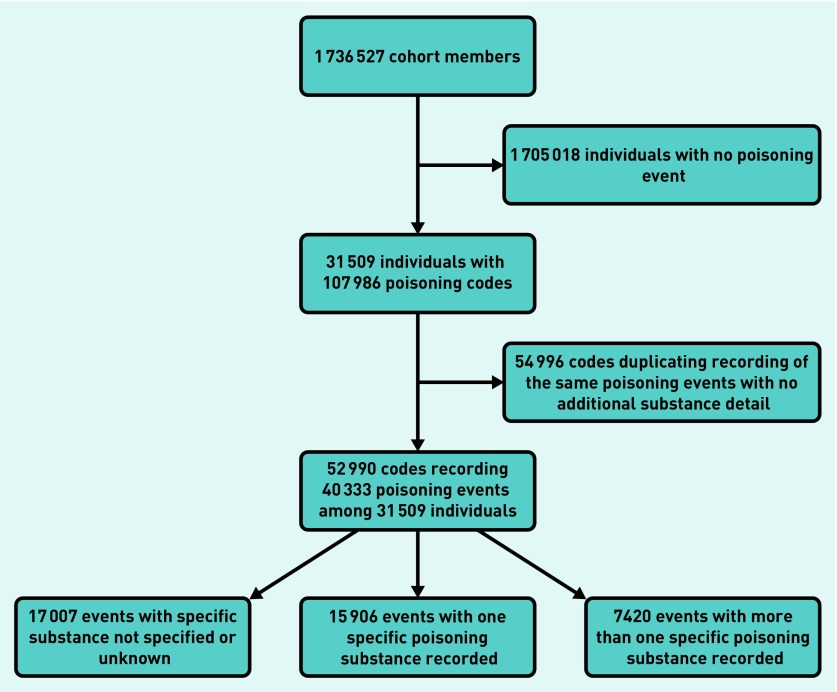
Poisoning substances were identified by ICD-10 or Read Codes. Incidence rates and adjusted incidence rate ratios (aIRR) were calculated for poisoning substances by age, sex, index of multiple deprivation, and calendar year.
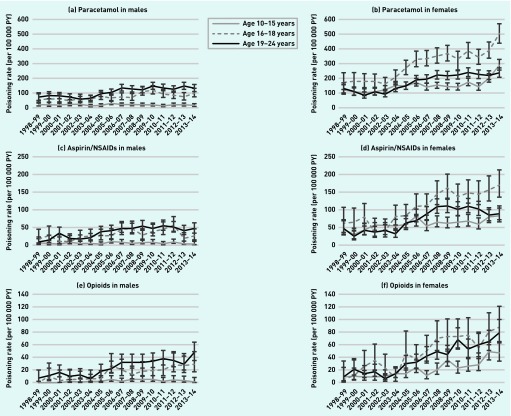
In total, 40 333 poisoning episodes were identified, with 57.8% specifying the substances involved. The most common substances were paracetamol (39.8%), alcohol (32.7%), non-steroidal anti-inflammatory drugs (NSAIDs) (11.6%), antidepressants (10.2%), and opioids (7.6%). Poisoning rates were highest at ages 16-18 years for females and 19-24 years for males. Opioid poisonings increased fivefold from 1998-2014 (females: aIRR 5.30, 95% confidence interval (CI) = 4.08 to 6.89; males: aIRR 5.11, 95% CI = 3.37 to 7.76), antidepressant poisonings three-to fourfold (females: aIRR 3.91, 95% CI = 3.18 to 4.80, males: aIRR 2.70, 95% CI = 2.04 to 3.58), aspirin/NSAID poisonings threefold (females: aIRR 2.84, 95% CI = 2.40 to 3.36, males: aIRR 2.76, 95% CI = 2.05 to 3.72) and paracetamol poisonings threefold in females (aIRR 2.87, 95% CI = 2.58 to 3.20). Across all substances poisoning incidence was higher in more disadvantaged groups, with the strongest gradient for opioid poisonings among males (aIRR 3.46, 95% CI = 2.24 to 5.36).
It is important that GPs raise awareness with families of the substances young people use to self-harm, especially the common use of over-the-counter medications. Quantities of medication prescribed to young people at risk of self-harm and their families should be limited, particularly analgesics and antidepressants.
在全球范围内,中毒是大多数需要医疗干预的自伤行为的原因。最近缺乏关于中毒物质的数据,但这些数据对于自伤预防是必要的。
评估英格兰 10-24 岁人群中毒物质的模式和趋势。
对 1998 年至 2014 年间 1736527 名年轻人进行了临床实践研究数据链接、住院事件统计和国家统计局死亡率数据的开放队列研究。
通过 ICD-10 或 Read 代码确定中毒物质。按年龄、性别、多重剥夺指数和日历年份计算中毒物质的发病率和调整发病率比(aIRR)。
共确定了 40333 例中毒事件,其中 57.8%明确了涉及的物质。最常见的物质是对乙酰氨基酚(39.8%)、酒精(32.7%)、非甾体抗炎药(NSAIDs)(11.6%)、抗抑郁药(10.2%)和阿片类药物(7.6%)。女性在 16-18 岁,男性在 19-24 岁时,中毒率最高。阿片类药物中毒自 1998-2014 年增加了五倍(女性:aIRR 5.30,95%置信区间[CI] = 4.08 至 6.89;男性:aIRR 5.11,95%CI = 3.37 至 7.76),抗抑郁药中毒增加了三到四倍(女性:aIRR 3.91,95%CI = 3.18 至 4.80,男性:aIRR 2.70,95%CI = 2.04 至 3.58),阿司匹林/NSAID 中毒增加了三倍(女性:aIRR 2.84,95%CI = 2.40 至 3.36,男性:aIRR 2.76,95%CI = 2.05 至 3.72),女性对乙酰氨基酚中毒增加了三倍(aIRR 2.87,95%CI = 2.58 至 3.20)。在所有物质中,中毒发病率在弱势群体中更高,男性阿片类药物中毒的梯度最强(aIRR 3.46,95%CI = 2.24 至 5.36)。
重要的是,全科医生应提高家庭对年轻人用于自伤的物质的认识,特别是对非处方药物的使用。应限制有自伤风险的年轻人及其家庭开处方的药物数量,特别是镇痛药和抗抑郁药。