Center for Radiological Research, Columbia University Medical Center, New York, NY, 10032, USA.
Herbert Irving Comprehensive Cancer Center, Proteomics Shared Resource, Columbia University Medical Center, New York, NY, 10032, USA.
Sci Rep. 2018 Sep 10;8(1):13557. doi: 10.1038/s41598-018-31740-8.
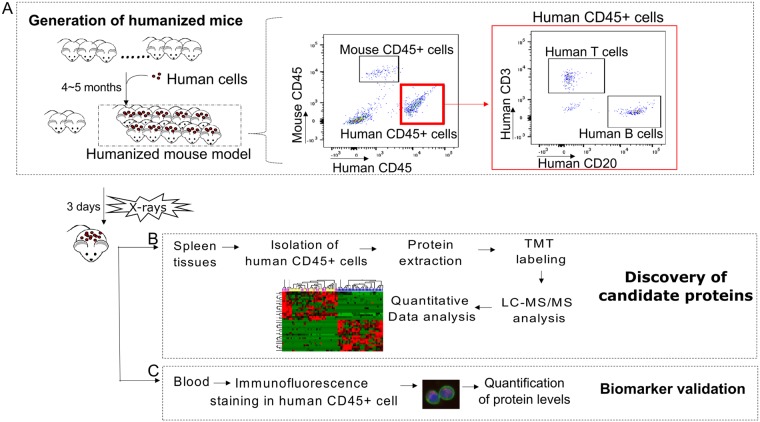
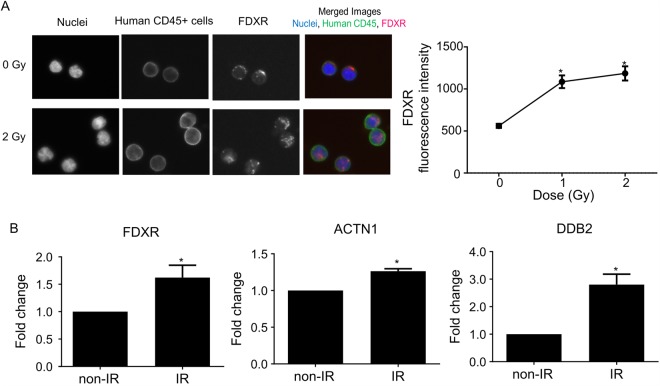
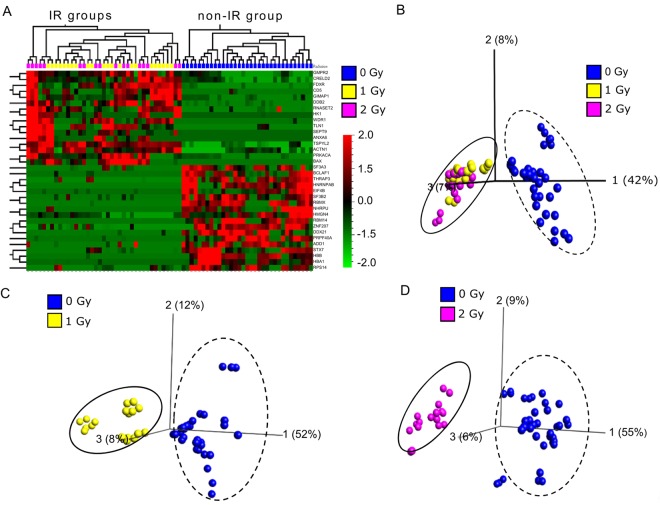
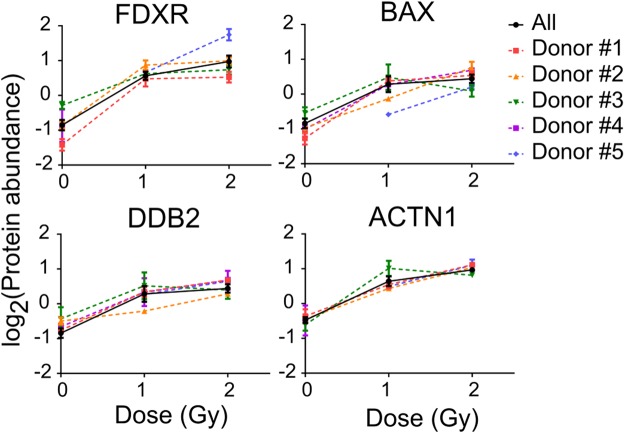
After a radiological incident, there is an urgent need for fast and reliable bioassays to identify radiation-exposed individuals within the first week post exposure. This study aimed to identify candidate radiation-responsive protein biomarkers in human lymphocytes in vivo using humanized NOD scid gamma (Hu-NSG) mouse model. Three days after X-irradiation (0-2 Gy, 88 cGy/min), human CD45+ lymphocytes were collected from the Hu-NSG mouse spleen and quantitative changes in the proteome of the human lymphocytes were analysed by mass spectrometry. Forty-six proteins were differentially expressed in response to radiation exposure. FDXR, BAX, DDB2 and ACTN1 proteins were shown to have dose-dependent response with a fold change greater than 2. When these proteins were used to estimate radiation dose by linear regression, the combination of FDXR, ACTN1 and DDB2 showed the lowest mean absolute errors (≤0.13 Gy) and highest coefficients of determination (R = 0.96). Biomarker validation studies were performed in human lymphocytes 3 days after irradiation in vivo and in vitro. In conclusion, this is the first study to identify radiation-induced human protein signatures in vivo using the humanized mouse model and develop a protein panel which could be used for the rapid assessment of absorbed dose 3 days after radiation exposure.
在放射性事故发生后,迫切需要快速可靠的生物检测方法,以便在暴露后第一周内确定受辐射的个体。本研究旨在使用人源化 NOD scid gamma (Hu-NSG) 小鼠模型,在体内鉴定人类淋巴细胞中对辐射有反应的候选蛋白生物标志物。在 X 射线照射后 3 天(0-2Gy,88cGy/min),从 Hu-NSG 小鼠脾脏中收集人类 CD45+淋巴细胞,并通过质谱分析人类淋巴细胞蛋白质组的定量变化。有 46 种蛋白质对辐射暴露表现出差异表达。FDXR、BAX、DDB2 和 ACTN1 蛋白显示出与剂量相关的反应,倍数变化大于 2。当这些蛋白质用于通过线性回归估计辐射剂量时,FDXR、ACTN1 和 DDB2 的组合显示出最低的平均绝对误差(≤0.13Gy)和最高的决定系数(R=0.96)。在体内和体外照射后 3 天的人类淋巴细胞中进行了生物标志物验证研究。总之,这是首次使用人源化小鼠模型在体内鉴定辐射诱导的人类蛋白质特征,并开发出一种蛋白质谱,可用于快速评估辐射暴露后 3 天的吸收剂量。