Tseng Chin-Hsiao
Department of Internal Medicine, National Taiwan University College of Medicine, Taipei 10051, Taiwan.
Division of Endocrinology and Metabolism, Department of Internal Medicine, National Taiwan University Hospital, Taipei 10048, Taiwan.
J Clin Med. 2018 Sep 9;7(9):264. doi: 10.3390/jcm7090264.
Metformin may show an antibiotic effect, but whether its use can reduce the risk of tuberculosis infection has rarely been investigated in population-based studies.
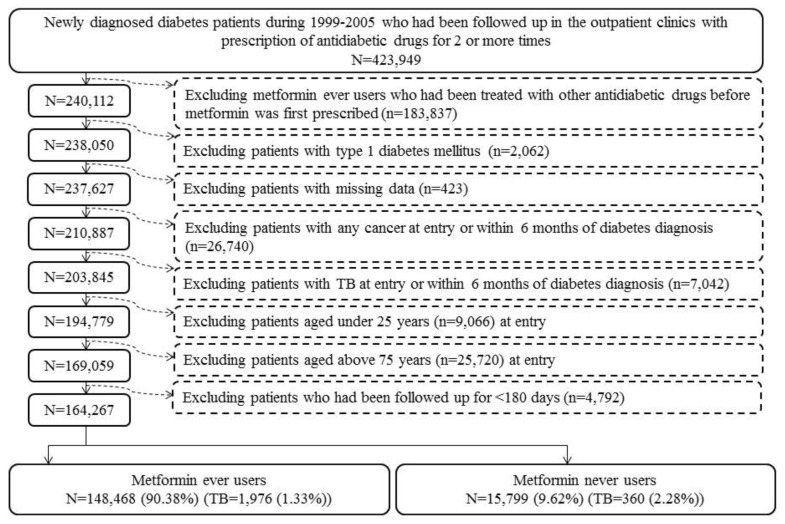
This is a retrospective cohort analysis of the Taiwan's National Health Insurance database. New-onset type 2 diabetes patients, 148,468 ever users and 15,799 never users of metformin, identified during 1999⁻2005 were followed up until 31 December 2011 for the incidence of tuberculosis infection. Hazard ratios were estimated by Cox regression incorporated with the inverse probability of treatment weighting using propensity score.
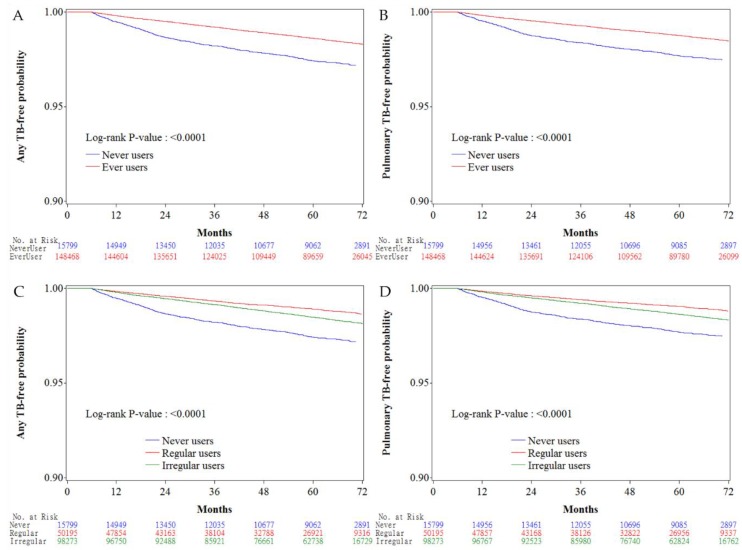
A total of 360 never users and 1976 ever users developed a tuberculosis infection with respective incidence of 510.91 and 282.94 per 100,000 person⁻years. The overall hazard ratio of presenting a tuberculosis infection among metformin ever users in respect to never users was 0.552 (95% confidence interval: 0.493⁻0.617). The hazard ratios for the first (<27.10 months), second (27.10⁻58.27 months), and third (>58.27 months) tertile of cumulative duration of metformin therapy were 1.116 (0.989⁻1.261), 0.543 (0.478⁻0.618), and 0.200 (0.171⁻0.233), respectively; and were 1.037 (0.918⁻1.173), 0.533 (0.469⁻0.606), and 0.249 (0.215⁻0.288), respectively, for the first (<817,000 mg), second (817,000⁻2,047,180 mg), and third (>2,047,180 mg) tertile of cumulative doses of metformin. The findings were consistent when analyses were restricted to pulmonary tuberculosis. Additionally, regular users of metformin tended to have greater benefit than irregular users.
Metformin use is associated with a reduced risk of tuberculosis infection in a dose⁻response pattern in type 2 diabetes patients.
二甲双胍可能具有抗生素作用,但在基于人群的研究中,其使用是否能降低结核病感染风险鲜有调查。
这是一项对台湾国民健康保险数据库的回顾性队列分析。1999年至2005年期间确诊的148468例曾使用二甲双胍的新发性2型糖尿病患者和15799例从未使用过二甲双胍的患者,随访至2011年12月31日,以观察结核病感染的发生率。采用Cox回归结合倾向评分的逆概率加权法估计风险比。
共有360例从未使用者和1976例曾使用者发生结核病感染,发病率分别为每10万人年510.91例和282.94例。曾使用二甲双胍的患者发生结核病感染相对于从未使用者的总体风险比为0.552(95%置信区间:0.493 - 0.617)。二甲双胍治疗累积持续时间的第一个(<27.10个月)、第二个(27.10 - 58.27个月)和第三个(>58.27个月)三分位数的风险比分别为1.116(0.989 - 1.261)、0.543(0.478 - 0.618)和0.200(0.171 - 0.233);二甲双胍累积剂量的第一个(<817,000毫克)、第二个(817,000 - 2,047,180毫克)和第三个(>2,047,180毫克)三分位数的风险比分别为1.037(0.918 - 1.173)、0.533(0.469 - 0.606)和0.249(0.215 - 0.288)。当分析仅限于肺结核时,结果一致。此外,规律使用二甲双胍的患者往往比不规律使用者获益更大。
在2型糖尿病患者中,使用二甲双胍与结核病感染风险降低呈剂量反应模式相关。