Department of Cardiology, WujinHospital affiliated with Jiangsu University, Changzhou, Jiangsu Province, 213017, China.
Department of Pediatrics, No. 2 Hospital of Changzhou, Changzhou, 213001, Jiangsu, China.
Lipids Health Dis. 2018 Sep 11;17(1):213. doi: 10.1186/s12944-018-0859-5.
Genetic and environment factors affect the occurrence and development of coronary artery disease (CAD). Proprotein convertase subtilisin/kexin type 9 (PCSK9), has been investigated extensively in the field of lipid metabolism and CAD. We performed this case-control study to investigate the relationship between serum PCSK9 levels and PCSK9 polymorphisms and lipid levels and CAD risk in a southern Chinese population.
A hospital-based case-control study with 1, 096 subjects, including 626 CAD patients and 470 controls, were conducted. Genotyping of PCSK9 polymorphisms was performed using polymerase chain reaction-ligase detection reaction (PCR-LDR) method.
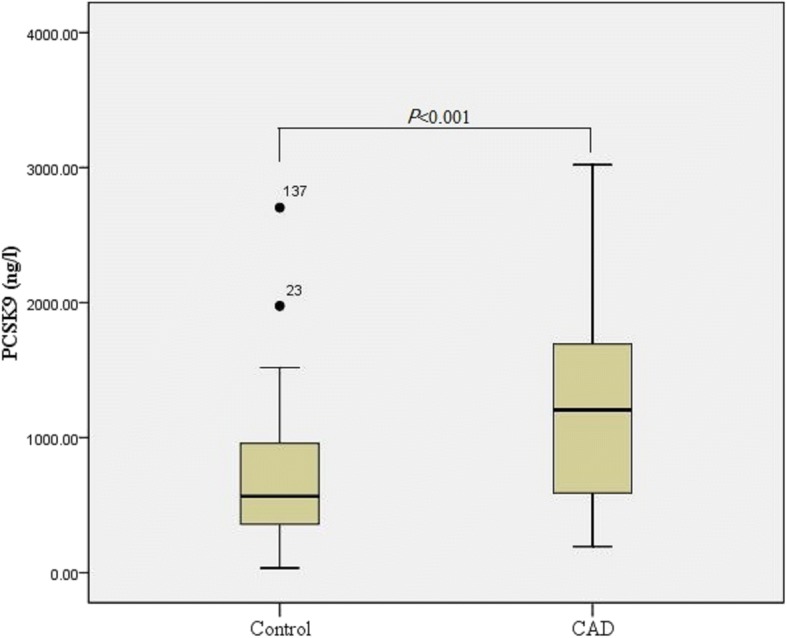
The frequencies of the AA, AG and GG genotypes of PCSK9 E670G polymorphism were 90.58, 9.27, and 0.16% in the CAD patients, compared with 88.72, 10.85 and 0.43% in the controls, respectively. No R46L variant was detected in this population. There were no significant differences in genotype and allele frequencies of PCSK9E670G polymorphism between the CAD group and the controls. Serum lipid levels were not significantly different in carriers with the G allele and those with the AA genotype. The median (QR) of PCSK9 concentration was 1205.00 ng/l (577.28-1694.13 ng/l) in cases and 565.87 ng/l (357.17-967.50 ng/l) in controls, respectively. Compared with controls, CAD patients had significantly higher PCSK9 levels (z = 4.559, P < 0.001). After adjusting for age, gender, essential hypertension, diabetic mellitus, smoking and lipid profiles, PCSK9 levels remain significantly associated with increased CAD susceptibility (OR = 1.002, 95% CI = 1.001-1.002, P < 0.001). The correlation analyses showed that serum PCSK9 levels were positively associated with triglyceride (TG), Apo B and atherogenic index of plasma (AIP) levels in controls. No significant association between the PCSK9 E670G polymorphism and serum PCSK9 levels was observed in the CAD group and the controls.
The present study shows that serum PCSK9 levels, but not PCSK9 polymorphisms, are associated with CAD risk in Southern Chinese Han population, and that serum PCSK9 levels are positively associated with AIP.
遗传和环境因素影响冠心病(CAD)的发生和发展。前蛋白转化酶枯草溶菌素/ kexin 9 型(PCSK9)在脂质代谢和 CAD 领域得到了广泛研究。我们进行了这项病例对照研究,以调查南方汉族人群血清 PCSK9 水平与 PCSK9 多态性与血脂水平和 CAD 风险之间的关系。
采用基于医院的病例对照研究,共纳入 1096 例受试者,包括 626 例 CAD 患者和 470 例对照。采用聚合酶链反应-连接酶检测反应(PCR-LDR)法对 PCSK9 多态性进行基因分型。
CAD 患者 PCSK9 E670G 多态性的 AA、AG 和 GG 基因型频率分别为 90.58%、9.27%和 0.16%,而对照组分别为 88.72%、10.85%和 0.43%。该人群未检测到 R46L 变异。CAD 组和对照组之间 PCSK9E670G 多态性的基因型和等位基因频率无显著差异。携带 G 等位基因和 AA 基因型的患者血清脂质水平无显著差异。病例组的 PCSK9 浓度中位数(四分位距)为 1205.00ng/L(577.28-1694.13ng/L),对照组为 565.87ng/L(357.17-967.50ng/L)。与对照组相比,CAD 患者的 PCSK9 水平显著升高(z=4.559,P<0.001)。在校正年龄、性别、原发性高血压、糖尿病、吸烟和血脂谱后,PCSK9 水平与 CAD 易感性增加仍显著相关(OR=1.002,95%CI=1.001-1.002,P<0.001)。相关性分析显示,对照组血清 PCSK9 水平与甘油三酯(TG)、载脂蛋白 B(Apo B)和血浆致动脉粥样硬化指数(AIP)水平呈正相关。CAD 组和对照组之间 PCSK9E670G 多态性与血清 PCSK9 水平无显著相关性。
本研究表明,血清 PCSK9 水平而非 PCSK9 多态性与中国南方汉族人群 CAD 风险相关,且血清 PCSK9 水平与 AIP 呈正相关。