Food Allergy Research and Resource Program, Department of Food Science & Technology, University of Nebraska, 279 Food Innovation Center, Lincoln, NE 68588-6207, USA.
Research Group Innovative Testing in Life Sciences and Chemistry, University of Applied Sciences, Heidelberglaan 7, 3584 CS Utrecht, The Netherlands.
Nutrients. 2018 Sep 11;10(9):1281. doi: 10.3390/nu10091281.
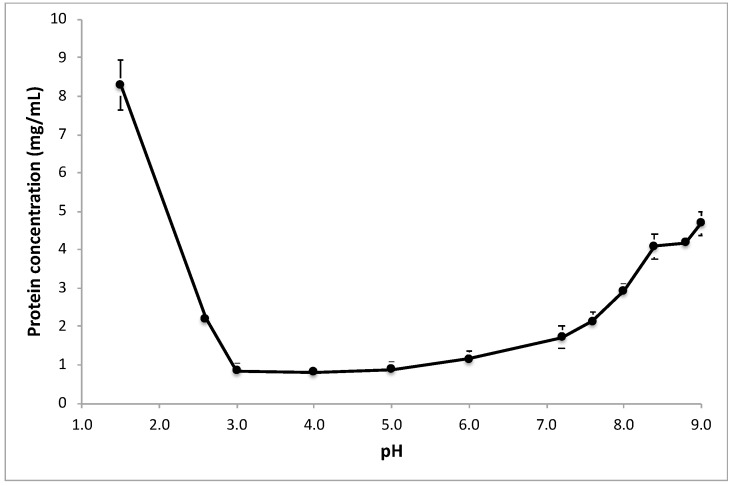
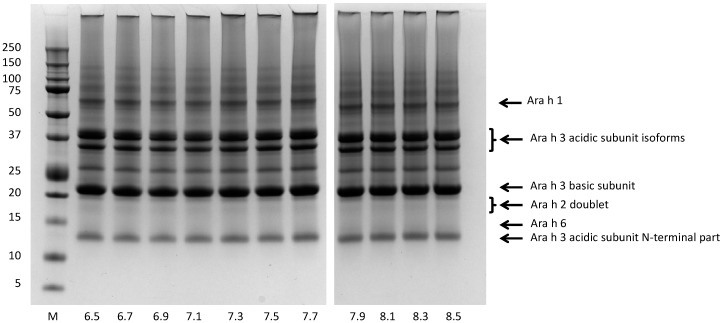
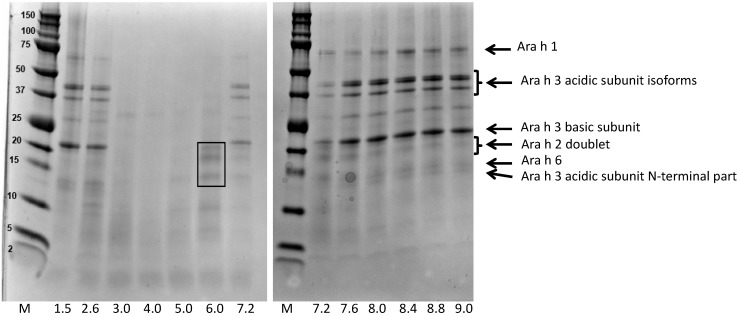
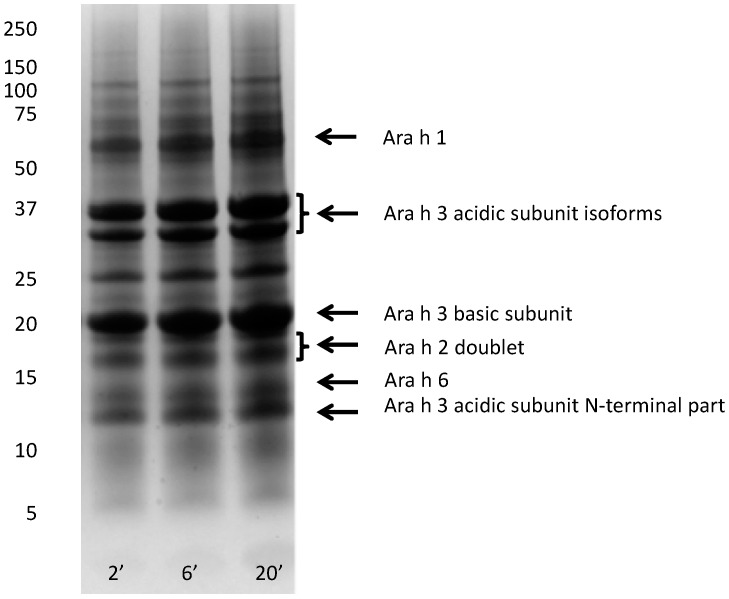
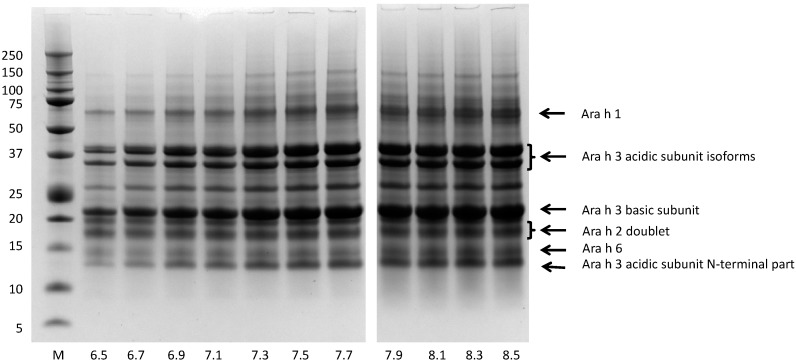
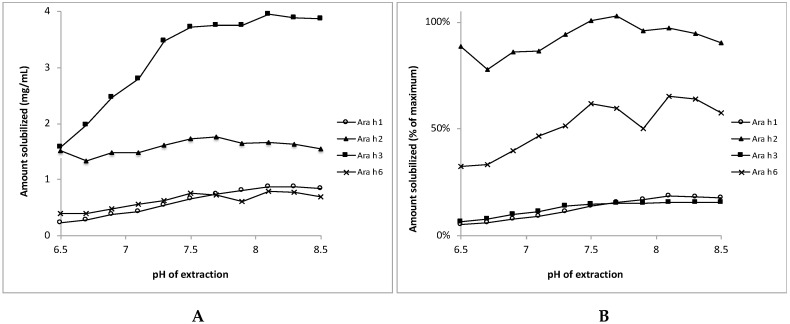
The oral mucosa is the first immune tissue that encounters allergens upon ingestion of food. We hypothesized that the bio-accessibility of allergens at this stage may be a key determinant for sensitization. Light roasted peanut flour was suspended at various pH in buffers mimicking saliva. Protein concentrations and allergens profiles were determined in the supernatants. Peanut protein solubility was poor in the pH range between 3 and 6, while at a low pH (1.5) and at moderately high pHs (>8), it increased. In the pH range of saliva, between 6.5 and 8.5, the allergens Ara h2 and Ara h6 were readily released, whereas Ara h1 and Ara h3 were poorly released. Increasing the pH from 6.5 to 8.5 slightly increased the release of Ara h1 and Ara h3, but the recovery remained low (approximately 20%) compared to that of Ara h2 and Ara h6 (approximately 100% and 65%, respectively). This remarkable difference in the extraction kinetics suggests that Ara h2 and Ara h6 are the first allergens an individual is exposed to upon ingestion of peanut-containing food. We conclude that the peanut allergens Ara h2 and Ara h6 are quickly bio-accessible in the mouth, potentially explaining their extraordinary allergenicity.
口腔黏膜是摄入食物时首先遇到过敏原的第一道免疫组织。我们假设在此阶段过敏原的生物可及性可能是致敏的关键决定因素。将轻度烤制的花生粉悬浮在模拟唾液的缓冲液中,在不同的 pH 值下。测定上清液中的蛋白质浓度和过敏原谱。花生蛋白在 pH 值为 3 到 6 之间的范围内溶解性差,而在低 pH 值(1.5)和中等高 pH 值(>8)下,它的溶解性增加。在唾液的 pH 值范围内,6.5 到 8.5 之间,过敏原 Ara h2 和 Ara h6 很容易释放,而 Ara h1 和 Ara h3 释放较少。将 pH 值从 6.5 增加到 8.5 稍微增加了 Ara h1 和 Ara h3 的释放,但与 Ara h2 和 Ara h6 相比,回收率仍然较低(分别约为 20%和 100%和 65%)。这种提取动力学的显著差异表明,Ara h2 和 Ara h6 是个体摄入含花生食物时首先接触到的过敏原。我们得出结论,花生过敏原 Ara h2 和 Ara h6 在口腔中很快具有生物可及性,这可能解释了它们非凡的致敏性。