Department of Neuroscience, McKnight Brain Institute, University of Florida, PO Box 100244, Gainesville, FL, 32610-0244, USA.
Genetics and Genomics Program, University of Florida, Gainesville, FL, 32611, USA.
Neurochem Res. 2019 Jan;44(1):38-48. doi: 10.1007/s11064-018-2634-4. Epub 2018 Sep 12.
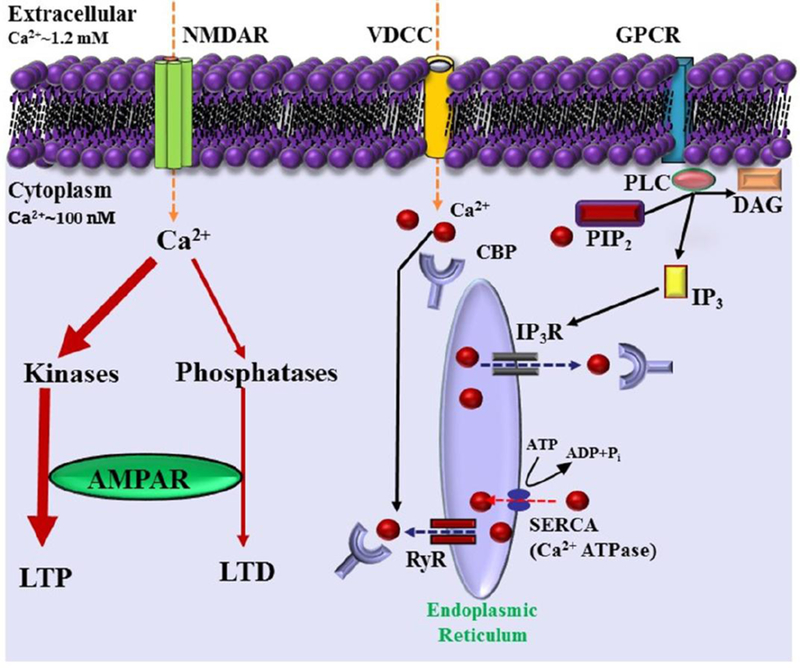
Glutamate is the primary excitatory neurotransmitter in neurons and glia. N-methyl-D-aspartate (NMDA), α-amino-3-hydroxy-5-methyl-4-isoxazolepropionic acid (AMPA), and kainate receptors are major ionotropic glutamate receptors. Glutamatergic neurotransmission is strongly linked with Ca homeostasis. Research has provided ample evidence that brain aging is associated with altered glutamatergic neurotransmission and Ca dysregulation. Much of the work has focused on the hippocampus, a brain region critically involved in learning and memory, which is particularly susceptible to dysfunction during senescence. The current review examines Ca regulation with a focus on the NMDA receptors in the hippocampus. Integrating the knowledge of the complexity of age-related alterations in Ca homeostasis and NMDA receptor-mediated glutamatergic neurotransmission will positively shape the development of highly effective therapeutics to treat brain disorders including cognitive impairment.
谷氨酸是神经元和神经胶质细胞中的主要兴奋性神经递质。N-甲基-D-天冬氨酸(NMDA)、α-氨基-3-羟基-5-甲基-4-异恶唑丙酸(AMPA)和海人藻酸受体是主要的离子型谷氨酸受体。谷氨酸能神经传递与 Ca 稳态密切相关。研究提供了充分的证据表明,大脑衰老与谷氨酸能神经传递的改变和 Ca 失调有关。大部分工作都集中在海马体上,海马体是一个与学习和记忆密切相关的脑区,在衰老过程中特别容易出现功能障碍。本综述检查了 Ca 调节,重点是海马体中的 NMDA 受体。整合与年龄相关的 Ca 稳态和 NMDA 受体介导的谷氨酸能神经传递改变的复杂性的知识,将积极推动开发高度有效的治疗方法来治疗包括认知障碍在内的脑疾病。