Rath Charlotte L, Rye Jørgensen Niklas, Wienecke Troels
Department of Neurology, Neurovascular Centre, Zealand University Hospital, Roskilde, Denmark.
Department of Clinical Biochemistry, Rigshospitalet, University of Copenhagen, Copenhagen, Denmark.
Front Neurol. 2018 Aug 28;9:712. doi: 10.3389/fneur.2018.00712. eCollection 2018.
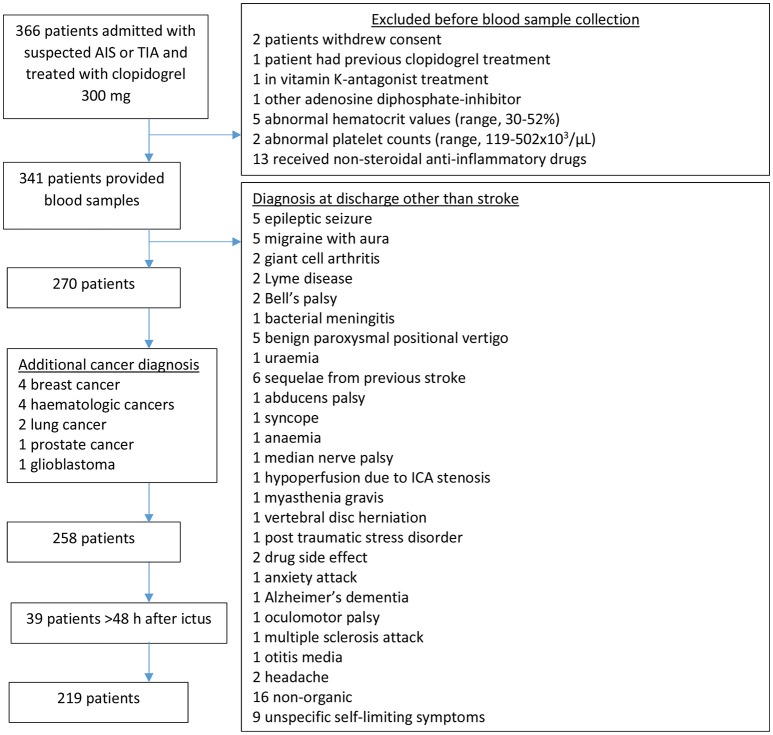
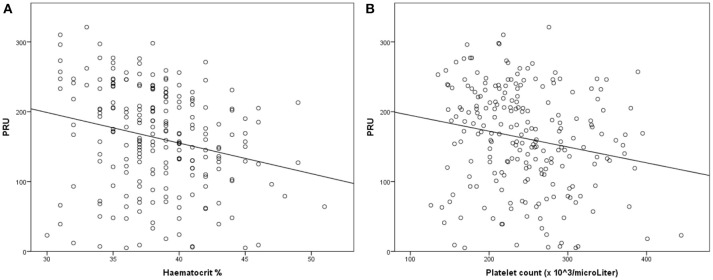
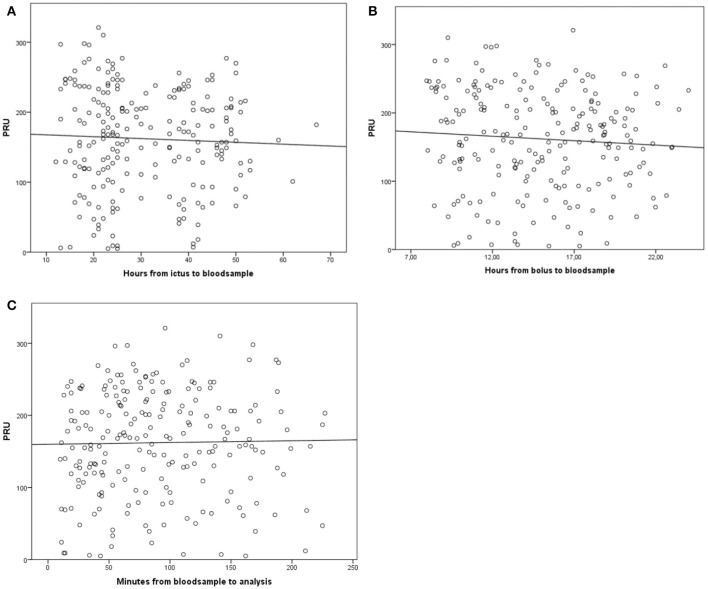
Early anti-platelet therapy is a cornerstone in the prevention of recurrent ischaemic stroke (IS) and transient ischaemic attacks (TIAs), although the responsiveness to anti-platelet medications varies among patients. Several studies have reported that patients with ischaemic stroke who exhibit high on-treatment platelet reactivity (HTPR) 5-10 days after antiplatelet medication onset, have an increased risk of vascular events. In this study we aim to determine the prevalence of HTPR in the hyper-acute stroke phase less than 48 h from symptom onset, after the administration of a 300 mg bolus of oral clopidogrel in a real-world setting in Danish IS and TIA patients. In total, 219 Danish patients with acute IS or TIA received 300 mg of oral clopidogrel on admission. Blood samples from all patients were analyzed using the VerifyNow P2Y12 system at 8-24 h after clopidogrel intake. Concomitant therapy and the intervals between ictus and blood collection, clopidogrel intake and blood collection, and blood sampling and analysis were recorded for all patients. HTPR in the hyper-acute stroke phase was observed in 28.8% (63/219) samples. After adjustment for age, sex, co-morbidities, and co-medications, none of the tested variables exhibited an association with HTPR or the platelet reaction unit value measured using the VerifyNow P2Y12 system. The recognition of HTPR to specific anti-platelet agents in the hyper-acute phase after stroke may be the first step toward interventions that may further minimize the early recurrent stroke risk. Further large randomized trials including clinical outcome assessments are necessary.
早期抗血小板治疗是预防缺血性中风(IS)复发和短暂性脑缺血发作(TIA)的基石,尽管患者对抗血小板药物的反应性各不相同。多项研究报告称,抗血小板药物治疗开始后5-10天出现高治疗期血小板反应性(HTPR)的缺血性中风患者,发生血管事件的风险增加。在本研究中,我们旨在确定在丹麦IS和TIA患者的真实环境中,在症状发作后不到48小时的超急性期中风阶段,给予300mg口服氯吡格雷后HTPR的患病率。总共219名丹麦急性IS或TIA患者在入院时接受了300mg口服氯吡格雷。在氯吡格雷摄入后8-24小时,使用VerifyNow P2Y12系统对所有患者的血样进行分析。记录所有患者的伴随治疗以及发作与采血、氯吡格雷摄入与采血、采血与分析之间的间隔时间。在28.8%(63/219)的样本中观察到超急性期中风阶段的HTPR。在对年龄、性别、合并症和联合用药进行调整后,所测试的变量均未显示与HTPR或使用VerifyNow P2Y12系统测量的血小板反应单位值存在关联。识别中风后超急性期对特定抗血小板药物的HTPR可能是采取干预措施的第一步,这些干预措施可能会进一步降低早期中风复发风险。有必要进行包括临床结局评估在内的进一步大型随机试验。