Abu Eid Sameer, Hackl Martina T, Kaplanian Mairam, Winter Max-Paul, Kaltenecker Doris, Moriggl Richard, Luger Anton, Scherer Thomas, Fürnsinn Clemens
Division of Endocrinology & Metabolism, Department of Medicine III, Medical University of Vienna, Vienna, Austria.
Division of Cardiology, Department of Medicine II, Medical University of Vienna, Vienna, Austria.
Front Endocrinol (Lausanne). 2018 Aug 28;9:490. doi: 10.3389/fendo.2018.00490. eCollection 2018.
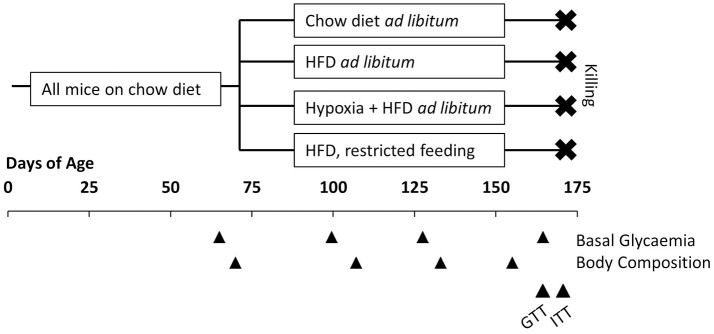
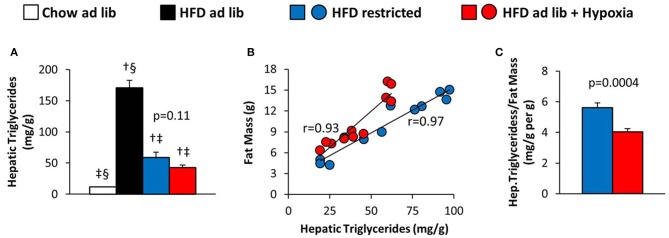
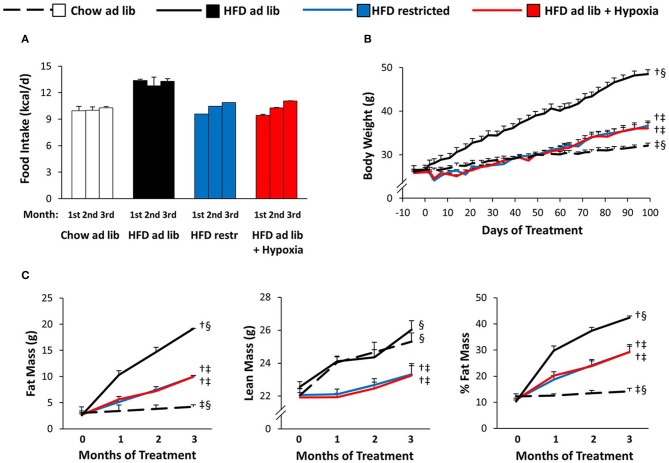
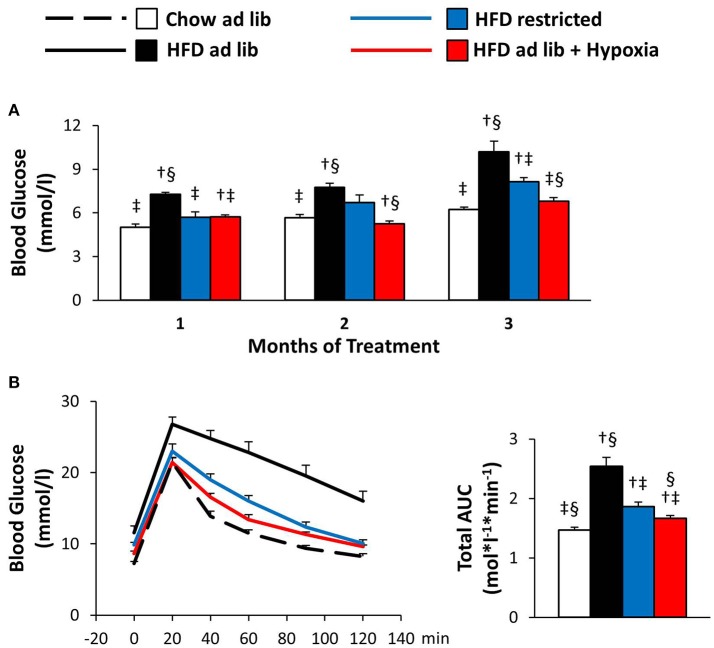
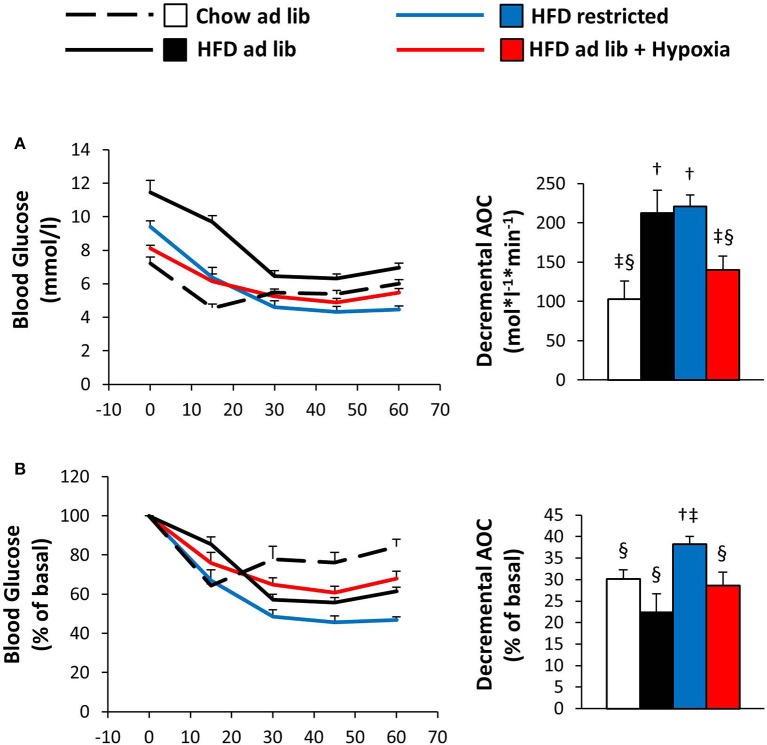
Blood glucose and the prevalence of diabetes are lower in mountain than lowland dwellers, which could among other factors be due to reduced oxygen availability. To investigate metabolic adaptations to life under hypoxia, male mice on high fat diet (HFD) were continuously maintained at 10% O. At variance to preceding studies, the protocol was designed to dissect direct metabolic effects from such mediated indirectly via hypoxia-induced reductions in appetite and weight gain. This was achieved by two separate control groups on normal air, one with free access to HFD, and one fed restrictedly in order to obtain a weight curve matching that of hypoxia-exposed mice. Comparable body weight in restrictedly fed and hypoxic mice was achieved by similar reductions in calorie intake (-22%) and was associated with parallel effects on body composition as well as on circulating insulin, leptin, FGF-21, and adiponectin. Whereas the effects of hypoxia on the above parameters could thus be attributed entirely to blunted weight gain, hypoxia improved glucose homeostasis in part independently of body weight (fasted blood glucose, mmol/l: freely fed control, 10.2 ± 0.7; weight-matched control, 8.0 ± 0.3; hypoxia, 6.8 ± 0.2; < 0.007 each; AUC in the glucose tolerance test, mol/lmin: freely fed control, 2.54 ± 0.15; weight-matched control, 1.86 ± 0.08; hypoxia, 1.67 ± 0.05; < 0.05 each). Although counterintuitive to lowering of glycemia, insulin sensitivity appeared to be impaired in animals adapted to hypoxia: In the insulin tolerance test, hypoxia-treated mice started off with lower glycaemia than their weight-matched controls (initial blood glucose, mmol/l: freely fed control, 11.5 ± 0.7; weight-matched control, 9.4 ± 0.3; hypoxia, 8.1 ± 0.2; < 0.02 each), but showed a weaker response to insulin (final blood glucose, mmol/l: freely fed control, 7.0 ± 0.3; weight-matched control, 4.5 ± 0.2; hypoxia, 5.5 ± 0.3; < 0.01 each). Furthermore, hypoxia weight-independently reduced hepatic steatosis as normalized to total body fat, suggesting a shift in the relative distribution of triglycerides from liver to fat (mg/g liver triglycerides per g total fat mass: freely fed control, 10.3 ± 0.6; weight-matched control, 5.6 ± 0.3; hypoxia, 4.0 ± 0.2; < 0.0004 each). The results show that exposure of HFD-fed mice to continuous hypoxia leads to a unique metabolic phenotype characterized by improved glucose homeostasis along with evidence for impaired rather than enhanced insulin sensitivity.
山区居民的血糖水平和糖尿病患病率低于低地居民,这在其他因素中可能是由于氧气供应减少所致。为了研究对低氧生活的代谢适应情况,将高脂饮食(HFD)的雄性小鼠持续饲养在10%氧气环境中。与之前的研究不同,该实验方案旨在区分直接代谢效应与通过低氧诱导的食欲和体重增加间接介导的效应。这是通过两个在正常空气中的单独对照组实现的,一组可自由获取高脂饮食,另一组进行限制喂养以获得与低氧暴露小鼠相匹配的体重曲线。通过类似的卡路里摄入量减少(-22%),使限制喂养小鼠和低氧小鼠的体重相当,并且这与对身体成分以及循环胰岛素、瘦素、FGF-21和脂联素的平行效应相关。因此,虽然低氧对上述参数的影响可完全归因于体重增加的减弱,但低氧部分独立于体重改善了葡萄糖稳态(空腹血糖,mmol/l:自由进食对照组,10.2±0.7;体重匹配对照组,8.0±0.3;低氧组,6.8±0.2;每组P<0.007;葡萄糖耐量试验中的AUC,mol/lmin:自由进食对照组,2.54±0.15;体重匹配对照组,1.86±0.08;低氧组,1.67±0.05;每组P<0.05)。尽管与降低血糖的直觉相反,但适应低氧的动物胰岛素敏感性似乎受损:在胰岛素耐量试验中,低氧处理的小鼠起始血糖水平低于其体重匹配的对照组(初始血糖,mmol/l:自由进食对照组,11.5±0.7;体重匹配对照组,9.4±0.3;低氧组,8.1±0.2;每组P<0.02),但对胰岛素的反应较弱(最终血糖,mmol/l:自由进食对照组,7.0±0.3;体重匹配对照组,4.5±0.2;低氧组,5.5±0.3;每组P<0.01)。此外,低氧与体重无关地降低了以全身脂肪标准化的肝脏脂肪变性,表明甘油三酯的相对分布从肝脏向脂肪转移(每克总脂肪量中肝脏甘油三酯的mg/g:自由进食对照组,10.3±0.6;体重匹配对照组,5.6±0.3;低氧组,4.0±0.2;每组P<0.0004)。结果表明,将高脂饮食喂养的小鼠暴露于持续低氧环境会导致一种独特的代谢表型,其特征为葡萄糖稳态改善,同时有胰岛素敏感性受损而非增强的证据。