Graf Michaela, Zieringer Julia, Haas Thorsten, Nieß Alexander, Blombach Bastian, Takors Ralf
Institute of Biochemical Engineering, University of Stuttgart, Stuttgart, Germany.
Front Microbiol. 2018 Aug 29;9:2058. doi: 10.3389/fmicb.2018.02058. eCollection 2018.
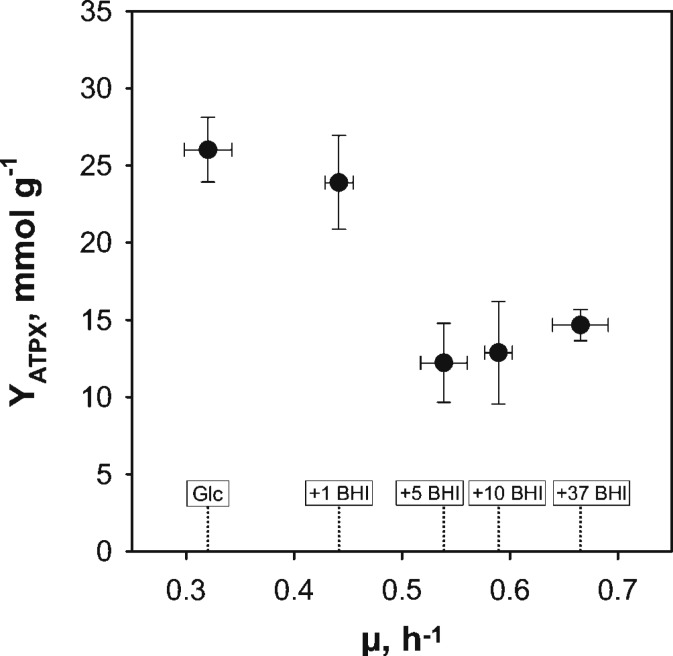
To ensure economic competitiveness, bioprocesses should achieve maximum productivities enabled by high growth rates (μ) and equally high substrate consumption rates (q) as a prerequisite of sufficient carbon-to-product conversion. Both traits were investigated and improved via bioprocess engineering approaches studying the industrial work horse . Standard minimal medium CGXII with glucose as sole carbon source was supplemented with complex brain-heart-infusion (BHI) or amino acid (AA) cocktails. Maximum μ of 0.67 h was exclusively observed in 37 g BHI L whereas only minor growth stimulation was found after AA supplementation (μ = 0.468 h). Increasing glucose consumption rates (q) were solely observed in certain dosages of BHI (1-10 g L), while 37 g BHI L and AA addition revealed q below the reference experiments. Moreover, BHI supplementation revealed Monod-type saturation kinetics of μ ( = 2.73 g BHI L) referring to the preference of non-AAs as key boosting nutrients. ATP-demands under reference, 1 g BHI L, and AA conditions were nearly constant but halved in BHI concentrations above 5 g L reflecting the energetic advantage of consuming complex nutrient components in addition to "simple" building blocks such as AAs. Furthermore, revealed maximum biomass per carbon yields of about 18 g C-mol irrespective of the medium. In AA supplementation experiments, simultaneous uptake of 17 AAs was observed, maximum individual consumption rates determined, and L-asparagine and L-glutamine were distinguished as compounds with the highest consumption rates. Employment of the expanded stoichiometric model successfully reproduced experimental results and revealed the importance of 's transaminase network to compensate needs of limiting AA supply. Model-based sensitivity studies attributed the highest impact on μ to AAs with high ATP and NADPH demands such as L-tryptophan or L-phenylalanine.
为确保经济竞争力,生物过程应实现由高生长速率(μ)和同样高的底物消耗速率(q)所支持的最大生产率,这是实现足够的碳到产物转化的前提条件。通过研究工业主力菌株的生物过程工程方法对这两个特性进行了研究和改进。以葡萄糖作为唯一碳源的标准基本培养基CGXII添加了复合脑心浸液(BHI)或氨基酸(AA)混合物。仅在添加37 g/L BHI时观察到最大生长速率μ为0.67 h⁻¹,而添加AA后仅发现轻微的生长刺激(μ = 0.468 h⁻¹)。仅在特定剂量的BHI(1 - 10 g/L)中观察到葡萄糖消耗速率(q)增加,而添加37 g/L BHI和AA时q低于参考实验。此外,添加BHI显示出μ的Monod型饱和动力学(Kₛ = 2.73 g BHI/L),表明非氨基酸作为关键促进营养物质的偏好。在参考条件、1 g/L BHI和AA条件下的ATP需求几乎恒定,但在BHI浓度高于5 g/L时减半,这反映了除氨基酸等“简单”构建块外消耗复合营养成分的能量优势。此外,无论培养基如何,均显示出约18 g C-mol的最大每碳生物量产量。在AA添加实验中,观察到17种氨基酸的同时摄取,确定了最大个体消耗速率,并且L-天冬酰胺和L-谷氨酰胺被确定为消耗速率最高的化合物。使用扩展化学计量模型成功再现了实验结果,并揭示了转氨酶网络对补偿有限AA供应需求的重要性。基于模型的敏感性研究表明,对μ影响最大的是具有高ATP和NADPH需求的氨基酸,如L-色氨酸或L-苯丙氨酸。