Chang Yuanmay
Institute of Long-Term Care, MacKay Medical College, New Taipei City, Taiwan.
Shin Kong Wu Ho-Su Memorial Hospital, Taipei, Taiwan.
SAGE Open Med. 2018 Sep 10;6:2050312118798941. doi: 10.1177/2050312118798941. eCollection 2018.
Far infrared radiation has been widely used in a variety of healthcare institutions and clinical research. Previous studies have shown that far infrared radiation can promote blood circulation and enhance the functioning of the immune system. Many patients receiving peritoneal dialysis have been co-treated with far infrared radiation to reduce the occurrence of inflammation. This study seeks to evaluate the effects of far infrared radiation therapy on inflammation.
We used the lipopolysaccharide-induced peritonitis mouse model to study the effect of far infrared radiation treatment. Sixteen mice were randomly divided into two groups, a far infrared radiation treatment group ( = 8) and a non-far infrared radiation treatment group ( = 8). Collected blood samples were studied by analyzing the RNA level of peripheral blood mononuclear cells and the plasma protein levels of interleukin-6 (IL-6), tumor necrosis factor alpha (TNF-α), and endothelial nitric oxide synthase (eNOS).
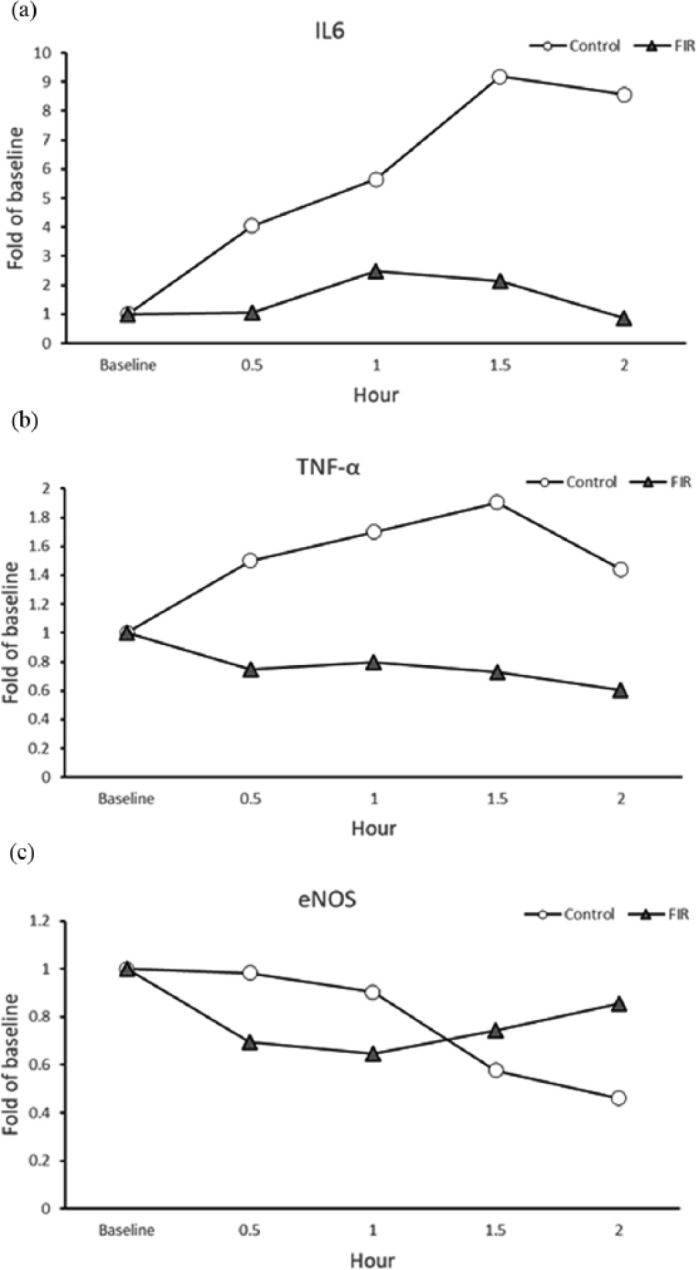
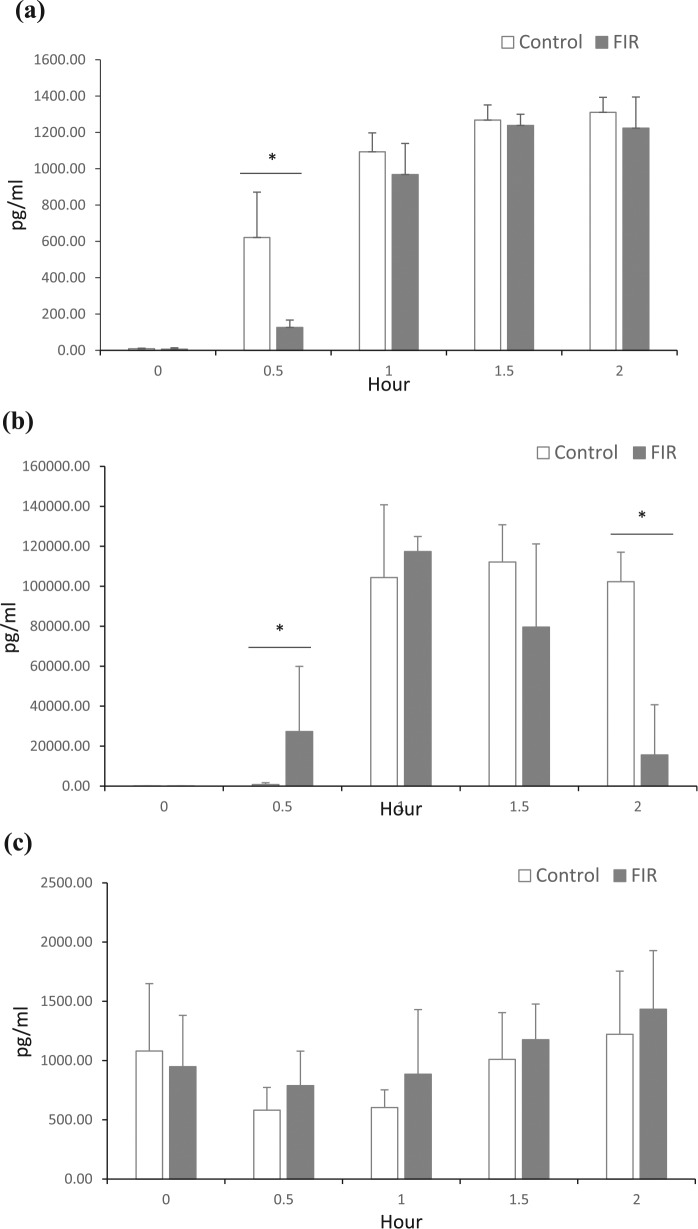
The administration of far infrared radiation inhibited the RNA levels of interleukin-6 and TNF-α after stimulation by lipopolysaccharide. The far infrared radiation treatment inhibited the endothelial nitric oxide synthase RNA levels at 1 h, but the RNA levels returned close to the baseline level after 2 h. In the control group, the endothelial nitric oxide synthase RNA levels were continuously decreasing. The interleukin-6 concentration in the plasma of the far infrared radiation group showed significant inhibition 30 min after lipopolysaccharide stimulation. The tumor necrosis factor alpha RNA concentration in plasma of the far infrared radiation group was significantly reduced 2 h after lipopolysaccharide stimulation.
Far infrared radiation therapy can inhibit interleukin-6 and tumor necrosis factor alpha RNA levels of peripheral blood mononuclear cells and recover endothelial nitric oxide synthase expression. These results demonstrate that far infrared radiation therapy might aid in reducing the level of inflammation experienced by patients going through peritoneal dialysis treatment.
远红外线辐射已广泛应用于各类医疗机构及临床研究。既往研究表明,远红外线辐射可促进血液循环并增强免疫系统功能。许多接受腹膜透析的患者同时接受远红外线辐射治疗以减少炎症的发生。本研究旨在评估远红外线辐射疗法对炎症的影响。
我们使用脂多糖诱导的腹膜炎小鼠模型来研究远红外线辐射治疗的效果。16只小鼠随机分为两组,远红外线辐射治疗组(n = 8)和非远红外线辐射治疗组(n = 8)。通过分析外周血单核细胞的RNA水平以及白细胞介素-6(IL-6)、肿瘤坏死因子α(TNF-α)和内皮型一氧化氮合酶(eNOS)的血浆蛋白水平对采集的血样进行研究。
给予远红外线辐射可抑制脂多糖刺激后白细胞介素-6和TNF-α的RNA水平。远红外线辐射治疗在1小时时抑制内皮型一氧化氮合酶RNA水平,但2小时后RNA水平恢复至接近基线水平。在对照组中,内皮型一氧化氮合酶RNA水平持续下降。远红外线辐射组血浆中的白细胞介素-6浓度在脂多糖刺激后30分钟显示出显著抑制。远红外线辐射组血浆中的肿瘤坏死因子α RNA浓度在脂多糖刺激后2小时显著降低。
远红外线辐射疗法可抑制外周血单核细胞的白细胞介素-6和肿瘤坏死因子α RNA水平,并恢复内皮型一氧化氮合酶表达。这些结果表明,远红外线辐射疗法可能有助于降低接受腹膜透析治疗患者的炎症水平。