Benhaiem Sarah, Marescot Lucile, Hofer Heribert, East Marion L, Lebreton Jean-Dominique, Kramer-Schadt Stephanie, Gimenez Olivier
Department of Ecological Dynamics, Leibniz Institute for Zoo and Wildlife Research, Berlin, Germany.
CEFE, CNRS, University Montpellier, University Paul Valéry Montpellier 3, EPHE, IRD, Montpellier, France.
Front Vet Sci. 2018 Aug 28;5:197. doi: 10.3389/fvets.2018.00197. eCollection 2018.
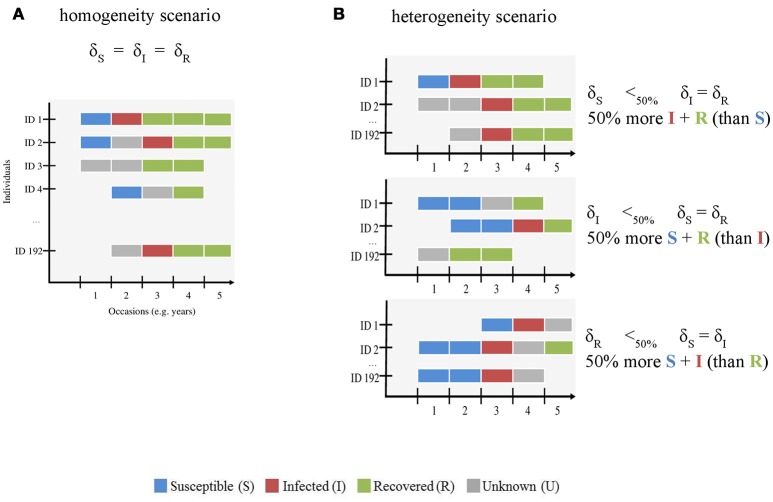
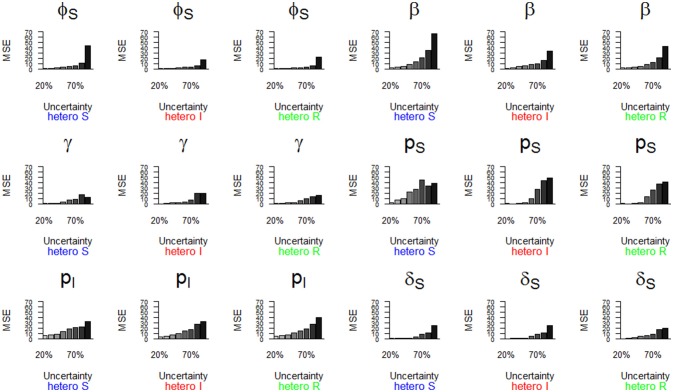
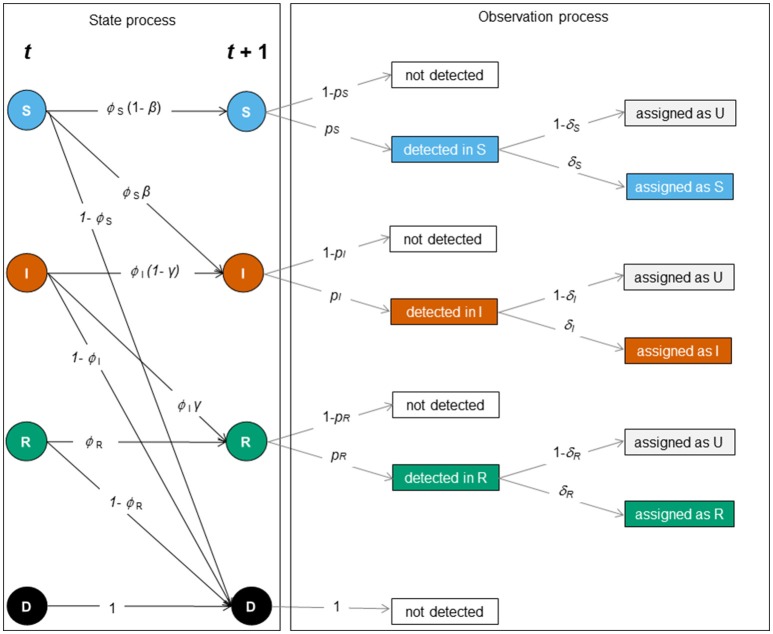
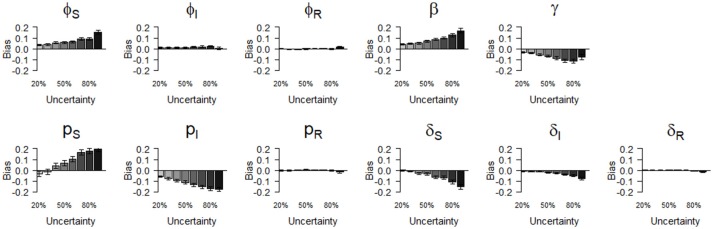
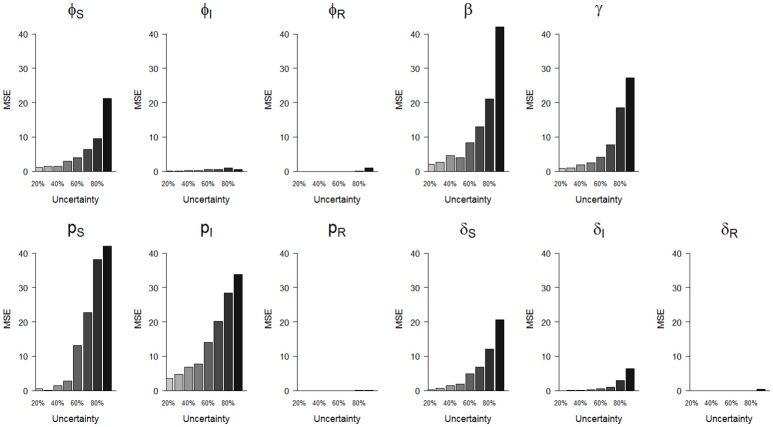
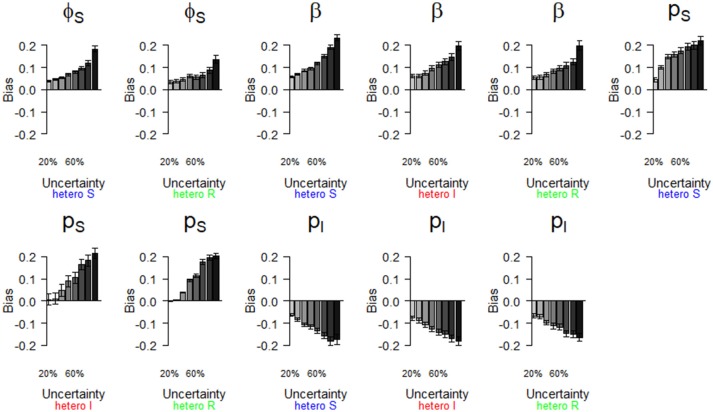
Estimating eco-epidemiological parameters in free-ranging populations can be challenging. As known individuals may be undetected during a field session, or their health status uncertain, the collected data are typically "imperfect". Multi-event capture-mark-recapture (MECMR) models constitute a substantial methodological advance by accounting for such imperfect data. In these models, animals can be "undetected" or "detected" at each time step. Detected animals can be assigned an infection state, such as "susceptible" (S), "infected" (I), or "recovered" (R), or an "unknown" (U) state, when for instance no biological sample could be collected. There may be heterogeneity in the assignment of infection states, depending on the manifestation of the disease in the host or the diagnostic method. For example, if obtaining the samples needed to prove viral infection in a detected animal is difficult, this can result in a low chance of assigning the I state. Currently, it is unknown how much uncertainty MECMR models can tolerate to provide reliable estimates of eco-epidemiological parameters and whether these parameters are sensitive to heterogeneity in the assignment of infection states. We used simulations to assess how estimates of the survival probability of individuals in different infection states and the probabilities of infection and recovery responded to (1) increasing infection state uncertainty (i.e., the proportion of U) from 20 to 90%, and (2) heterogeneity in the probability of assigning infection states. We simulated data, mimicking a highly virulent disease, and used SIR-MECMR models to quantify bias and precision. For most parameter estimates, bias increased and precision decreased gradually with state uncertainty. The probabilities of survival of I and R individuals and of detection of R individuals were very robust to increasing state uncertainty. In contrast, the probabilities of survival and detection of S individuals, and the infection and recovery probabilities showed high biases and low precisions when state uncertainty was >50%, particularly when the assignment of the S state was reduced. Considering this specific disease scenario, SIR-MECMR models are globally robust to state uncertainty and heterogeneity in state assignment, but the previously mentioned parameter estimates should be carefully interpreted if the proportion of U is high.
估算自由放养种群中的生态流行病学参数可能具有挑战性。由于在野外调查期间可能无法检测到已知个体,或者其健康状况不确定,因此收集到的数据通常是“不完美的”。多事件捕获-标记-重捕(MECMR)模型通过考虑此类不完美数据,在方法上取得了重大进展。在这些模型中,动物在每个时间步长都可能被“未检测到”或“检测到”。对于检测到的动物,可以根据例如无法收集生物样本的情况,将其感染状态指定为“易感”(S)、“感染”(I)或“康复”(R),或者“未知”(U)状态。根据疾病在宿主中的表现或诊断方法,感染状态的指定可能存在异质性。例如,如果在检测到的动物中获取证明病毒感染所需的样本很困难,这可能导致指定为I状态的概率较低。目前,尚不清楚MECMR模型能够容忍多少不确定性才能提供可靠的生态流行病学参数估计,以及这些参数是否对感染状态指定中的异质性敏感。我们使用模拟来评估处于不同感染状态的个体的生存概率估计以及感染和康复概率如何响应:(1)将感染状态不确定性(即U的比例)从20%增加到90%,以及(2)感染状态指定概率中的异质性。我们模拟了数据,模拟一种高致病性疾病,并使用SIR-MECMR模型来量化偏差和精度。对于大多数参数估计,偏差随着状态不确定性的增加而逐渐增加,精度逐渐降低。I和R个体的生存概率以及R个体的检测概率对增加的状态不确定性非常稳健。相比之下,当状态不确定性>50%时,尤其是当S状态的指定减少时,S个体的生存和检测概率以及感染和康复概率显示出高偏差和低精度。考虑到这种特定的疾病情况,SIR-MECMR模型总体上对状态不确定性和状态指定中的异质性具有稳健性,但如果U的比例较高,则应谨慎解释前面提到的参数估计。