Chen Wenbiao, Tang Donge, Xu Yong, Zou Yaoshuang, Sui Weiguo, Dai Yong, Diao Hongyan
State Key Laboratory for Diagnosis and Treatment of Infectious Diseases, Collaborative Innovation Center for Diagnosis and Treatment of Infectious Diseases, The First Affiliated Hospital, College of Medicine, Zhejiang University, Hangzhou Clinical Medical Research Center, the Second Clinical Medical College of Jinan University (Shenzhen People's Hospital), Shenzhen, Guangdong Nephrology Department of Guilin No.181 Hospital, Guangxi Key Laboratory of Metabolic Diseases Research, Guilin Key laboratory of Kidney Diseases Research, Guilin, Guangxi, P.R. China.
Medicine (Baltimore). 2018 Sep;97(37):e12035. doi: 10.1097/MD.0000000000012035.
Histone post-translational modifications (PTMs) carry epigenetic information to regulate diverse cellular processes at the chromatin level. Crotonylation, one of the most important and common PTMs, plays a key role in the regulation of various biological processes. However, no study has evaluated the role of lysine crotonylation in maintenance hemodialysis patients (MHP).
Here, we comparatively evaluated the crotonylation proteome of normal controls (NC) and MHP using liquid chromatography tandem mass spectrometry (LC-MS/MS) coupled with highly sensitive immune-affinity purification.
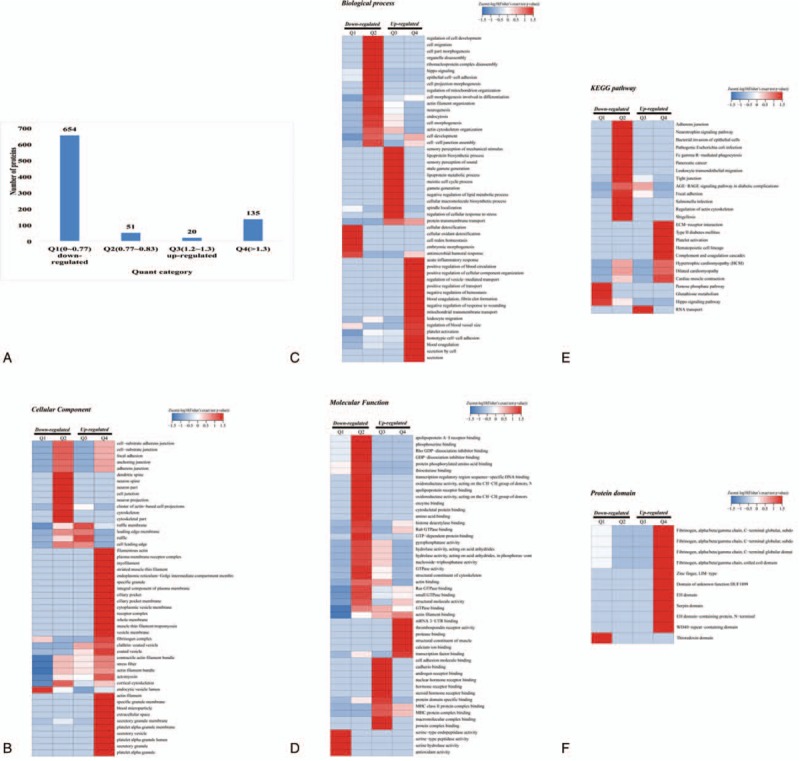
A total of 1109 lysine modification sites distributed on 347 proteins were identified, including 93 and 252 crotonylated upregulated and downregulated proteins, respectively. Thus, a decrease in crotonylation of histone proteins was observed in patients with kidney failure undergoing maintenance hemodialysis. Intensive bioinformatic analysis revealed that most of the crotonylated proteins were distributed in the cytoplasm, nucleus, mitochondria, and extracellular region. Gene ontology enrichment analysis showed that the crotonylated proteins were significantly enriched in the platelet alpha granule lumen, platelet degranulation, and cell adhesion molecule binding. In addition, protein domain, including fibrinogen alpha/beta/gamma chain, zinc finger, and WD40-repeat-containing domain, were significantly enriched in crotonylated proteins. Kyoto Encyclopedia of Genes and Genomes (KEGG)-based functional enrichment analysis revealed that crotonylated proteins were enriched in complement and coagulation cascades, cardiac muscle contraction, and hematopoietic cell lineage, all of which have important associations with hemodialysis complications.
This is the first report on the global crotonylation proteome of MHP. Lysine crotonylation was found to play important regulatory roles in pathophysiological processes in MHP.
组蛋白翻译后修饰(PTMs)携带表观遗传信息,在染色质水平调节多种细胞过程。巴豆酰化是最重要且常见的PTMs之一,在各种生物过程的调节中起关键作用。然而,尚无研究评估赖氨酸巴豆酰化在维持性血液透析患者(MHP)中的作用。
在此,我们使用液相色谱串联质谱(LC-MS/MS)结合高度灵敏的免疫亲和纯化技术,对正常对照(NC)和MHP的巴豆酰化蛋白质组进行了比较评估。
共鉴定出分布在347种蛋白质上的1109个赖氨酸修饰位点,其中分别有93种和252种巴豆酰化上调和下调的蛋白质。因此,在接受维持性血液透析的肾衰竭患者中观察到组蛋白的巴豆酰化减少。深入的生物信息学分析表明,大多数巴豆酰化蛋白质分布在细胞质、细胞核、线粒体和细胞外区域。基因本体富集分析显示,巴豆酰化蛋白质在血小板α颗粒腔、血小板脱颗粒和细胞粘附分子结合中显著富集。此外,包括纤维蛋白原α/β/γ链、锌指和含WD40重复结构域在内的蛋白质结构域在巴豆酰化蛋白质中显著富集。基于京都基因与基因组百科全书(KEGG)的功能富集分析表明,巴豆酰化蛋白质在补体和凝血级联反应、心肌收缩和造血细胞谱系中富集,所有这些都与血液透析并发症有重要关联。
这是关于MHP全球巴豆酰化蛋白质组的首次报告。发现赖氨酸巴豆酰化在MHP的病理生理过程中起重要调节作用。