Carl R. Woese Institute for Genomic Biology, University of Illinois at Urbana-Champaign, Urbana, IL, USA.
Carl Zeiss Labs@Location Partner, Carl R. Woese Institute for Genomic Biology University of Illinois at Urbana-Champaign, Urbana, IL, USA.
Sci Rep. 2018 Sep 13;8(1):13731. doi: 10.1038/s41598-018-31890-9.
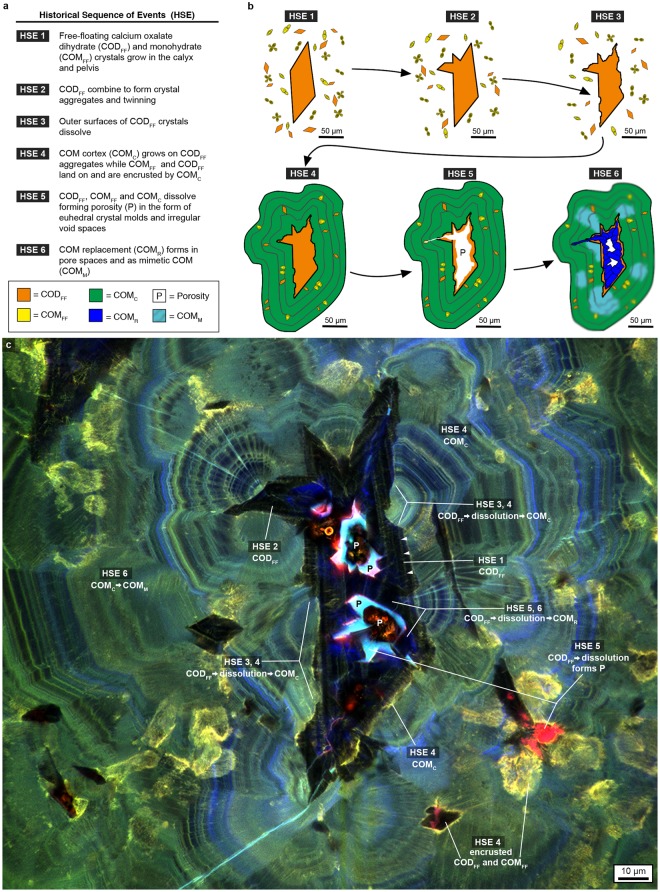
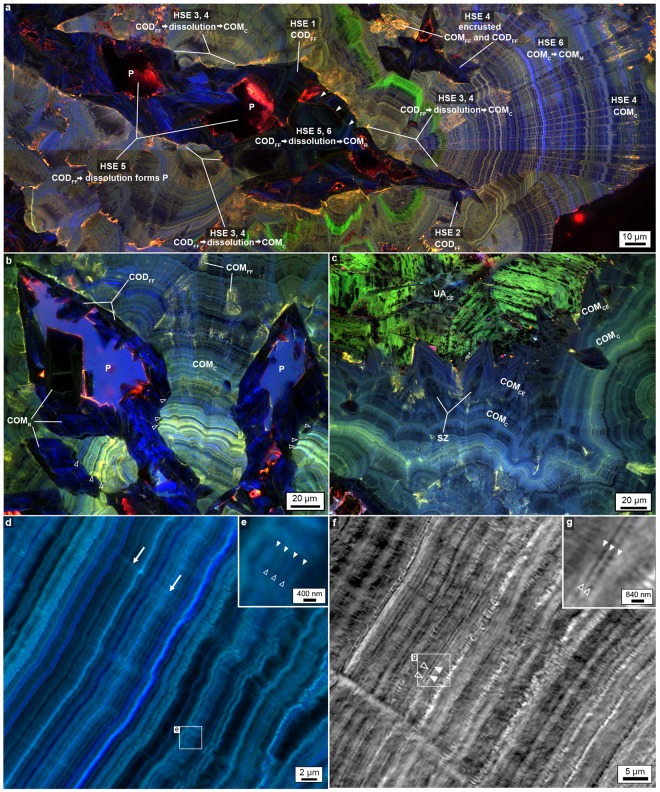
More than 10% of the global human population is now afflicted with kidney stones, which are commonly associated with other significant health problems including diabetes, hypertension and obesity. Nearly 70% of these stones are primarily composed of calcium oxalate, a mineral previously assumed to be effectively insoluble within the kidney. This has limited currently available treatment options to painful passage and/or invasive surgical procedures. We analyze kidney stone thin sections with a combination of optical techniques, which include bright field, polarization, confocal and super-resolution nanometer-scale auto-fluorescence microscopy. Here we demonstrate using interdisciplinary geology and biology (geobiology) approaches that calcium oxalate stones undergo multiple events of dissolution as they crystallize and grow within the kidney. These observations open a fundamentally new paradigm for clinical approaches that include in vivo stone dissolution and identify high-frequency layering of organic matter and minerals as a template for biomineralization in natural and engineered settings.
全球超过 10%的人口患有肾结石,肾结石通常与其他重大健康问题有关,包括糖尿病、高血压和肥胖症。这些结石中近 70%主要由草酸钙组成,草酸钙以前被认为在肾脏中几乎不溶解。这就限制了目前可用的治疗方法只能通过痛苦的排石和/或侵入性手术来进行。我们使用包括明场、偏光、共聚焦和超分辨率纳米级自动荧光显微镜在内的多种光学技术来分析肾结石薄片。在这里,我们利用跨学科地质学和生物学(地质生物学)方法证明,草酸钙结石在肾脏内结晶和生长过程中会经历多次溶解事件。这些观察结果为临床方法开辟了一个全新的范例,包括体内结石溶解,并确定了有机物和矿物质的高频分层作为自然和工程环境中生物矿化的模板。