Department of Orthopaedics, The Second Affiliated Hospital and Yuying Children's Hospital of Wenzhou Medical University, Wenzhou, Zhejiang,325035 China.
School of Pharmaceutical Sciences, Wenzhou Medical University, Wenzhou, Zhejiang 325035, China.
Theranostics. 2018 Aug 7;8(16):4429-4446. doi: 10.7150/thno.26717. eCollection 2018.
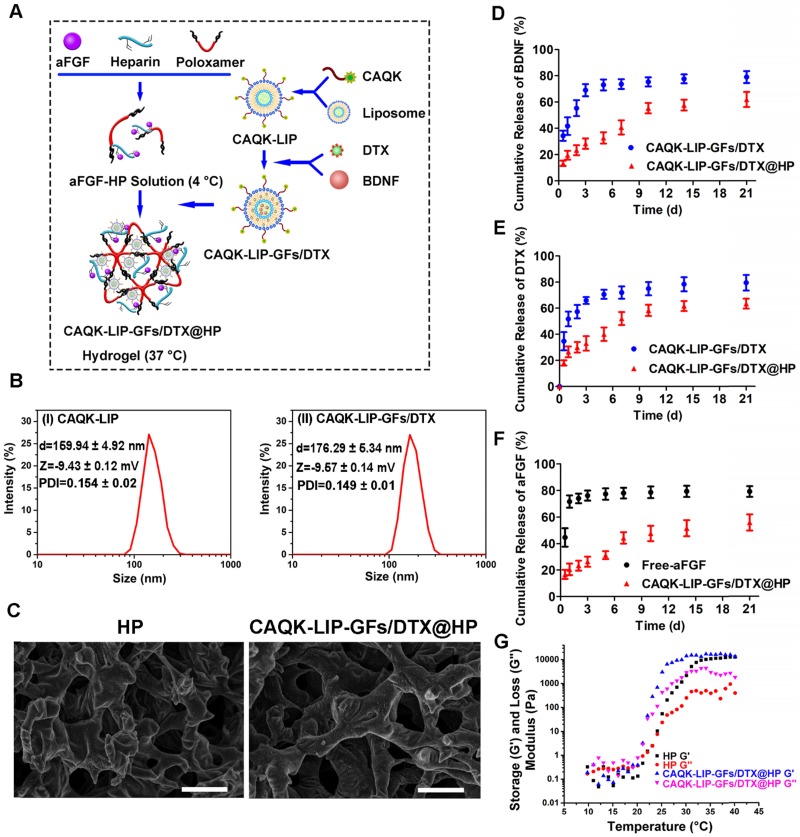
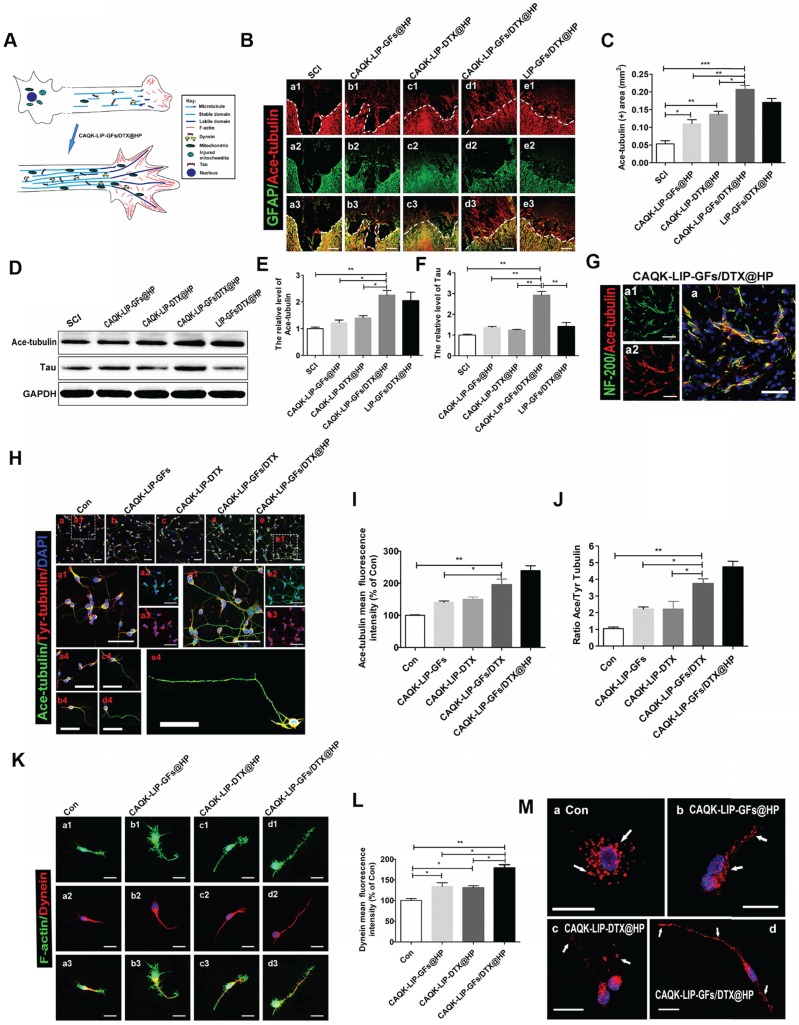
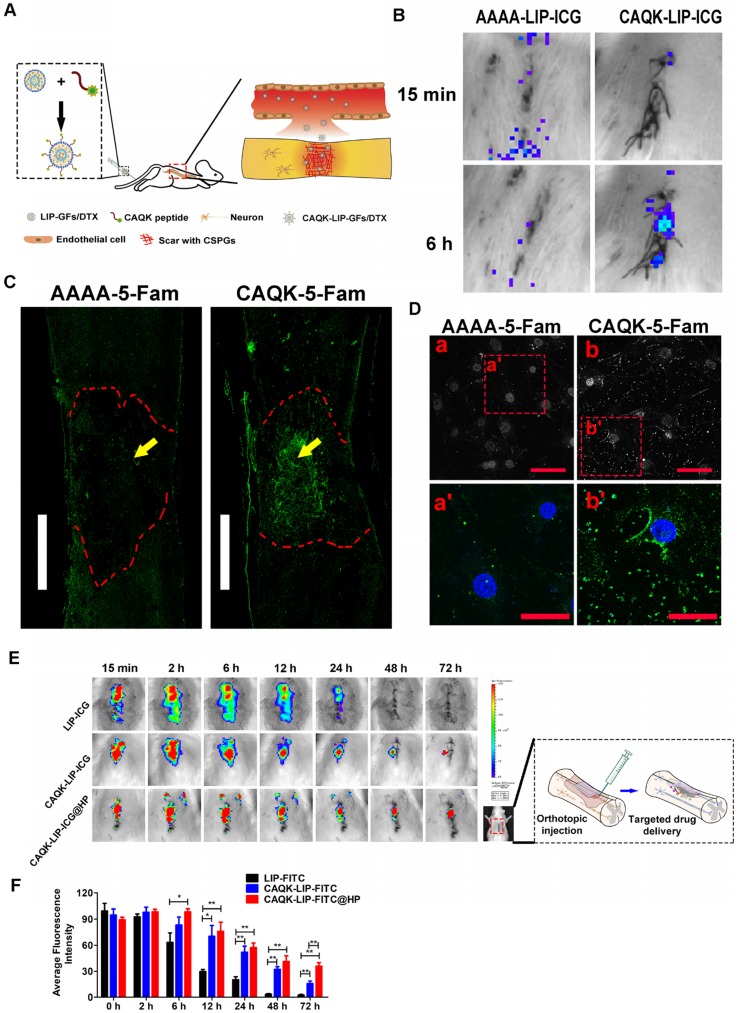
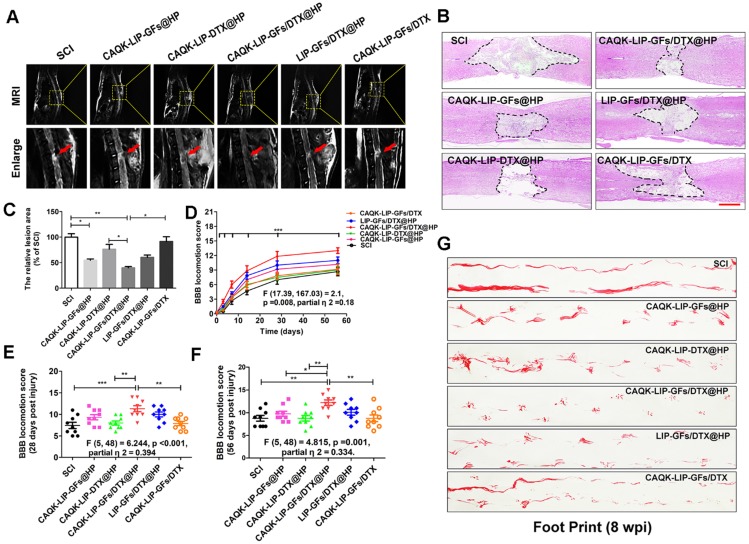
Proper selection and effective delivery of combination drugs targeting multiple pathophysiological pathways key to spinal cord injury (SCI) hold promise to address the thus far scarce clinical therapeutics for improving recovery after SCI. In this study, we aim to develop a clinically feasible way for targeted delivery of multiple drugs with different physiochemical properties to the SCI site, detail the underlying mechanism of neural recovery, and detect any synergistic effect related to combination therapy. Liposomes (LIP) modified with a scar-targeted tetrapeptide (cysteine-alanine-glutamine-lysine, CAQK) were first constructed to simultaneously encapsulate docetaxel (DTX) and brain-derived neurotrophic factor (BDNF) and then were further added into a thermosensitive heparin-modified poloxamer hydrogel (HP) with affinity-bound acidic fibroblast growth factor (aFGF-HP) for local administration into the SCI site (CAQK-LIP-GFs/DTX@HP) in a rat model. fluorescence imaging was used to examine the specificity of CAQK-LIP-GFs/DTX binding to the injured site. Multiple comprehensive evaluations including biotin dextran amine anterograde tracing and magnetic resonance imaging were used to detect any synergistic effects and the underlying mechanisms of CAQK-LIP-GFs/DTX@HP both (rat SCI model) and (primary neuron). The multiple drugs were effectively delivered to the injured site. The combined application of GFs and DTX supported neuro-regeneration by improving neuronal survival and plasticity, rendering a more permissive extracellular matrix environment with improved regeneration potential. In addition, our combination therapy promoted axonal regeneration via moderation of microtubule function and mitochondrial transport along the regenerating axon. This novel multifunctional therapeutic strategy with a scar-homing delivery system may offer promising translational prospects for the clinical treatment of SCI.
适当选择和有效传递针对多种病理生理途径的联合药物是脊髓损伤 (SCI) 治疗的关键,有望解决 SCI 后改善恢复的临床治疗方法仍然很少的问题。在这项研究中,我们旨在开发一种针对 SCI 部位靶向递送具有不同理化性质的多种药物的临床可行方法,详细阐明神经恢复的潜在机制,并检测与联合治疗相关的任何协同作用。首先构建了一种带有瘢痕靶向四肽(半胱氨酸-丙氨酸-谷氨酰胺-赖氨酸,CAQK)的脂质体(LIP),以同时包封多西紫杉醇(DTX)和脑源性神经营养因子(BDNF),然后将其进一步添加到具有亲和结合酸性成纤维细胞生长因子(aFGF-HP)的热敏肝素修饰泊洛沙姆水凝胶(HP)中,以便在大鼠模型中局部施用于 SCI 部位(CAQK-LIP-GFs/DTX@HP)。荧光成像用于检查 CAQK-LIP-GFs/DTX 与损伤部位结合的特异性。多种综合评估,包括生物素葡聚糖胺顺行示踪和磁共振成像,用于检测 CAQK-LIP-GFs/DTX@HP 在(大鼠 SCI 模型)和(原代神经元)中的任何协同作用和潜在机制。多种药物被有效递送到损伤部位。GFs 和 DTX 的联合应用通过改善神经元存活和可塑性来支持神经再生,使细胞外基质环境更具再生潜能。此外,我们的联合治疗通过调节微管功能和线粒体沿再生轴的运输来促进轴突再生。这种具有瘢痕归巢递药系统的新型多功能治疗策略可能为 SCI 的临床治疗提供有前景的转化前景。