Centre for Advance Imaging, The University of Queensland, St Lucia, Queensland 4072, Australia.
Institute for Molecular Bioscience, The University of Queensland, St Lucia, Queensland 4072, Australia.
Sci Adv. 2018 Sep 12;4(9):eaau4640. doi: 10.1126/sciadv.aau4640. eCollection 2018 Sep.
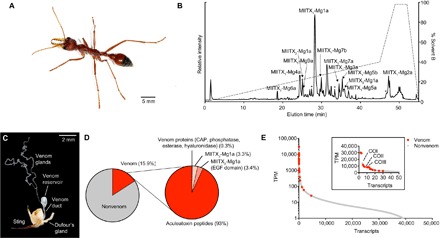
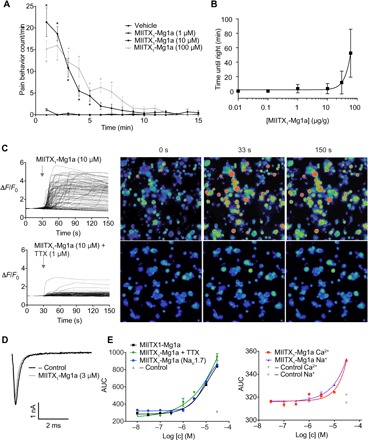
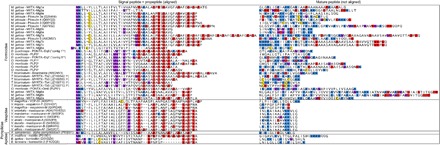
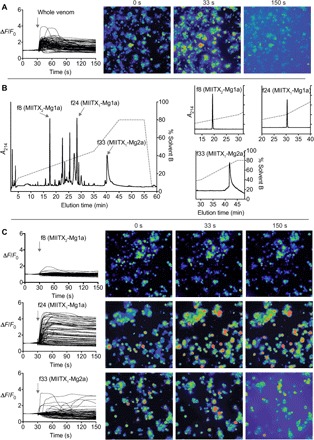
Ants (Hymenoptera: Formicidae) are diverse and ubiquitous, and their ability to sting is familiar to many of us. However, their venoms remain largely unstudied. We provide the first comprehensive characterization of a polypeptidic ant venom, that of the giant red bull ant, . We reveal a suite of novel peptides with a range of posttranslational modifications, including disulfide bond formation, dimerization, and glycosylation. One venom peptide has sequence features consistent with an epidermal growth factor fold, while the remaining peptides have features suggestive of a capacity to form amphipathic helices. We show that these peptides are derived from what appears to be a single, pharmacologically diverse, gene superfamily (aculeatoxins) that includes most venom peptides previously reported from the aculeate Hymenoptera. Two aculeatoxins purified from the venom were found to be capable of activating mammalian sensory neurons, consistent with the capacity to produce pain but via distinct mechanisms of action. Further investigation of the major venom peptide MIITX-Mg1a revealed that it can also incapacitate arthropods, indicative of dual utility in both defense and predation. MIITX-Mg1a accomplishes these functions by generating a leak in membrane ion conductance, which alters membrane potential and triggers neuronal depolarization. Our results provide the first insights into the evolution of the major toxin gene superfamily of the aculeate Hymenoptera and provide a new paradigm in the functional evolution of toxins from animal venoms.
蚂蚁(膜翅目:蚁科)种类繁多,分布广泛,我们许多人都熟悉它们蜇人的能力。然而,它们的毒液在很大程度上仍未被研究过。我们首次全面描述了一种多肽蚂蚁毒液,即巨型红公牛蚁的毒液。我们揭示了一系列具有多种翻译后修饰的新型肽,包括二硫键形成、二聚化和糖基化。一种毒液肽具有表皮生长因子折叠的序列特征,而其余肽具有形成两亲性螺旋的特征。我们表明,这些肽似乎来自一个单一的、具有药理学多样性的基因超家族(aculeatoxins),该超家族包括以前从螫刺目膜翅目昆虫中报道的大多数毒液肽。从毒液中纯化的两种 aculeatoxins 被发现能够激活哺乳动物感觉神经元,这与产生疼痛的能力一致,但作用机制不同。对主要毒液肽 MIITX-Mg1a 的进一步研究表明,它还可以使节肢动物丧失能力,表明其在防御和捕食中具有双重用途。MIITX-Mg1a 通过产生膜离子电导率的泄漏来实现这些功能,这会改变膜电位并引发神经元去极化。我们的研究结果首次揭示了螫刺目膜翅目主要毒素基因超家族的进化,并为动物毒液毒素的功能进化提供了新的范例。