van den Berg Marleen, van Dijk Marloes, Byrne Julianne, Campbell Helen, Berger Claire, Borgmann-Staudt Anja, Calaminus Gabriele, Dirksen Uta, Winther Jeanette F, Fossa Sophie D, Grabow Desiree, Grandage Victoria L, van den Heuvel-Eibrink Marry M, Kaiser Melanie, Kepak Tomas, Kremer Leontien C, Kruseova Jarmila, Kuehni Claudia E, Lambalk Cornelis B, van Leeuwen Flora E, Leiper Alison, Modan-Moses Dalit, Morsellino Vera, Spix Claudia, Kaatsch Peter, van Dulmen-den Broeder Eline
Department of Pediatrics, Amsterdam UMC, Vrije Universiteit, Amsterdam, Netherlands.
Boyne Research Institute, Drogheda, Ireland.
JMIR Res Protoc. 2018 Sep 14;7(9):e10824. doi: 10.2196/10824.
Despite a significant number of studies on female fertility following childhood, adolescent, and young adult (CAYA) cancer, studies establishing precise (dose-related) estimates of treatment-related risks are still scarce. Previous studies have been underpowered, did not include detailed treatment information, or were based on self-report only without any hormonal assessments. More precise assessments of who is at risk for sub- or infertility are needed.
The objective of our study is to describe the design and methods of 2 studies on female fertility (a cohort study and a nested case-control study) among female survivors of CAYA cancer performed within the European PanCareLIFE project.
For the cohort study, which aims to evaluate the overall risk of fertility impairment, as well as the risk for specific subgroups of female CAYA cancer survivors, 13 institutions from 9 countries provide data on fertility impairment. Survivors are defined as being fertility impaired if they meet at least one of 8 different criteria based on self-reported and hormonal data. For the nested case-control study, which aims to identify specific treatment-related risk factors associated with fertility impairment in addition to possible dose-response relationships, cases (fertility impaired survivors) are selected from the cohort study and matched to controls (survivors without fertility impairment) on a 1:2 basis.
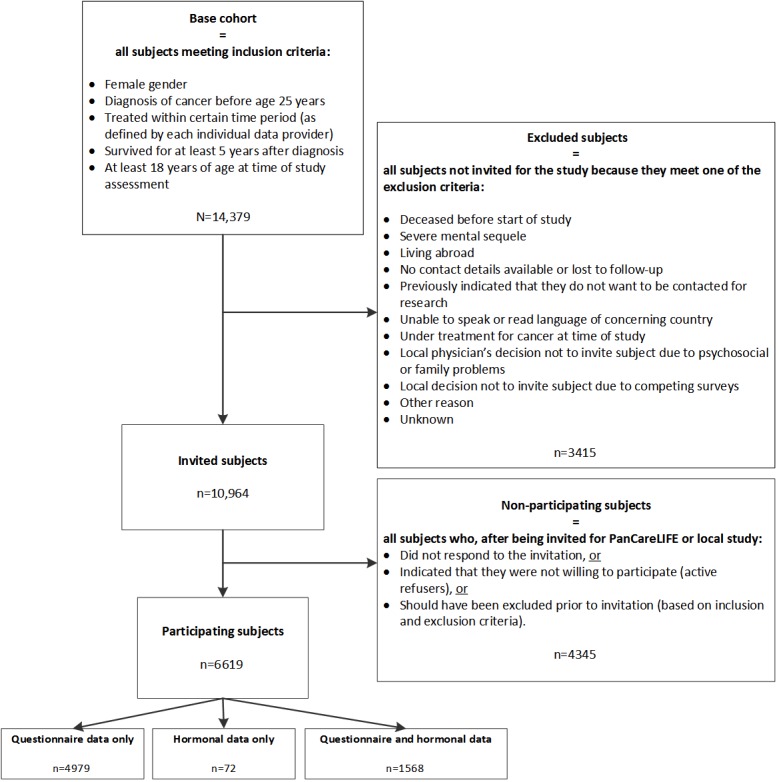
Of the 10,964 survivors invited for the cohort study, data are available from 6619 survivors, either questionnaire-based only (n=4979), hormonal-based only (n=72), or both (n=1568). For the nested case-control study, a total of 450 cases and 882 controls are identified.
Results of both PanCareLIFE fertility studies will provide detailed insight into the risk of fertility impairment following CAYA cancer and diagnostic- or treatment-related factors associated with an increased risk. This will help clinicians to adequately counsel both girls and young women, who are about to start anticancer treatment, as well as adult female CAYA cancer survivors, concerning future parenthood and to timely refer them for fertility preservation. Ultimately, we aim to empower patients and survivors and improve their quality of life.
RR1-10.2196/10824.
尽管针对儿童期、青少年期及青年期(CAYA)癌症女性患者生育能力的研究数量众多,但确定治疗相关风险的精确(剂量相关)估计的研究仍然匮乏。以往的研究样本量不足,未包含详细的治疗信息,或仅基于自我报告且未进行任何激素评估。需要对哪些人存在生育力低下或不育风险进行更精确的评估。
我们研究的目的是描述在欧洲PanCareLIFE项目中针对CAYA癌症女性幸存者开展的两项关于女性生育能力的研究(一项队列研究和一项巢式病例对照研究)的设计与方法。
队列研究旨在评估生育力受损的总体风险以及CAYA癌症女性幸存者特定亚组的风险,来自9个国家的13个机构提供生育力受损数据。如果幸存者根据自我报告和激素数据满足8项不同标准中的至少一项,则被定义为生育力受损。巢式病例对照研究旨在除了确定可能的剂量反应关系外,还识别与生育力受损相关的特定治疗相关风险因素,病例(生育力受损的幸存者)从队列研究中选取,并与对照(未生育力受损的幸存者)按1:2的比例匹配。
在受邀参加队列研究的10964名幸存者中,有6619名幸存者的数据可用,仅基于问卷(n = 4979)、仅基于激素(n = 72)或两者兼具(n = 1568)。对于巢式病例对照研究,共确定了450例病例和882名对照。
PanCareLIFE生育力研究的两项结果将深入了解CAYA癌症后生育力受损的风险以及与风险增加相关的诊断或治疗相关因素。这将有助于临床医生就未来生育问题为即将开始抗癌治疗的女孩和年轻女性以及成年CAYA癌症女性幸存者提供充分的咨询,并及时将她们转介至生育力保存治疗。最终,我们旨在增强患者和幸存者的能力并改善其生活质量。
RR1 - 10.2196/10824。