Department of Translational Research and New Technologies in Medicine and Surgery, University of Pisa, Via Roma 55, 56126 Pisa, Italy.
IRCCS Neuromed, Via Atinense 18, 86077 Pozzilli (IS), Italy.
Int J Mol Sci. 2018 Sep 13;19(9):2756. doi: 10.3390/ijms19092756.
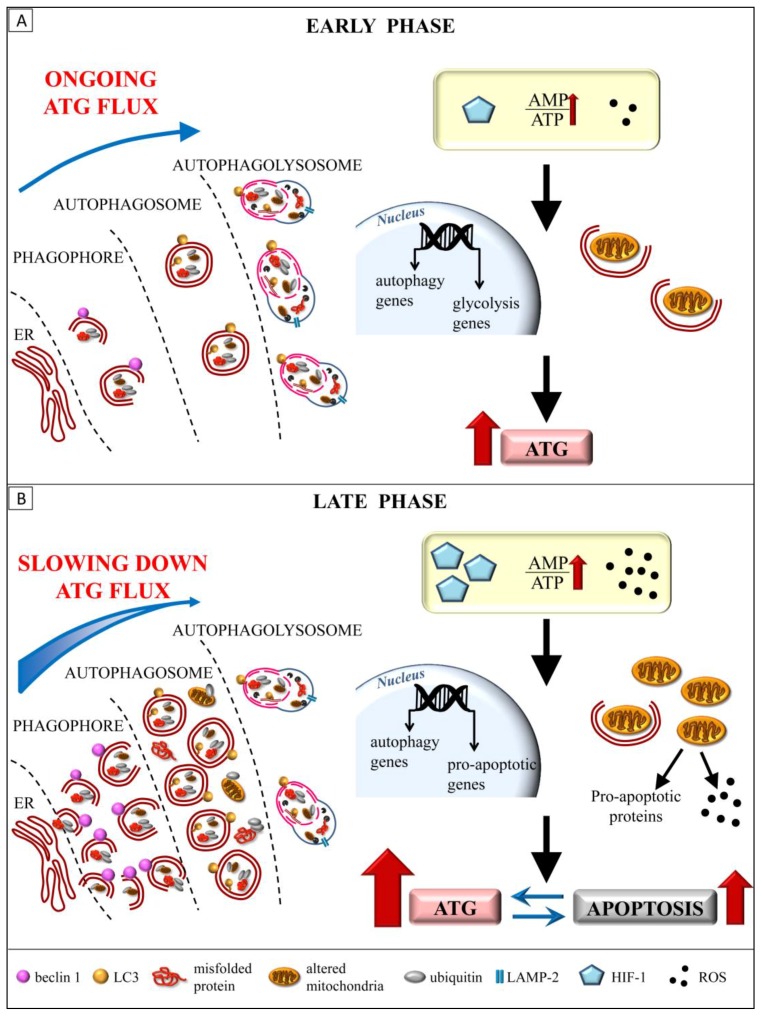
Autophagy primarily works to counteract nutrient deprivation that is strongly engaged during starvation and hypoxia, which happens in hypoperfusion. Nonetheless, autophagy is slightly active even in baseline conditions, when it is useful to remove aged proteins and organelles. This is critical when the mitochondria and/or proteins are damaged by toxic stimuli. In the present review, we discuss to that extent the recruitment of autophagy is beneficial in counteracting brain hypoperfusion or, vice-versa, its overactivity may per se be detrimental for cell survival. While analyzing these opposite effects, it turns out that the autophagy activity is likely not to be simply good or bad for cell survival, but its role varies depending on the timing and amount of autophagy activation. This calls for the need for an appropriate autophagy tuning to guarantee a beneficial effect on cell survival. Therefore, the present article draws a theoretical pattern of autophagy activation, which is hypothesized to define the appropriate timing and intensity, which should mirrors the duration and severity of brain hypoperfusion. The need for a fine tuning of the autophagy activation may explain why confounding outcomes occur when autophagy is studied using a rather simplistic approach.
自噬主要作用是对抗营养缺乏,在饥饿和缺氧时(即低灌注时)会强烈发生这种情况,而在基础条件下,自噬也有轻微的活性,此时它可以清除老化的蛋白质和细胞器。当线粒体和/或蛋白质受到有毒刺激而受损时,这一点尤为重要。在本次综述中,我们讨论了自噬的募集在对抗脑低灌注方面的益处,或者相反,其过度活跃本身可能对细胞存活有害。在分析这些相反的作用时,结果表明,自噬活性对细胞存活的影响可能并不简单地是好是坏,而是其作用取决于自噬激活的时间和程度。这就需要对自噬进行适当的调节,以保证对细胞存活产生有益的影响。因此,本文提出了一种自噬激活的理论模式,该模式假设定义了适当的时间和强度,应反映脑低灌注的持续时间和严重程度。自噬激活需要精细调节,这可能解释了为什么当使用相当简单的方法研究自噬时会出现混淆的结果。