Ai Leo, Bansal Priya, Mueller Jerel K, Legon Wynn
Division of Physical Therapy and Division of Rehabilitation Science, Department of Rehabilitation Medicine, Medical School, University of Minnesota, 426 Church St. SE Rm 361, Minneapolis, MN, 55455, USA.
Department of Neurological Surgery, School of Medicine, University of Virginia, 409 Lane Rd. Rm 1031, Charlottesville, VA, 22901, USA.
BMC Neurosci. 2018 Sep 14;19(1):56. doi: 10.1186/s12868-018-0456-6.
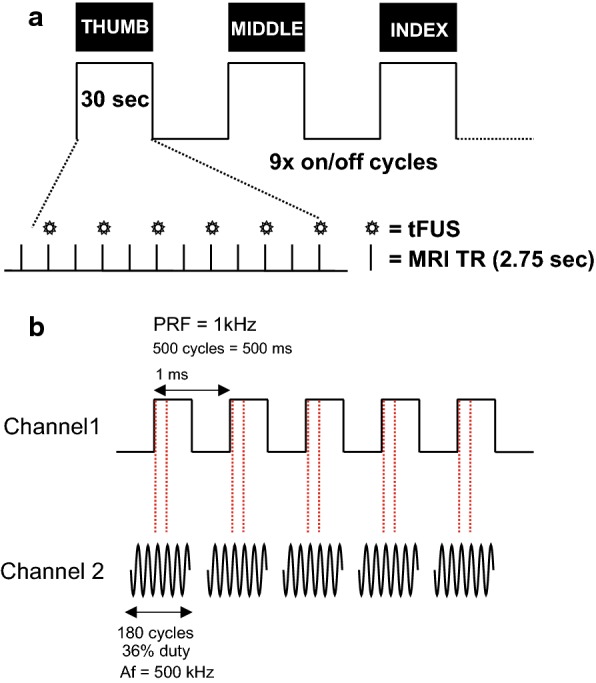
Transcranial focused ultrasound (tFUS) is a new non-invasive neuromodulation technique that uses mechanical energy to modulate neuronal excitability with high spatial precision. tFUS has been shown to be capable of modulating EEG brain activity in humans that is spatially restricted, and here, we use 7T MRI to extend these findings. We test the effect of tFUS on 7T BOLD fMRI signals from individual finger representations in the human primary motor cortex (M1) and connected cortical motor regions. Participants (N = 5) performed a cued finger tapping task in a 7T MRI scanner with their thumb, index, and middle fingers to produce a BOLD signal for individual M1 finger representations during either tFUS or sham neuromodulation to the thumb representation.
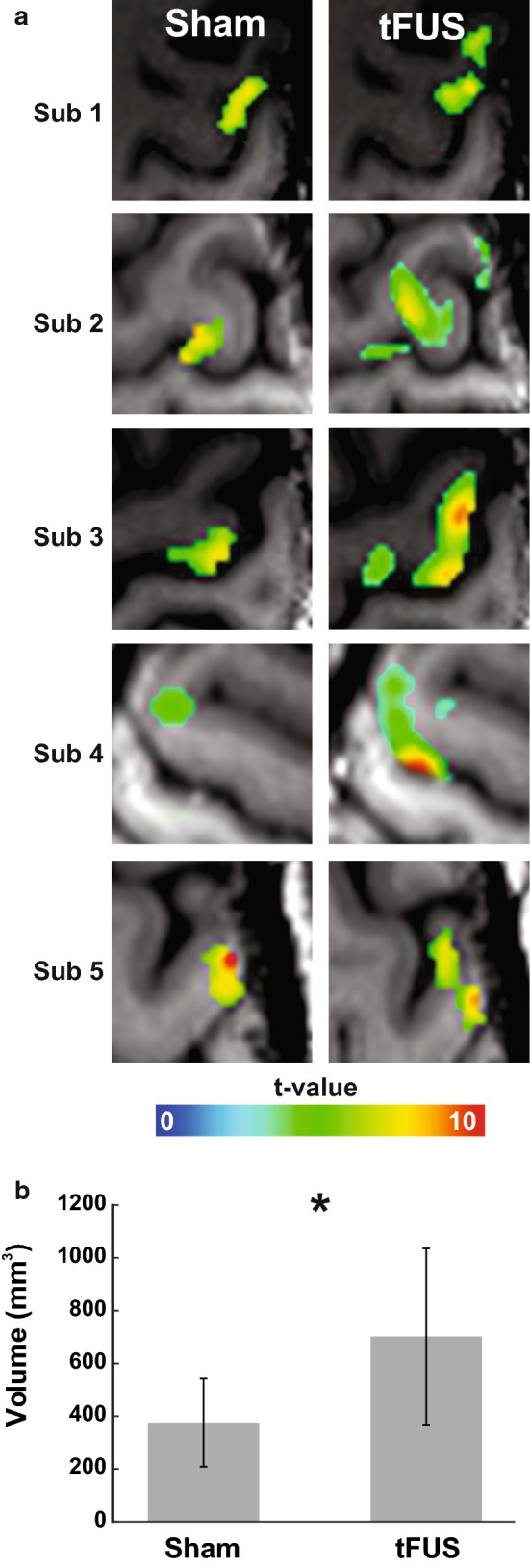
Results demonstrated a statistically significant increase in activation volume of the M1 thumb representation for the tFUS condition as compared to sham. No differences in percent BOLD changes were found. This effect was spatially confined as the index and middle finger M1 finger representations did not show similar significant changes in either percent change or activation volume. No effects were seen during tFUS to M1 in the supplementary motor area or the dorsal premotor cortex.
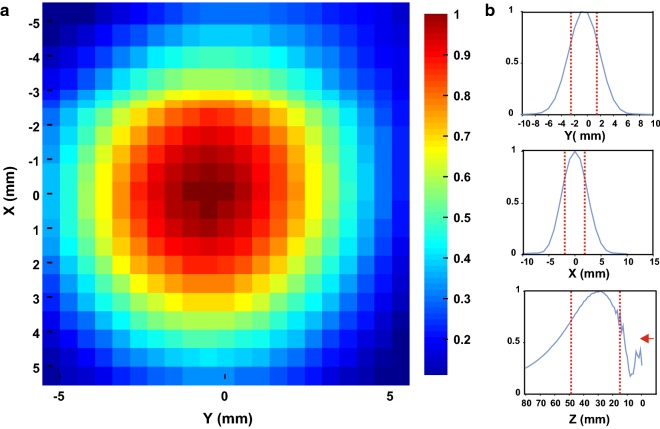
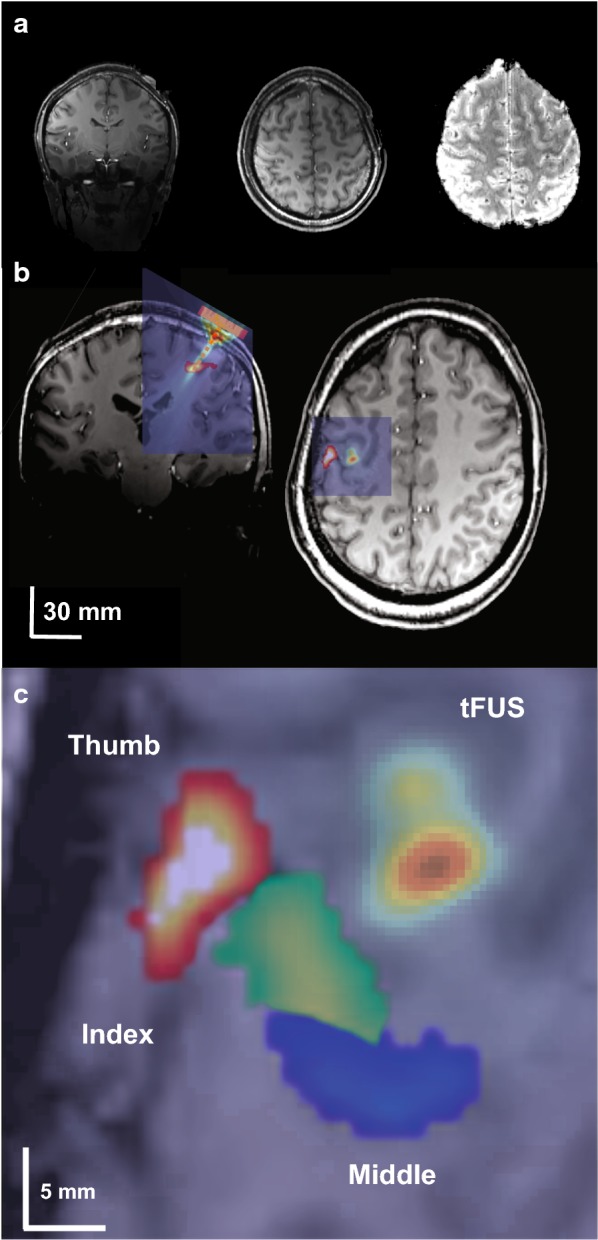
Single element tFUS can be paired with high field MRI that does not induce significant artifact. tFUS increases activation volumes of the targeted finger representation that is spatially restricted within M1 but does not extend to functionally connected motor regions. Trial registration ClinicalTrials.gov NCT03634631 08/14/18.
经颅聚焦超声(tFUS)是一种新型非侵入性神经调节技术,它利用机械能以高空间精度调节神经元兴奋性。已有研究表明,tFUS能够调节人类脑电图中的大脑活动,且这种调节在空间上具有局限性。在此,我们使用7T磁共振成像(MRI)来扩展这些发现。我们测试了tFUS对来自人类初级运动皮层(M1)中单个手指表征以及相连的皮层运动区域的7T血氧水平依赖性功能磁共振成像(BOLD fMRI)信号的影响。参与者(N = 5)在7T MRI扫描仪中用拇指、食指和中指执行提示性手指敲击任务,以便在对拇指表征进行tFUS或假神经调节期间,为M1中单个手指表征产生BOLD信号。
结果表明,与假刺激相比,tFUS条件下M1拇指表征的激活体积在统计学上有显著增加。未发现BOLD变化百分比存在差异。这种效应在空间上具有局限性,因为食指和中指的M1手指表征在变化百分比或激活体积方面均未显示出类似的显著变化。在对M1进行tFUS刺激时,辅助运动区或背侧运动前皮层未观察到任何效应。
单元素tFUS可与不会产生明显伪影的高场MRI相结合。tFUS增加了M1内空间受限的目标手指表征的激活体积,但并未扩展到功能相连的运动区域。试验注册ClinicalTrials.gov NCT03634631 2018年8月14日。