Imani Peace D, Carpenter Jennifer L, Bell Cynthia S, Brandt Mary L, Braun Michael C, Swartz Sarah J
Renal Section, Department of Pediatrics, Texas Children's Hospital/Baylor College of Medicine, 1102 Bates Avenue, Suite 245, Houston, TX, 77030, USA.
Department of Surgery, Texas Children's Hospital/Baylor College of Medicine, 6621 Fannin St, Houston, TX, 77030, USA.
BMC Nephrol. 2018 Sep 14;19(1):231. doi: 10.1186/s12882-018-1015-1.
End-stage renal disease (ESRD) although rare among infants presents many management challenges. We sought to evaluate factors associated with PD catheter failure among infants initiated on chronic PD.
A retrospective chart review of all children under two years of age who had PD catheters placed for initiation of chronic PD from 2002 to 2015. Data was extracted for catheter related events occurring within 12 months of catheter placement. Cox and Poisson regression models were used to delineate factors associated catheter complications.
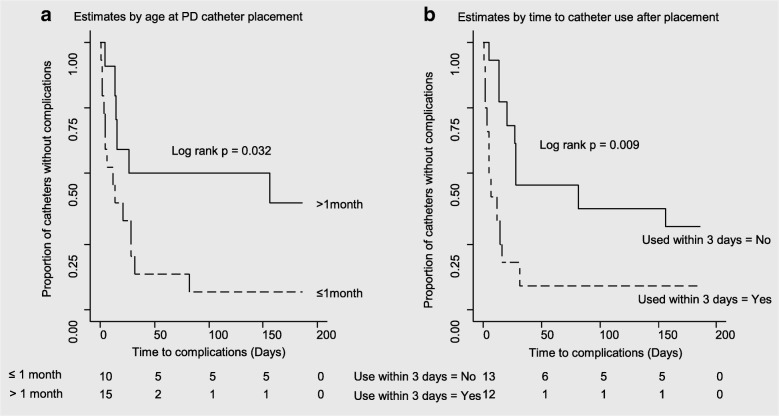
Twenty-five infants with median age 18 days had PD catheters placed for chronic dialysis. Common complications included leakage around the exit site (31%), blockage (26%), migration or malposition (23%), catheter-related infections (18%), and other complications (2%). Predictors of initial PD catheter failure were age less than one month at catheter placement (hazard ratio (HR) 7.77, 95% CI, 1.70-35.39, p = 0.008), use of catheter within three days of placement (HR 5.67, 95% CI, 1.39-23.10, p = 0.015) and presence of a hernia (HR 8.64, 95% CI, 1.19-62.36, p = 0.033). In an adjusted Poisson regression model, PD catheter use within three days of placement was the only predictor of any catheter complication over the12 months of follow up.
Use of PD catheters within three days of placement was associated with catheter failure. We recommend that when possible, catheters should be allowed to heal for at least three days prior to use to reduce risk of complications and improve catheter survival.
终末期肾病(ESRD)在婴儿中虽罕见,但带来诸多管理挑战。我们旨在评估开始长期腹膜透析(PD)的婴儿中与PD导管失败相关的因素。
对2002年至2015年期间所有因开始长期PD而置入PD导管的两岁以下儿童进行回顾性病历审查。提取导管置入后12个月内发生的与导管相关事件的数据。使用Cox和泊松回归模型来确定与导管并发症相关的因素。
25名中位年龄为18天的婴儿因慢性透析置入了PD导管。常见并发症包括出口部位渗漏(31%)、堵塞(26%)、移位或位置不当(23%)、导管相关感染(18%)以及其他并发症(2%)。初始PD导管失败的预测因素为导管置入时年龄小于1个月(风险比[HR] 7.77,95%置信区间[CI],1.70 - 35.39,p = 0.008)、置入后三天内使用导管(HR 5.67,95% CI,1.39 - 23.10,p = 0.015)以及存在疝气(HR 8.64,95% CI,1.19 - 62.36,p = 0.033)。在调整后的泊松回归模型中,置入后三天内使用PD导管是随访12个月内任何导管并发症的唯一预测因素。
置入后三天内使用PD导管与导管失败相关。我们建议,尽可能在导管置入后至少让其愈合三天再使用,以降低并发症风险并提高导管使用寿命。