Department of Civil Engineering, Indian Institute of Technology, Guwahati, 781039, India.
Discipline of Civil Engineering, Indian Institute of Technology, Indore, 453552, India.
Sci Rep. 2018 Sep 14;8(1):13833. doi: 10.1038/s41598-018-32091-0.
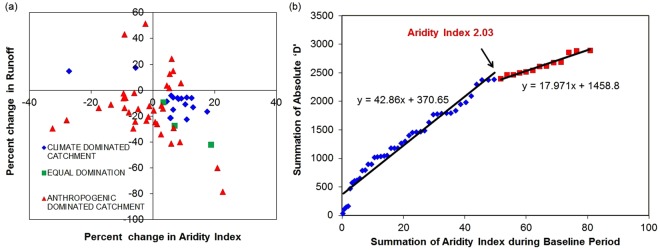
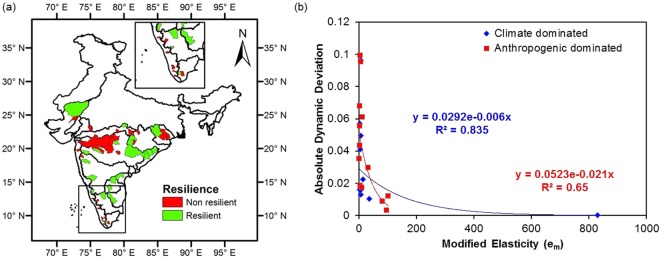
Most parts of the world are witnessing climatic warming and the trend is expected to increase in the future. It is important to assess the response of watershed hydrology to this warming. Moreover, human interactions and climatic variability influence the water balance of a catchment. We perform contribution analysis along with resilience study using Budyko framework and two parameters (dynamic deviation and modified elasticity), in-order to comprehend the involvement of anthropogenic stress and climatic variance on partitioning of precipitation and their relation with hydrologic resilience to warming shifts across 55 catchments in peninsular India. Here, 23 catchments have displayed hydrologic resilience (low departure and high elasticity) to climatic warming shifts. Only 37.14% of anthropogenic dominated catchments (higher contribution from human activities in runoff changes) were found to be resilient whereas 58.82% of climate dominated catchments had resilience attributes. Most of the catchments on western and extreme southern part of India were not hydrologic resilient. Extensive human interactions tend to depart the catchment from expected hydrological functioning under critical climatic conditions (Warming in our study) that lead to declining of hydrological resilience.
世界上大多数地区都在经历气候变暖,预计未来这一趋势还将加剧。评估流域水文学对这种变暖的响应非常重要。此外,人类活动和气候变率也会影响流域的水量平衡。我们使用布地科框架和两个参数(动态偏差和修正弹性)进行贡献分析和弹性研究,以了解人为压力和气候变率对降水分配的影响,以及它们与印度半岛 55 个流域水文弹性对变暖转变的关系。在这里,23 个流域对气候变暖转变表现出了水文弹性(低偏离和高弹性)。只有 37.14%的人为主导流域(人类活动对径流量变化的贡献更大)具有弹性,而 58.82%的气候主导流域具有弹性特征。印度西部和极南部的大部分流域都没有水文弹性。在极端气候条件下(在我们的研究中是变暖),广泛的人类活动往往会使流域偏离预期的水文功能,从而导致水文弹性下降。