Prince Thomas, Ackerman Andrew, Cavanaugh Alice, Schreiter Brielle, Juengst Brendon, Andolino Chaylen, Danella John, Chernin Mitch, Williams Heinric
Urology Department, Geisinger Clinic, Danville, 17822 PA, USA.
Weis Center for Research, Geisinger Clinic, Danville, 17822 PA, USA.
Oncotarget. 2018 Aug 24;9(66):32702-32717. doi: 10.18632/oncotarget.26021.
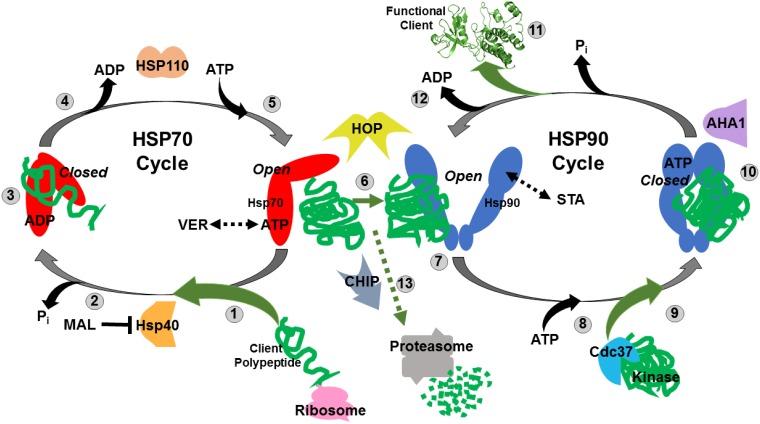
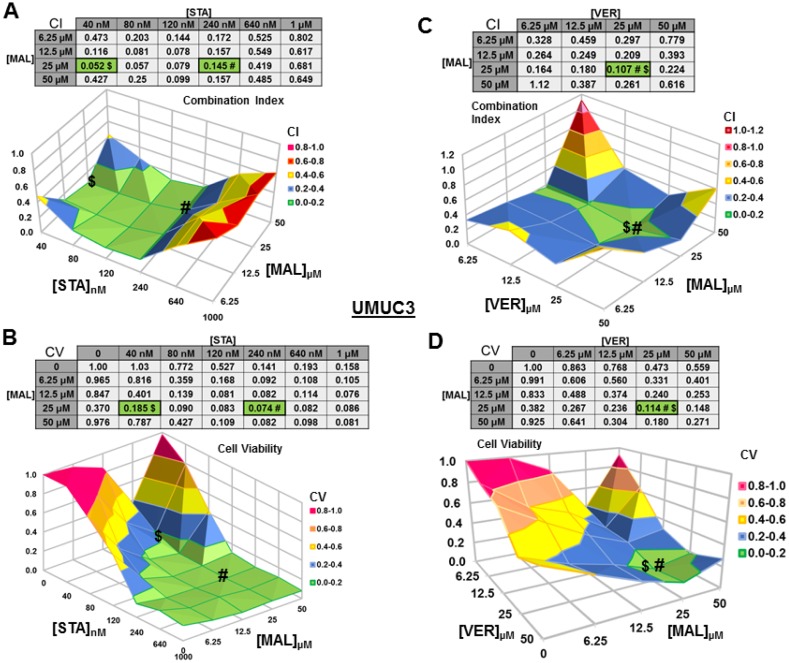
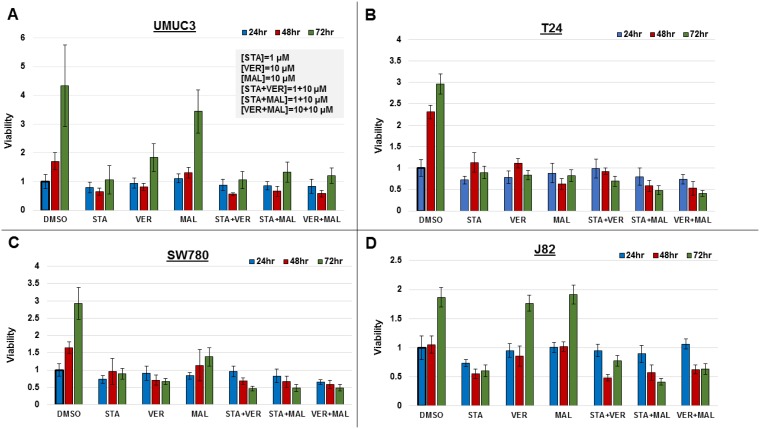
Muscle invasive bladder cancer (MIBC) is a common malignancy and major cause of morbidity worldwide. Over the last decade mortality rates for MIBC have not decreased as compared to other cancers indicating a need for novel strategies. The molecular chaperones HSP70 and HSP90 fold and maintain the 3-dimensional structures of numerous client proteins that signal for cancer cell growth and survival. Inhibition of HSP70 or HSP90 results in client protein degradation and associated oncogenic signaling. Here we targeted HSP70 and HSP90 with small molecule inhibitors that trap or block each chaperone in a low client-affinity "open" conformation. HSP70 inhibitors, VER155008 (VER) and MAL3-101 (MAL), along with HSP90 inhibitor, STA-9090 (STA), were tested alone and in combination for their ability to reduce cell viability and alter protein levels in 4 MIBC cell lines. When combined, VER+MAL synergistically reduced cell viability in each MIBC cell line while not inducing expression of heat shock proteins (HSPs). STA+MAL also synergistically reduced cell viability in each cell line but induced expression of cytoprotective HSPs indicating the merits of targeting HSP70 with VER+MAL. Additionally, we observed that STA induced the expression of the stress-related transcription factor HSF2 while reducing levels of the co-chaperone TTI1.
肌肉浸润性膀胱癌(MIBC)是一种常见的恶性肿瘤,也是全球发病的主要原因。在过去十年中,与其他癌症相比,MIBC的死亡率并未下降,这表明需要新的治疗策略。分子伴侣HSP70和HSP90折叠并维持众多客户蛋白的三维结构,这些蛋白是癌细胞生长和存活的信号。抑制HSP70或HSP90会导致客户蛋白降解和相关的致癌信号传导。在这里,我们用小分子抑制剂靶向HSP70和HSP90,这些抑制剂将每个伴侣捕获或阻断在低客户亲和力的“开放”构象中。单独或联合测试HSP70抑制剂VER155008(VER)和MAL3-101(MAL)以及HSP90抑制剂STA-9090(STA)在4种MIBC细胞系中降低细胞活力和改变蛋白质水平的能力。联合使用时,VER+MAL可协同降低每种MIBC细胞系的细胞活力,同时不诱导热休克蛋白(HSP)的表达。STA+MAL也可协同降低每种细胞系的细胞活力,但诱导细胞保护性HSP的表达,这表明用VER+MAL靶向HSP70的优点。此外,我们观察到STA诱导应激相关转录因子HSF2的表达,同时降低共伴侣TTI1的水平。