Institute for Physiology, Charité-Universitätsmedizin Berlin, Corporate Member of Freie Universität Berlin and Humboldt Universität zu Berlin, Charitéplatz 1, 10117 Berlin, Germany.
Organische Chemie 1, Universität Bayreuth, Universitätsstrasse 30, 95440 Bayreuth, Germany.
Int J Mol Sci. 2023 Feb 17;24(4):4083. doi: 10.3390/ijms24044083.
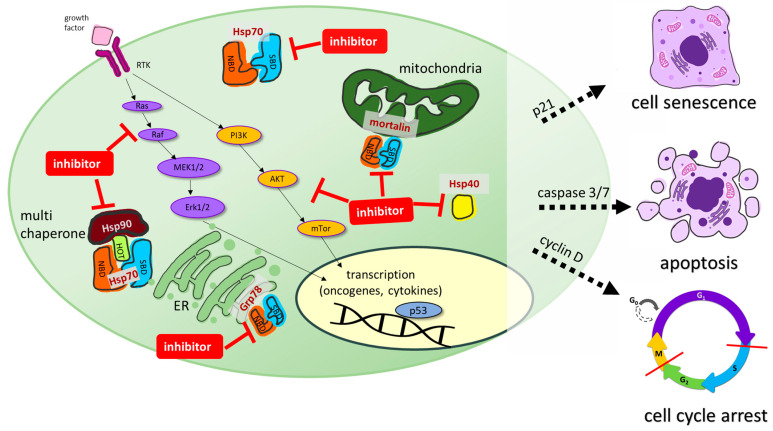
A class of chaperones dubbed heat shock protein 70 (Hsp70) possesses high relevance in cancer diseases due to its cooperative activity with the well-established anticancer target Hsp90. However, Hsp70 is closely connected with a smaller heat shock protein, Hsp40, forming a formidable Hsp70-Hsp40 axis in various cancers, which serves as a suitable target for anticancer drug design. This review summarizes the current state and the recent developments in the field of (semi-)synthetic small molecule inhibitors directed against Hsp70 and Hsp40. The medicinal chemistry and anticancer potential of pertinent inhibitors are discussed. Since Hsp90 inhibitors have entered clinical trials but have exhibited severe adverse effects and drug resistance formation, potent Hsp70 and Hsp40 inhibitors may play a significant role in overcoming the drawbacks of Hsp90 inhibitors and other approved anticancer drugs.
一类被称为热休克蛋白 70(Hsp70)的伴侣蛋白因其与已确立的抗癌靶标 Hsp90 的合作活性而与癌症密切相关。然而,Hsp70 与较小的热休克蛋白 Hsp40 密切相关,在各种癌症中形成一个强大的 Hsp70-Hsp40 轴,这是抗癌药物设计的合适靶标。本综述总结了(半)合成小分子抑制剂针对 Hsp70 和 Hsp40 的现状和最新进展。讨论了相关抑制剂的药物化学和抗癌潜力。由于 Hsp90 抑制剂已进入临床试验,但表现出严重的不良反应和耐药性形成,因此,有效的 Hsp70 和 Hsp40 抑制剂可能在克服 Hsp90 抑制剂和其他已批准的抗癌药物的缺点方面发挥重要作用。