Santegoets S J A M, de Groot A F, Dijkgraaf E M, Simões A M Carnaz, van der Noord V E, van Ham J J, Welters M J P, Kroep J R, van der Burg S H
Department of Medical Oncology, Leiden University Medical Center, Leiden, The Netherlands.
Oncoimmunology. 2018 May 31;7(8):e1465166. doi: 10.1080/2162402X.2018.1465166. eCollection 2018.
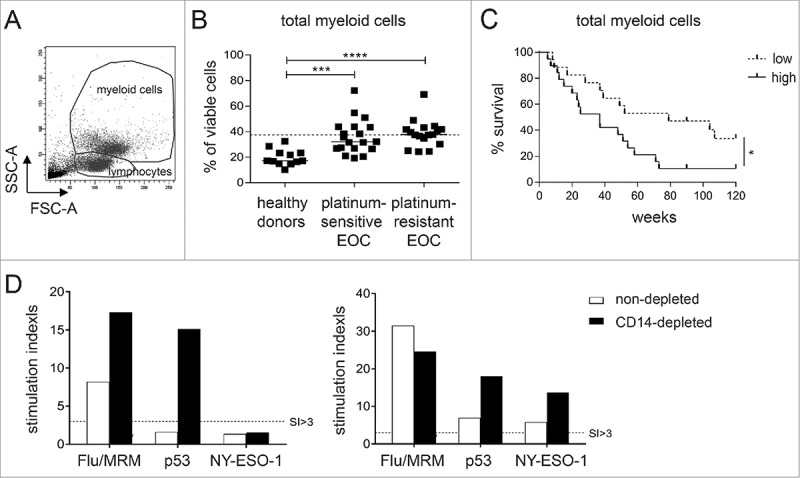
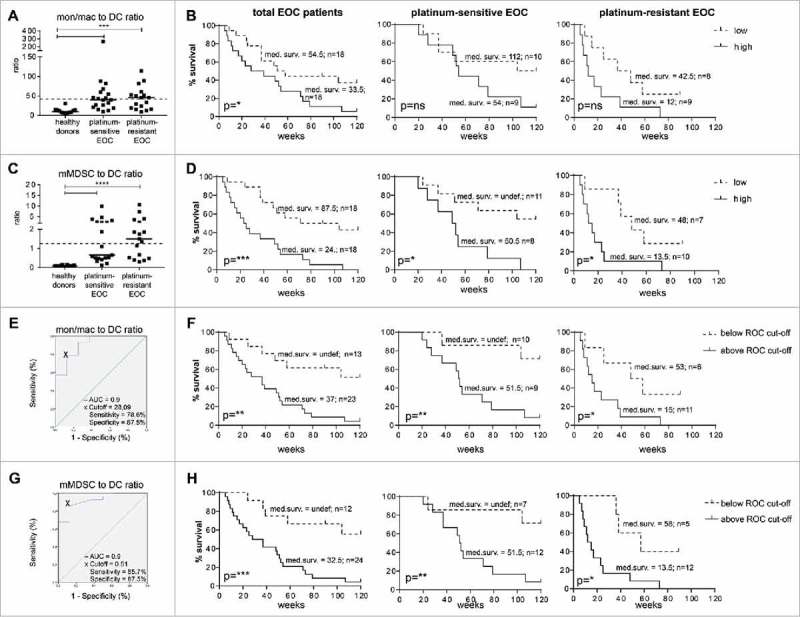
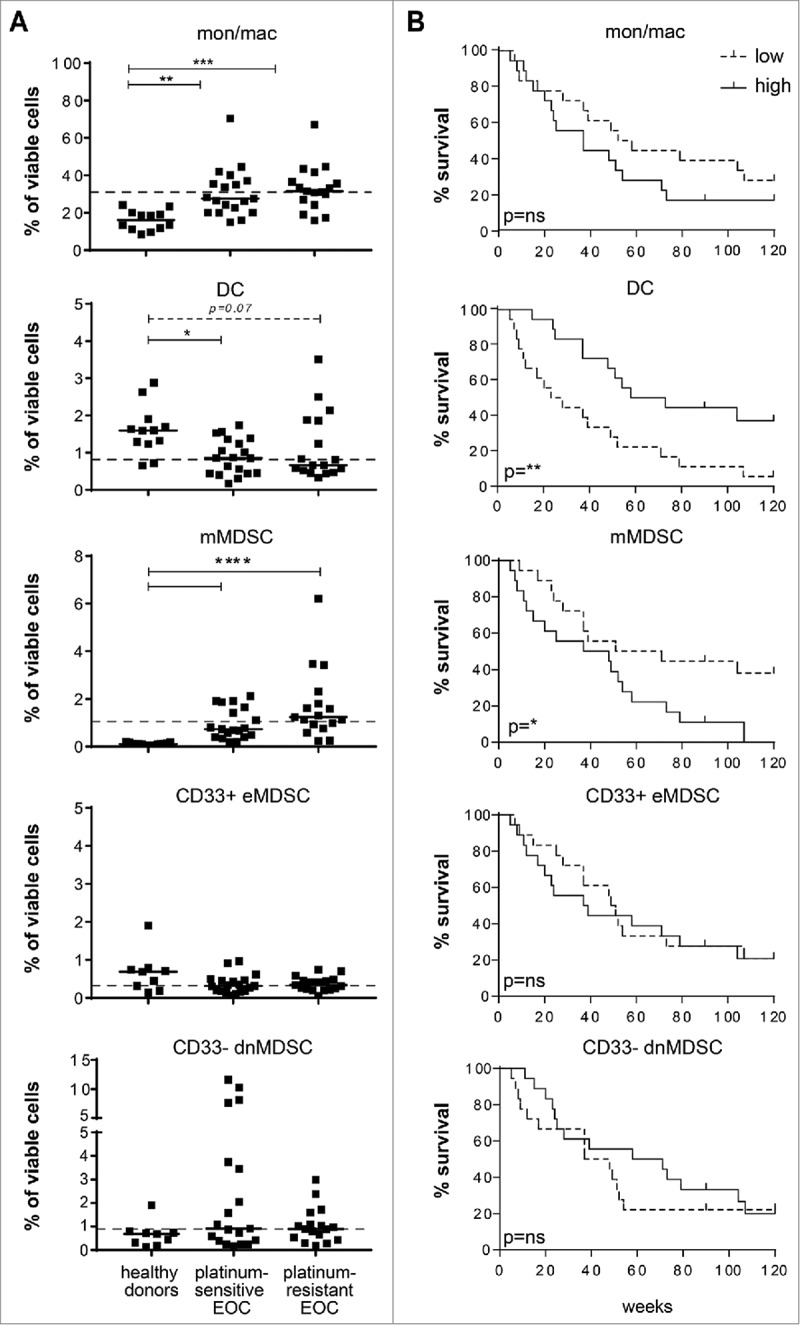
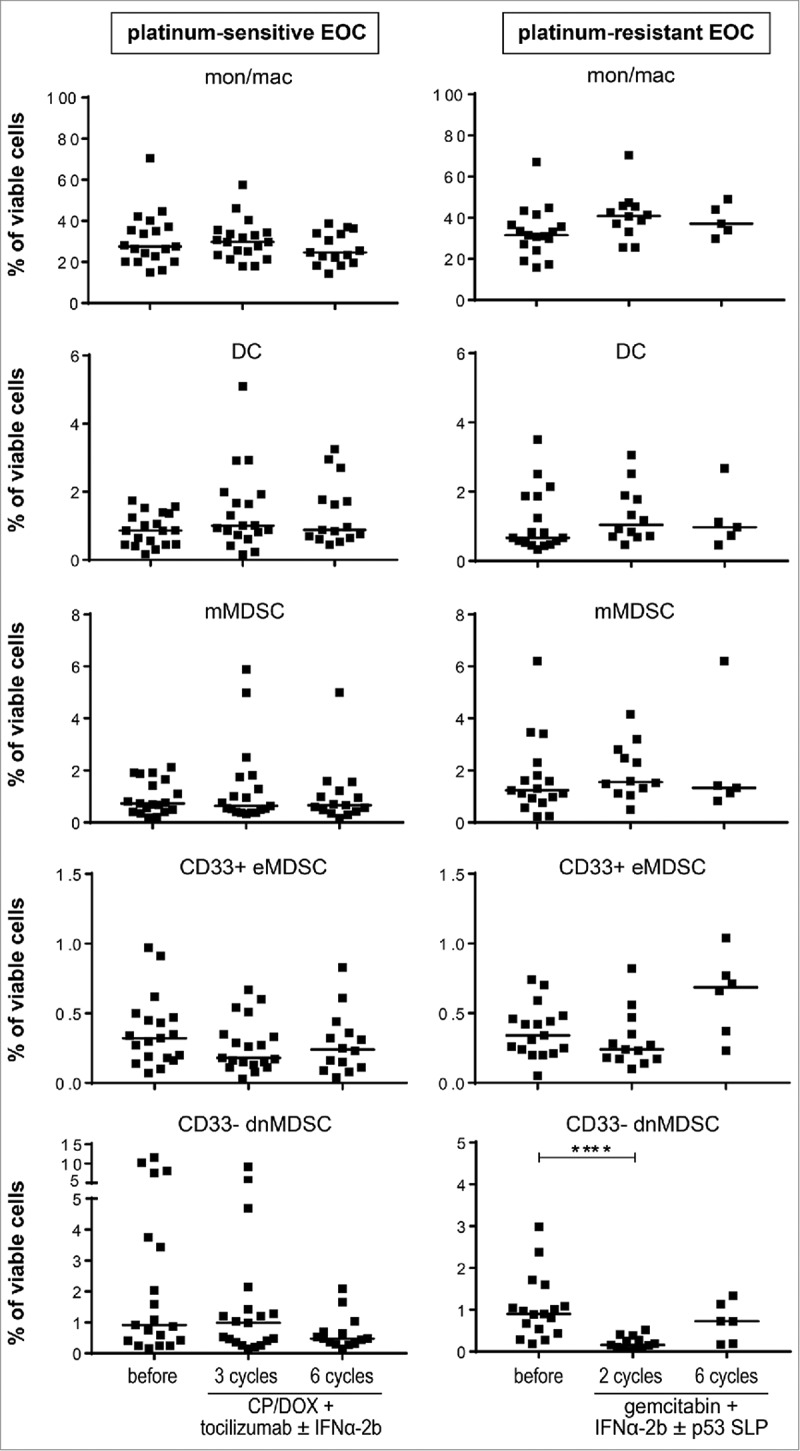
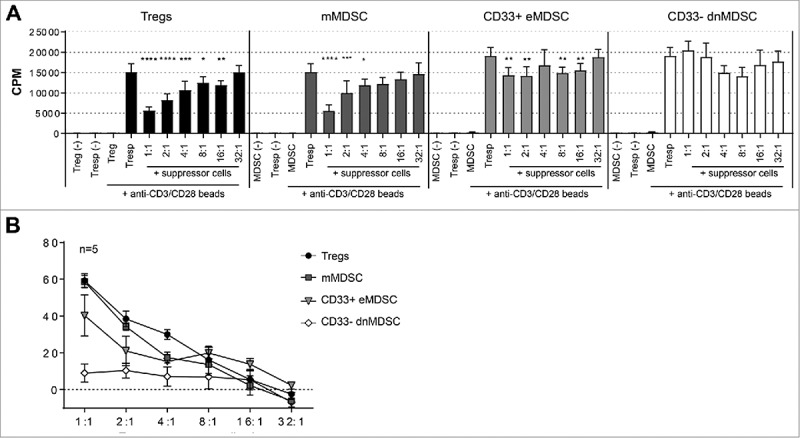
Epithelial ovarian cancer (EOC) may cause abnormal blood levels of leukocytes. This paraneoplastic manifestation is associated with a worse response to therapy and shorter survival. To understand the complexity and nature of these leukocytes, we dissected the different populations of myeloid cells and analyzed their relation to clinical outcome. Therefore, baseline blood samples of 36 EOC patients treated either with carboplatin/doxorubucin or with gemcitabine were analyzed for different subsets of monocytes/macrophages, myeloid derived suppressor cells (MDSC) and dendritic cells (DC) using multiparameter flow cytometry as well as functional assays for myeloid cell mediated suppression of antigen-specific T cell reactivity. Healthy donor blood served as control. EOC patients displayed an increase in monocytes/macrophages, monocytic MDSC (mMDSC) and CD33-CD11b+CD14-CD15- double-negative MDSC (CD33- dnMDSC) and a decrease in the frequency of DC, across all EOC subtypes. A low frequency of DC and high frequencies of monocytes/macrophages and mMDSC, but not CD33- dnMDSC, were associated with poor overall survival. Patient's monocytes/macrophages and mMDSC, but not CD33- dnMDSC, were shown to suppress T cell reactivity in vitro. The mMDSC and DC frequencies were not altered upon treatment. Importantly, the mMDSC to DC ratio was the strongest independent, highly sensitive and specific, predictive factor for survival. This was irrespective of the type of chemotherapy or disease stage and outperformed classical parameters as WHO status or time from last chemotherapy. Thus, the baseline blood mMDSC to DC ratio is a robust, independent and easy to analyze predictive factor for EOC survival, and may assist patient selection for immunotherapy.
上皮性卵巢癌(EOC)可能导致白细胞血液水平异常。这种副肿瘤表现与治疗反应较差和生存期较短相关。为了解这些白细胞的复杂性和性质,我们剖析了髓样细胞的不同群体,并分析了它们与临床结局的关系。因此,我们使用多参数流式细胞术以及髓样细胞介导的抗原特异性T细胞反应抑制功能测定法,对36例接受卡铂/阿霉素或吉西他滨治疗的EOC患者的基线血样进行了分析,以检测单核细胞/巨噬细胞、髓样来源的抑制细胞(MDSC)和树突状细胞(DC)的不同亚群。健康供体血液作为对照。在所有EOC亚型中,EOC患者的单核细胞/巨噬细胞、单核细胞MDSC(mMDSC)和CD33-CD11b+CD14-CD15-双阴性MDSC(CD33-dnMDSC)均增加,而DC频率降低。DC频率低以及单核细胞/巨噬细胞和mMDSC频率高,但CD33-dnMDSC频率高与总生存期差相关。患者的单核细胞/巨噬细胞和mMDSC,但不是CD33-dnMDSC,在体外显示出抑制T细胞反应性。治疗后mMDSC和DC频率未改变。重要的是,mMDSC与DC的比例是生存期最强的独立、高度敏感和特异的预测因素。这与化疗类型或疾病分期无关,并且优于WHO状态或上次化疗后的时间等经典参数。因此,基线血mMDSC与DC的比例是EOC生存期的一个可靠、独立且易于分析的预测因素,可能有助于免疫治疗的患者选择。