Department of Child Neurology, Brain Center Rudolf Magnus, University Medical Center Utrecht, Utrecht.
Department of Genetics, Center for Molecular Medicine, University Medical Center Utrecht, Utrecht.
Eur J Neurol. 2019 Jun;26(6):856-864. doi: 10.1111/ene.13811. Epub 2018 Oct 7.
Juvenile myoclonic epilepsy (JME) is a common epilepsy syndrome for which treatment response is generally assumed to be good. We aimed to determine the prevalence and prognostic risk factors for refractoriness of JME.
We systematically searched PubMed and EMBASE and included 43 eligible studies, reporting seizure outcome after antiepileptic drug (AED) treatment in JME cohorts. We defined refractory JME as persistence of any seizure despite AED treatment and performed a random-effects meta-analysis to assess the prevalence of refractory JME and of seizure recurrence after AED withdrawal in individuals with well-controlled seizures. Studies reporting potential prognostic risk factors in relation to seizure outcome were included for subsequent meta-analysis of risk factors for refractoriness.
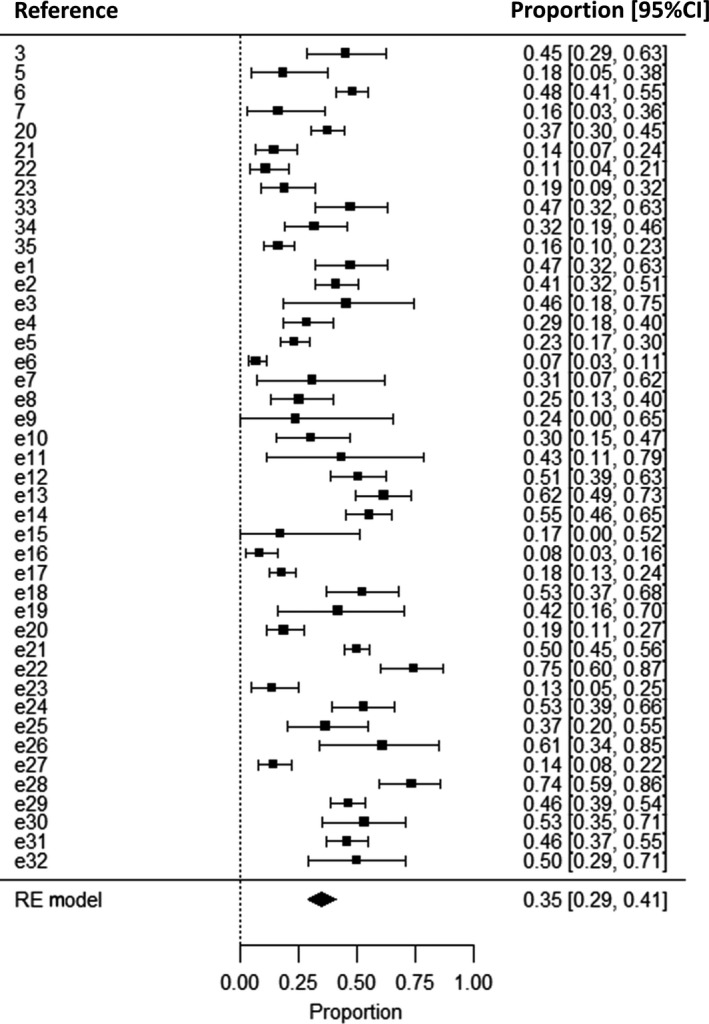
Overall, 35% (95% confidence interval, 29-41%) of individuals (n = 3311) were refractory. There was marked heterogeneity between studies. Seizures recurred in 78% (95% confidence interval, 52-94%) of individuals who attempted to withdraw from treatment after a period of seizure freedom (n = 246). Seizure outcome by publication year suggested that prognosis did not improve over time. Meta-analysis suggested six variables as prognostic factors for refractoriness, i.e. having three seizure types, absence seizures, psychiatric comorbidities, earlier age at seizure onset, history of childhood absence epilepsy and praxis-induced seizures.
One-third of people with JME were refractory, which is a higher prevalence than expected. Risk factors were identified and can be used to guide treatment and counselling of people with JME.
青少年肌阵挛癫痫(JME)是一种常见的癫痫综合征,通常认为其治疗反应良好。我们旨在确定 JME 耐药的患病率和预后危险因素。
我们系统地检索了 PubMed 和 EMBASE,并纳入了 43 项符合条件的研究,这些研究报告了 JME 队列中抗癫痫药物(AED)治疗后的发作结果。我们将难治性 JME 定义为尽管进行了 AED 治疗,但仍存在任何发作,并进行了随机效应荟萃分析,以评估在癫痫得到良好控制的个体中,AED 停药后癫痫复发和难治性 JME 的患病率。报告与发作结果相关的潜在预后危险因素的研究被纳入随后的耐药危险因素荟萃分析。
总体而言,35%(95%置信区间,29-41%)的个体(n=3311)耐药。研究之间存在显著的异质性。在尝试停药后,246 名发作自由的个体中有 78%(95%置信区间,52-94%)癫痫复发。按发表年份的发作结果表明,预后并未随时间改善。荟萃分析表明,有六个变量是耐药的预后因素,即有三种发作类型、失神发作、精神共病、发病年龄较早、儿童失神性癫痫史和动作诱发性发作。
三分之一的 JME 患者耐药,这一患病率高于预期。确定了危险因素,可用于指导 JME 患者的治疗和咨询。