Neuroassessment Group, KEMRI-Wellcome Trust Research Programme, Center for Geographic Medicine Research (Coast), Kilifi, Kenya.
Department of Psychiatry, University of Oxford, Oxford, UK.
BMJ Open. 2018 Sep 17;8(9):e023914. doi: 10.1136/bmjopen-2018-023914.
Our aim was to compare the neurocognitive performance and mental health outcome of adults living with HIV on antiretroviral therapy with that of community controls, all of low literacy. Furthermore, we also wanted to explore the relationship of these outcomes with quality of life among adults living with HIV.
This was a descriptive cross-sectional study.
The study was conducted in Kilifi County, a region located at the Kenyan coast.
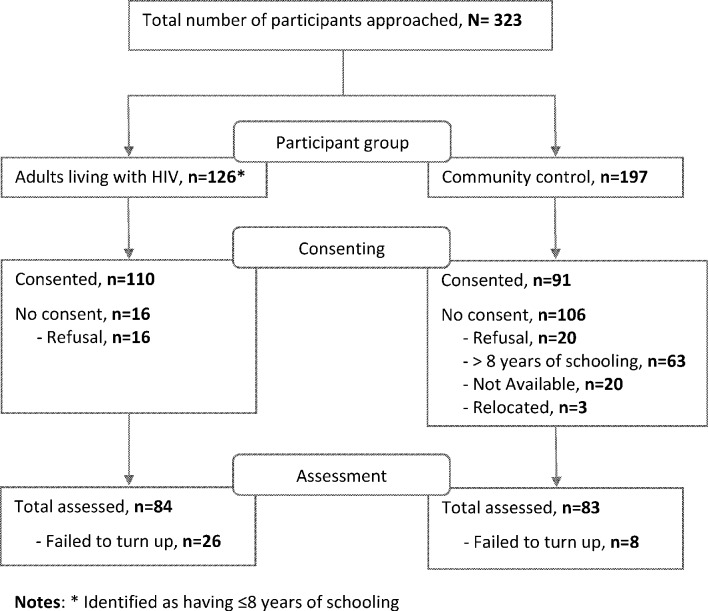
The participants consisted of a consecutive sample of 84 adults living with HIV and 83 randomly selected community controls all with ≤8 years of schooling. All participants were assessed for non-verbal intelligence, verbal working memory and executive functioning. The Major Depression Inventory and a quality of life measure (RAND SF-36) were also administered.
Using analysis of covariance, we found no statistically significant group differences between adults living with HIV and community controls in all the neurocognitive tests except for a marginal difference in the non-verbal intelligence test (F (1, 158)=3.83, p=0.05). However, depressive scores of adults living with HIV were significantly higher than those of controls (F (1, 158)=11.56, p<0.01). Also, quality of life scores of adults living with HIV were significantly lower than those of controls (F (1, 158)=4.62, p=0.03). For the HIV-infected group, results from multivariable linear regression analysis showed that increasing depressive scores were significantly associated with poorer quality of life (β=-1.17, 95% CI -1.55 to -0.80; p<0.01).
Our findings suggest that adults of low-literacy levels living with HIV and on antiretroviral medication at the Kenyan coast do not have significant cognitive deficits compared with their uninfected counterparts. However, their mental health, compared with that of HIV-uninfected adults, remains poorer and their quality of life may deteriorate when HIV and depressive symptoms co-occur.
我们旨在比较接受抗逆转录病毒治疗的艾滋病毒感染者与社区对照者(均为低文化程度)的神经认知表现和心理健康结局。此外,我们还想探讨这些结局与艾滋病毒感染者生活质量之间的关系。
这是一项描述性的横断面研究。
该研究在肯尼亚沿海的基利菲县进行。
参与者包括连续入选的 84 名艾滋病毒感染者和 83 名随机选择的社区对照者,他们的受教育年限均≤8 年。所有参与者都接受了非言语智力、言语工作记忆和执行功能的评估。还进行了主要抑郁量表和生活质量量表(RAND SF-36)的评估。
使用协方差分析,我们发现除非言语智力测试有边缘性差异(F (1, 158)=3.83, p=0.05)外,艾滋病毒感染者和社区对照者在所有神经认知测试中均无统计学显著的组间差异。然而,艾滋病毒感染者的抑郁评分显著高于对照组(F (1, 158)=11.56, p<0.01)。此外,艾滋病毒感染者的生活质量评分显著低于对照组(F (1, 158)=4.62, p=0.03)。对于 HIV 感染者组,多变量线性回归分析的结果表明,抑郁评分增加与生活质量下降显著相关(β=-1.17, 95%置信区间 -1.55 至 -0.80; p<0.01)。
我们的发现表明,肯尼亚沿海地区接受抗逆转录病毒药物治疗的低文化程度艾滋病毒感染者与未感染者相比,认知功能没有显著缺陷。然而,与未感染 HIV 的成年人相比,他们的心理健康状况仍然较差,当 HIV 和抑郁症状同时存在时,他们的生活质量可能会恶化。