Kunneman Marleen, Branda Megan E, Hargraves Ian, Pieterse Arwen H, Montori Victor M
Knowledge and Evaluation Research Unit, Mayo Clinic, Rochester, MN.
Department of Medical Decision Making, Leiden University Medical Center, Leiden, the Netherlands.
Mayo Clin Proc Innov Qual Outcomes. 2018 Feb 1;2(1):60-68. doi: 10.1016/j.mayocpiqo.2017.12.002. eCollection 2018 Mar.
To assess the extent to which (1) clinicians, using or not using conversation aids, foster choice awareness during clinical encounters and (2) fostering choice awareness, with or without conversation aids, is associated with greater patient involvement in shared decision making (SDM).
We randomly selected 100 video-recorded encounters, stratified by topic and study arm, from a database of 10 clinical trials of SDM interventions in 7 clinical contexts: low-risk acute chest pain, stable angina, diabetes, depression, osteoporosis, and Graves disease. Reviewers, unaware of our hypothesis, coded recordings with the OPTION-12 scale to quantify the extent to which clinicians involved patients in decision making (SDM, 0-100 score). Blinded to OPTION-12 scale scores, we used a self-developed coding scale to code whether and how choice awareness was fostered.
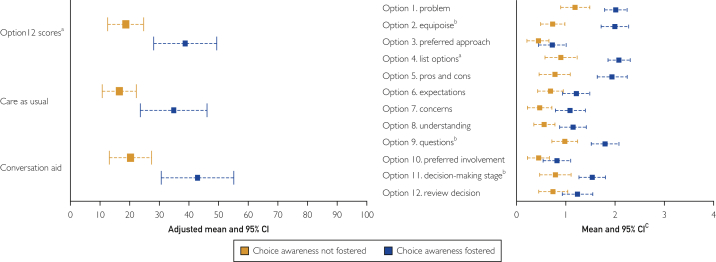
Clinicians fostered choice awareness in 53 of 100 encounters. Fostering choice awareness was associated with a higher OPTION-12 scale score (adjusted [for using vs not using a conversation aid] predicted mean difference, 20; 95% CI, 11-29). Using a conversation aid was associated with a higher, nonsignificant chance of fostering choice awareness (N=31 of 50 [62%] vs N=22 of 50 [44%]; adjusted [for trial] =.34) and with a higher OPTION-12 scale score, although adjusting for fostering choice awareness mitigated this effect (adjusted predicted mean difference 5.8; 95% CI, -1.3-12.8).
Fostering choice awareness is linked to a better execution of other SDM steps, such as informing patients or discussing preferences, even when SDM tools are not available or not used.
评估(1)使用或不使用沟通辅助工具的临床医生在临床诊疗过程中促进选择意识的程度,以及(2)无论有无沟通辅助工具,促进选择意识是否与患者更多地参与共同决策(SDM)相关。
我们从7种临床情境下的10项SDM干预临床试验数据库中,按主题和研究组分层,随机选取100次视频记录的诊疗过程,这些临床情境包括:低风险急性胸痛、稳定型心绞痛、糖尿病、抑郁症、骨质疏松症和格雷夫斯病。对假设不知情的评审人员使用OPTION - 12量表对记录进行编码,以量化临床医生让患者参与决策的程度(SDM,0 - 100分)。在对OPTION - 12量表评分不知情的情况下,我们使用自行开发的编码量表对是否以及如何促进选择意识进行编码。
在100次诊疗过程中,临床医生在53次诊疗中促进了选择意识。促进选择意识与更高的OPTION - 12量表评分相关(调整后[使用与未使用沟通辅助工具]预测平均差异为20;95%置信区间,11 - 29)。使用沟通辅助工具与促进选择意识的可能性更高但无统计学意义相关(50例中有31例[62%] vs 50例中有22例[44%];调整后[按试验] = 0.34),并且与更高的OPTION - 12量表评分相关,尽管在调整促进选择意识后这种效应有所减轻(调整后预测平均差异为5.8;95%置信区间,-1.3 - 12.8)。
促进选择意识与更好地执行其他SDM步骤相关,例如告知患者或讨论偏好,即使在没有SDM工具或未使用SDM工具的情况下也是如此。