Dartmouth Institute for Health Policy and Clinical Practice, Dartmouth College, Lebanon, New Hampshire.
UMR 1027 Team EQUITY, Paul Sabatier University, Toulouse, France.
Cancer. 2021 Feb 1;127(3):422-436. doi: 10.1002/cncr.33248. Epub 2020 Nov 10.
Women of lower socioeconomic status (SES) with early-stage breast cancer are more likely to report poorer physician-patient communication, lower satisfaction with surgery, lower involvement in decision making, and higher decision regret compared to women of higher SES. The objective of this study was to understand how to support women across socioeconomic strata in making breast cancer surgery choices.
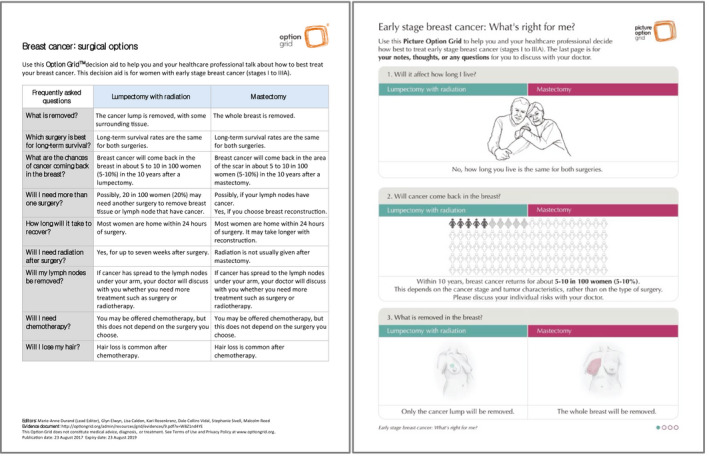
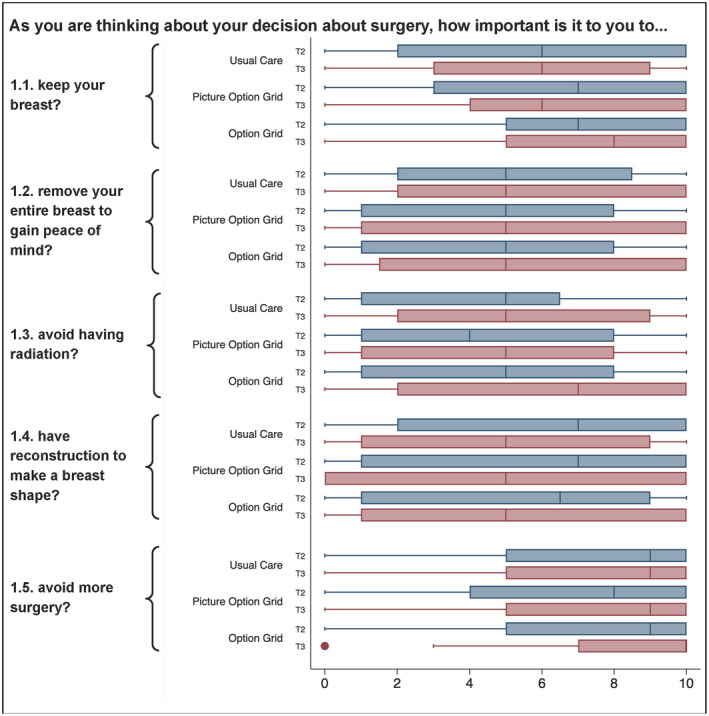
We conducted a 3-arm (Option Grid, Picture Option Grid, and usual care), multisite, randomized controlled superiority trial with surgeon-level randomization. The Option Grid (text only) and Picture Option Grid (pictures plus text) conversation aids were evidence-based summaries of available breast cancer surgery options on paper. Decision quality (primary outcome), treatment choice, treatment intention, shared decision making (SDM), anxiety, quality of life, decision regret, and coordination of care were measured from T0 (pre-consultation) to T5 (1-year after surgery.
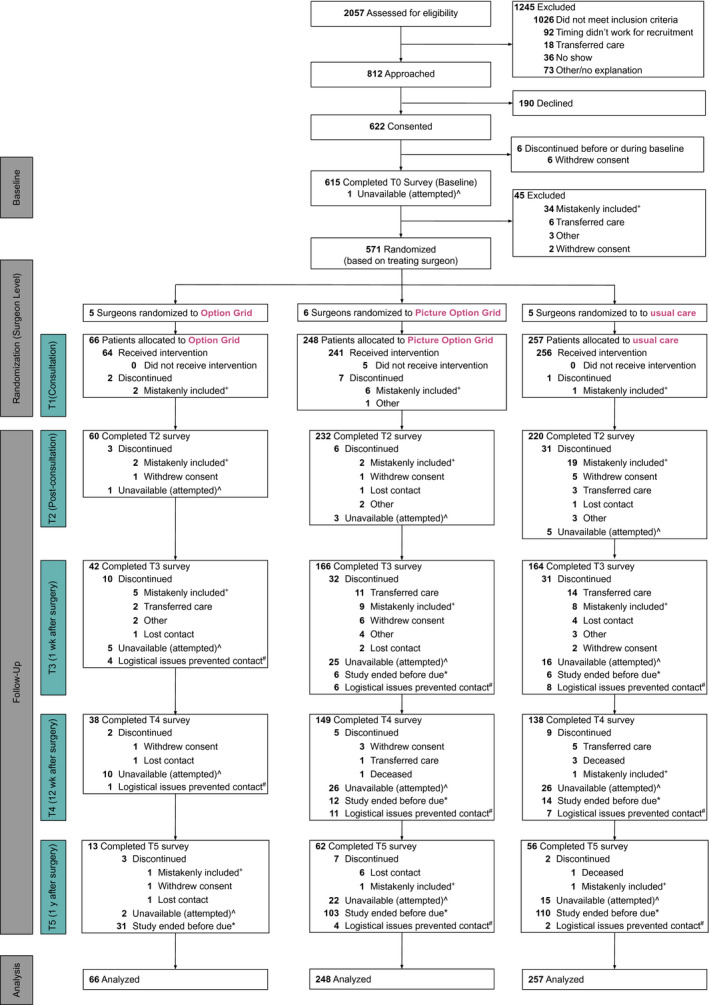
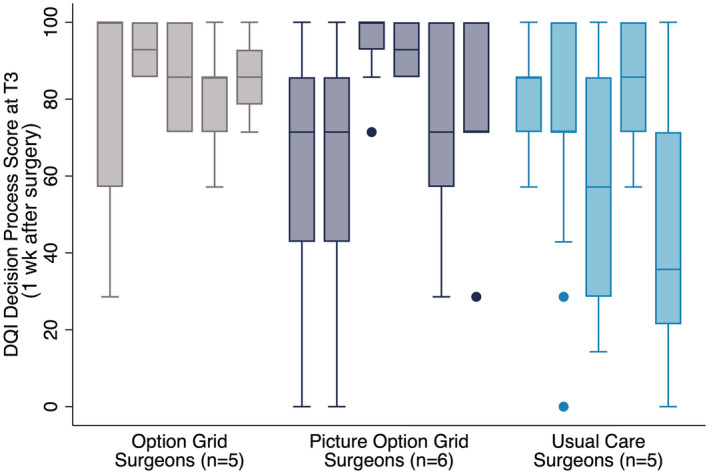
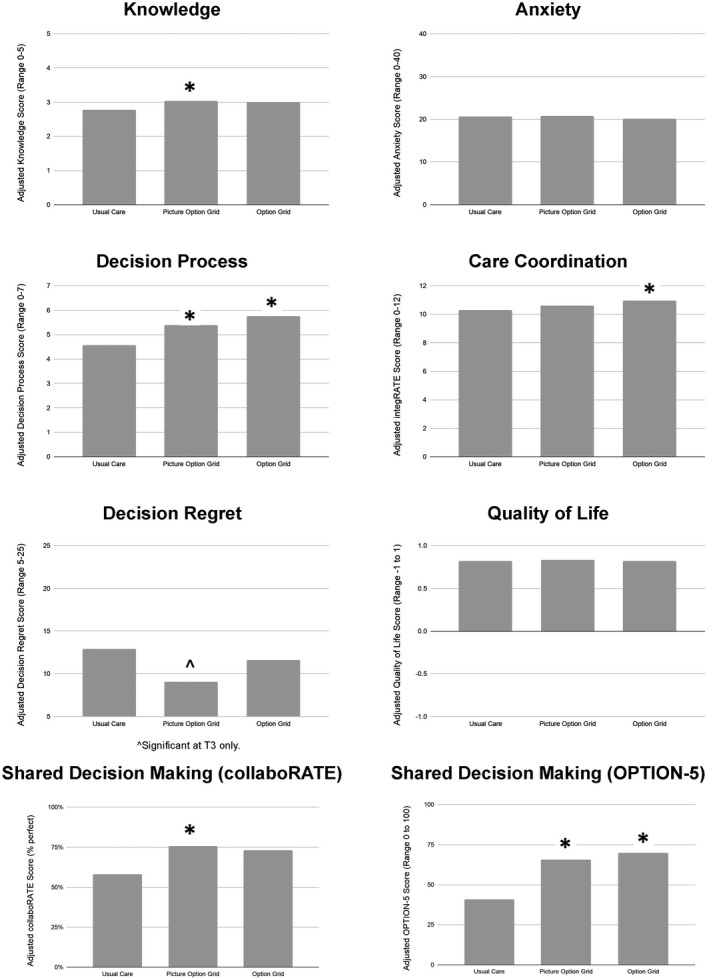
Sixteen surgeons saw 571 of 622 consented patients. Patients in the Picture Option Grid arm (n = 248) had higher knowledge (immediately after the visit [T2] and 1 week after surgery or within 2 weeks of the first postoperative visit [T3]), an improved decision process (T2 and T3), lower decision regret (T3), and more SDM (observed and self-reported) compared to usual care (n = 257). Patients in the Option Grid arm (n = 66) had higher decision process scores (T2 and T3), better coordination of care (12 weeks after surgery or within 2 weeks of the second postoperative visit [T4]), and more observed SDM (during the surgical visit [T1]) compared to usual care arm. Subgroup analyses suggested that the Picture Option Grid had more impact among women of lower SES and health literacy. Neither intervention affected concordance, treatment choice, or anxiety.
Paper-based conversation aids improved key outcomes over usual care. The Picture Option Grid had more impact among disadvantaged patients.
The objective of this study was to understand how to help women with lower incomes or less formal education to make breast cancer surgery choices. Compared with usual care, a conversation aid with pictures and text led to higher knowledge. It improved the decision process and shared decision making (SDM) and lowered decision regret. A text-only conversation aid led to an improved decision process, more coordinated care, and higher SDM compared to usual care. The conversation aid with pictures was more helpful for women with lower income or less formal education. Conversation aids with pictures and text helped women make better breast cancer surgery choices.
与社会经济地位较高的女性相比,处于较低社会经济地位的早期乳腺癌女性更有可能报告较差的医患沟通、对手术的满意度较低、参与决策程度较低、决策后后悔程度较高。本研究的目的是了解如何支持不同社会经济阶层的女性做出乳腺癌手术选择。
我们进行了一项 3 臂(选项网格、图片选项网格和常规护理)、多地点、随机对照优势试验,采用外科医生级别的随机分组。选项网格(仅文本)和图片选项网格(图片加文本)对话辅助工具是基于证据的乳腺癌手术选择摘要,以纸质形式呈现。决策质量(主要结果)、治疗选择、治疗意向、共享决策(SDM)、焦虑、生活质量、决策后悔和护理协调从 T0(咨询前)测量到 T5(手术后 1 年)。
16 名外科医生为 622 名同意参与的患者中的 571 名患者提供了治疗。图片选项网格组(n=248)的患者在知识方面更高(就诊后即刻[T2]和手术后 1 周或首次术后就诊后 2 周内[T3]),决策过程改善(T2 和 T3),决策后悔降低(T3),SDM 更多(观察和自我报告)与常规护理(n=257)相比。选项网格组(n=66)的患者在决策过程评分方面更高(T2 和 T3),护理协调更好(术后 12 周或第二次术后就诊后 2 周内[T4]),观察到的 SDM 更多(手术就诊期间[T1])与常规护理组相比。亚组分析表明,图片选项网格对社会经济地位较低和健康素养较低的女性影响更大。两种干预措施都没有影响一致性、治疗选择或焦虑。
基于纸质的对话辅助工具比常规护理更能改善关键结果。图片选项网格对弱势患者的影响更大。