The Second Department of Breast Surgery, Tangshan People's Hospital, Tangshan, Hebei 063000, P.R. China.
The Second Department of Chemoradiotherapy, Tangshan People's Hospital, Tangshan, Hebei 063000, P.R. China.
Int J Mol Med. 2018 Nov;42(5):2343-2352. doi: 10.3892/ijmm.2018.3842. Epub 2018 Aug 27.
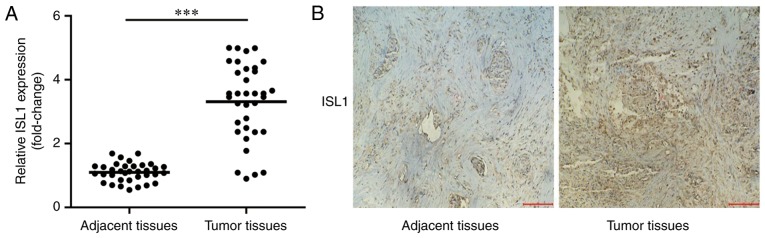
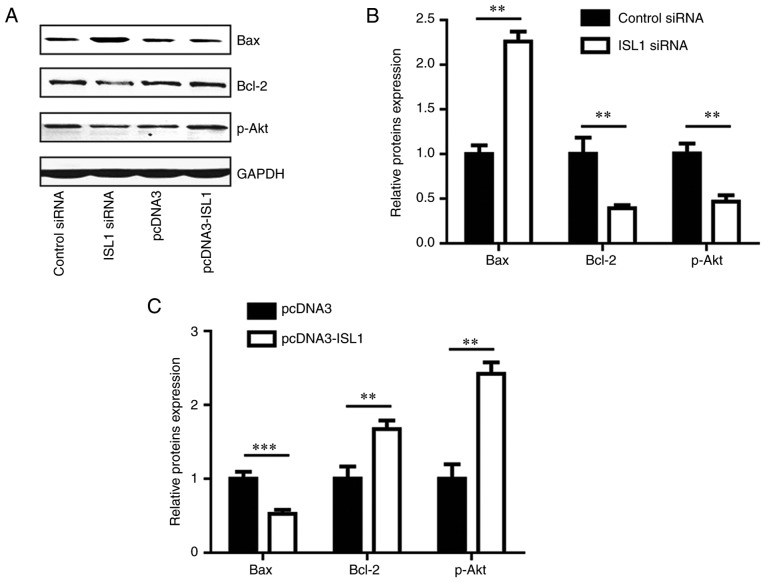
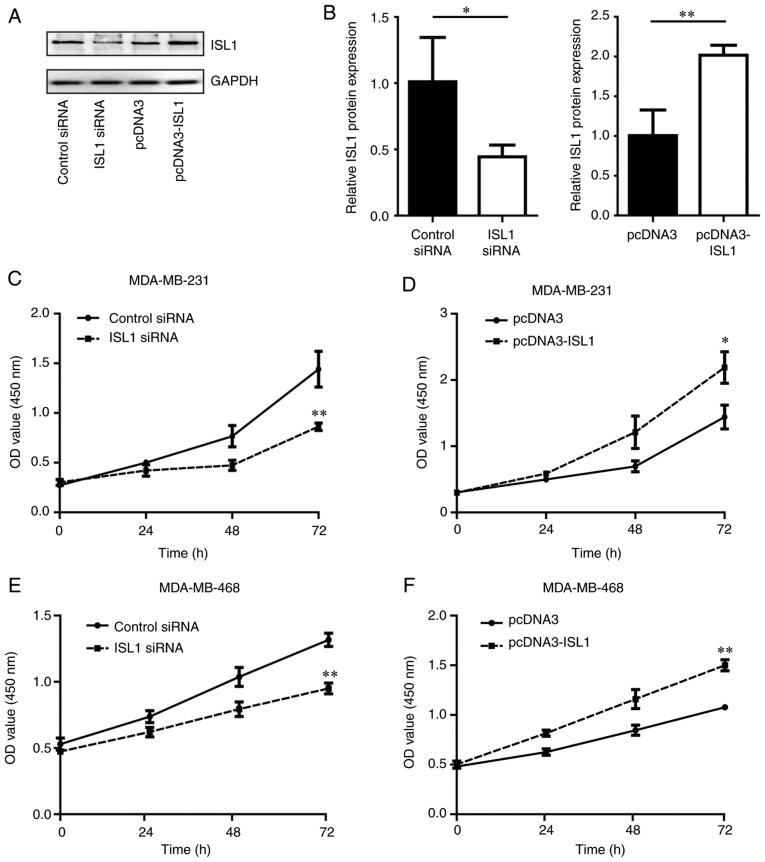
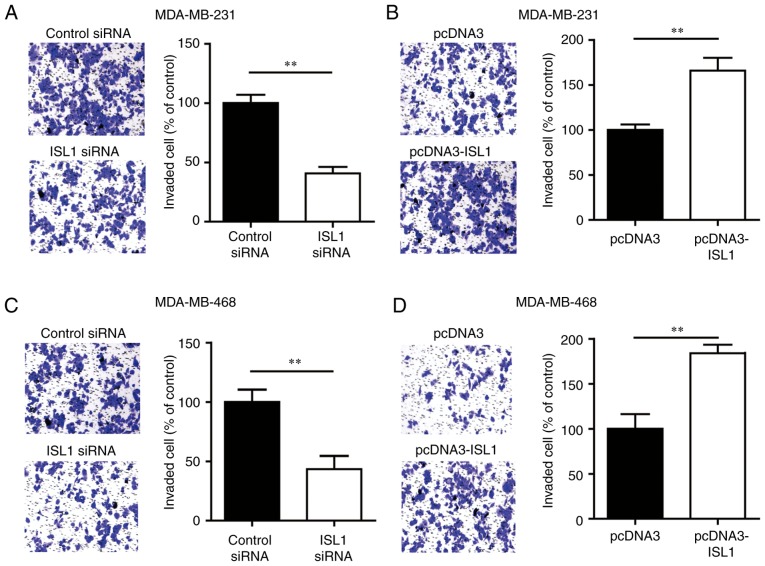
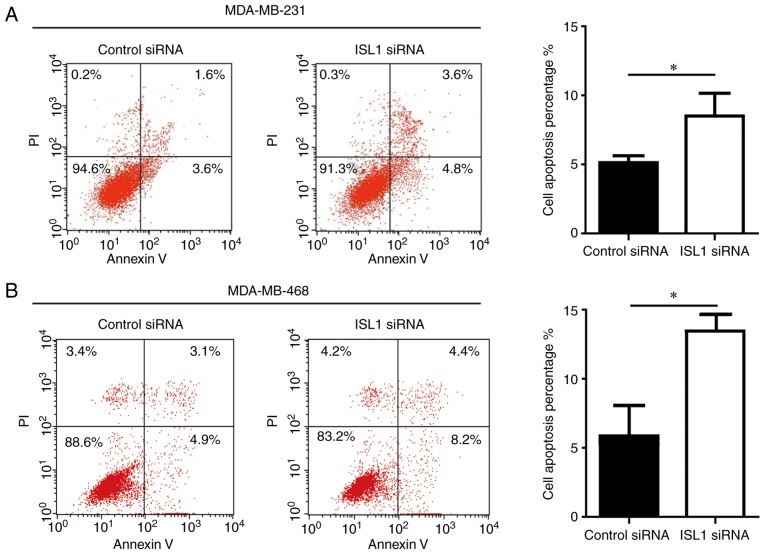
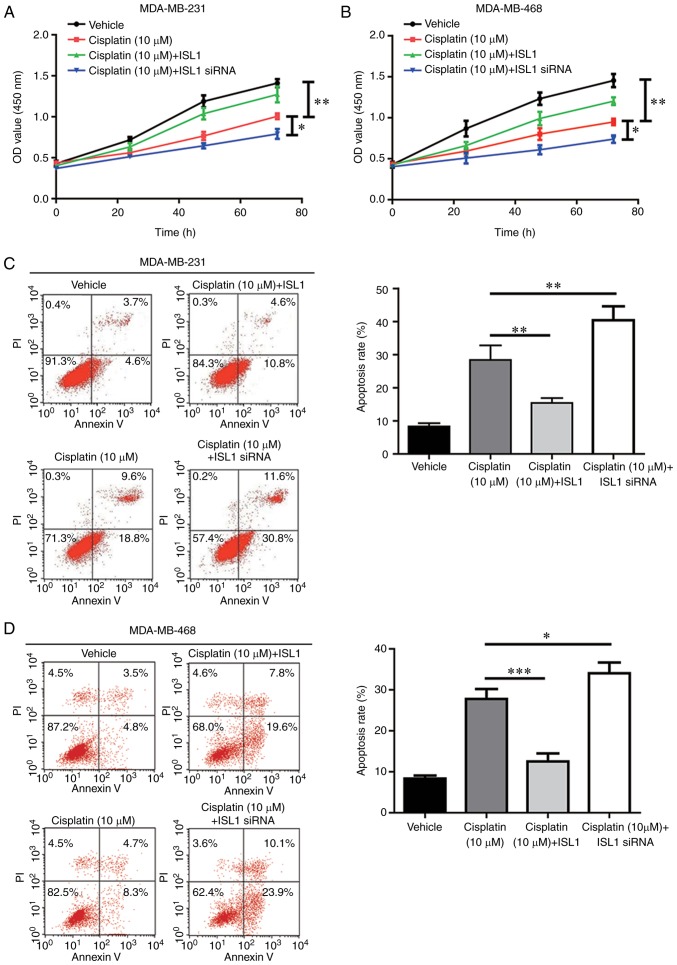
Triple‑negative breast cancer (TNBC) is a type of breast cancer that is characterized by the lack of expression of estrogen and progesterone receptors, and epidermal growth factor receptor 2. Therefore, there is an absence of a specific target for effective therapy in TNBC. Cisplatin is usually employed as a first‑line chemotherapy agent for patients with TNBC. However, resistance remains an obstacle for cisplatin‑based chemotherapy, due to its elusive underlying mechanism. Previously, abnormal expression of Islet 1 (ISL1) was demonstrated to be closely associated with cancer development and progression. The present study revealed that (ISL1) was significantly upregulated in TNBC tissues in comparison with adjacent normal tissues. Overexpression of ISL1 markedly promoted the proliferation and invasion of the TNBC MDA‑MB‑231 and MDA‑MB‑468 cell lines, while knockdown of ISL1 inhibited cell invasion and proliferation in these cell lines. In addition, overexpression of ISL1 reversed cisplatin‑induced cell apoptosis, while knockdown of ISL1 enhanced apoptosis following cisplatin treatment in MDA‑MB‑231 and MDA‑MB‑468 cells. Furthermore, the levels of the anti‑apoptotic proteins, phosphorylated‑protein kinase B and B‑cell lymphoma‑2 (Bcl‑2), were significantly decreased, while the levels of the pro‑apoptotic protein Bcl‑2‑associated X protein were remarkably increased in response to cisplatin treatment. The present study revealed that ISL1 overexpression reversed the protein expression profile of p‑Akt, Bcl‑2 and Bax, while ISL1 knockdown promoted cell apoptosis. Therefore, the data of the present study demonstrated that ISL1 contributes to TNBC progression and reverses cell sensitivity towards cisplatin in TNBC cells, suggesting that ISL1 is a potential therapeutic target for the treatment of TNBC.
三阴性乳腺癌(TNBC)是一种乳腺癌,其特征是缺乏雌激素和孕激素受体以及表皮生长因子受体 2 的表达。因此,在 TNBC 中缺乏有效的治疗靶点。顺铂通常被用作 TNBC 患者的一线化疗药物。然而,由于其潜在机制难以捉摸,耐药性仍然是顺铂为基础的化疗的障碍。先前的研究表明,胰岛 1(ISL1)的异常表达与癌症的发生和发展密切相关。本研究表明,与相邻正常组织相比,TNBC 组织中(ISL1)明显上调。ISL1 的过表达显著促进了 TNBC MDA-MB-231 和 MDA-MB-468 细胞系的增殖和侵袭,而 ISL1 的敲低抑制了这些细胞系中的细胞侵袭和增殖。此外,ISL1 的过表达逆转了顺铂诱导的细胞凋亡,而 ISL1 的敲低增强了 MDA-MB-231 和 MDA-MB-468 细胞中顺铂处理后的细胞凋亡。此外,抗凋亡蛋白磷酸化蛋白激酶 B 和 B 细胞淋巴瘤-2(Bcl-2)的水平显著降低,而促凋亡蛋白 Bcl-2 相关 X 蛋白的水平显著升高,对顺铂处理有反应。本研究表明,ISL1 的过表达逆转了 p-Akt、Bcl-2 和 Bax 的蛋白表达谱,而 ISL1 的敲低促进了细胞凋亡。因此,本研究的数据表明,ISL1 促进 TNBC 的进展,并逆转 TNBC 细胞对顺铂的敏感性,提示 ISL1 是治疗 TNBC 的潜在治疗靶点。