Jahangir Zainab, Bakillah Ahmed, Iqbal Jahangir
John P. Stevens High School, North Edison, NJ 08820, USA.
King Abdullah International Medical Research Center, Ministry of National Guard Health Affairs, Al Ahsa 31982, Saudi Arabia.
Diseases. 2018 Sep 17;6(3):82. doi: 10.3390/diseases6030082.
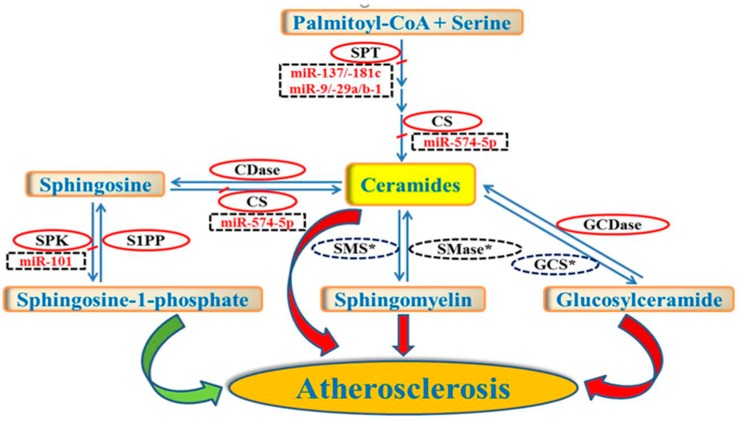
The rapidly expanding field of bioactive lipids is exemplified by the many sphingolipids, which are structurally and functionally diverse molecules with significant physiologic functions. These sphingolipids are main constituents of cellular membranes and have been found associated with plasma lipoproteins, and their concentrations are altered in several metabolic disorders such as atherosclerosis, obesity, and diabetes. Understanding the mechanisms that regulate their biosynthesis and secretion may provide novel information that might be amenable to therapeutic targeting in the treatment of these diseases. Several sphingolipid synthesis genes have been targeted as potential therapeutics for atherosclerosis. In recent years, significant progress has been made in studying the role of microRNAs (miRNAs) in lipid metabolism. However, little effort has been made to investigate their role in sphingolipid metabolism. Sphingolipid biosynthetic pathways involve various enzymes that lead to the formation of several key molecules implicated in atherosclerosis, and the identification of miRNAs that regulate these enzymes could help us to understand these complex pathways better and may prove beneficial in alleviating atherosclerosis.
生物活性脂质这一迅速发展的领域以众多鞘脂为代表,鞘脂是结构和功能多样的分子,具有重要的生理功能。这些鞘脂是细胞膜的主要成分,已发现与血浆脂蛋白有关,并且它们的浓度在诸如动脉粥样硬化、肥胖症和糖尿病等多种代谢紊乱中会发生改变。了解调节其生物合成和分泌的机制可能会提供新的信息,这些信息可能适用于这些疾病治疗中的治疗靶点。几种鞘脂合成基因已被作为动脉粥样硬化的潜在治疗靶点。近年来,在研究微小RNA(miRNA)在脂质代谢中的作用方面取得了重大进展。然而,在研究它们在鞘脂代谢中的作用方面所做的工作很少。鞘脂生物合成途径涉及多种酶,这些酶导致形成几种与动脉粥样硬化有关的关键分子,鉴定调节这些酶的miRNA可以帮助我们更好地理解这些复杂途径,并且可能证明对减轻动脉粥样硬化有益。