Sakeah Evelyn, Debpuur Cornelius, Oduro Abraham Rexford, Welaga Paul, Aborigo Raymond, Sakeah James Kotuah, Moyer Cheryl A
Navrongo Health Research Centre, Post Office Box 114, Navrongo, Upper East Region, Ghana.
Department of Medicine, University of Calgary, Calgary, AB, Canada.
BMC Womens Health. 2018 Sep 18;18(1):150. doi: 10.1186/s12905-018-0643-8.
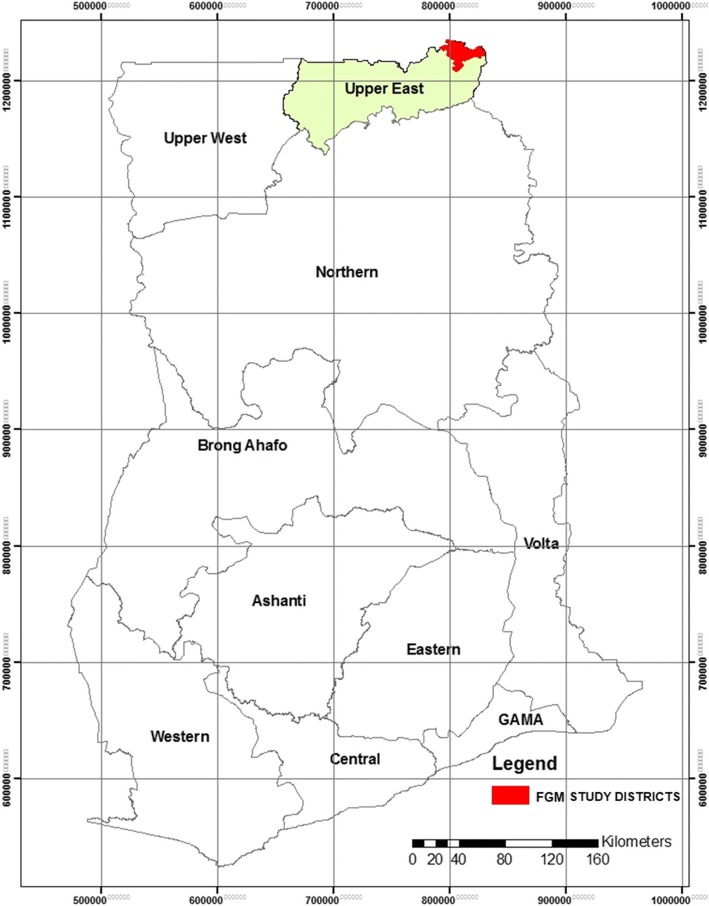
Globally, three million girls are at risk of female genital mutilation (FGM) and an estimated 200 million girls and women in the world have undergone FGM. While the overall prevalence of FGM in Ghana is 4%, studies have shown that the overall prevalence in the Upper East Region is 38%, with Bawku municipality recording the highest at 82%.
This study used a cross-sectional design with a quantitative approach: a survey with women of reproductive age (15-49).
Among all respondents, 830 women who participated in the study, 61% reported having undergone FGM. Of those circumcised, 66% indicated their mothers influenced it. Three quarters of the women think FGM could be stopped through health education. Women who live in the Pusiga district (AOR: 1.66; 95% CI: 1.16-2.38), are aged 35-49 (AOR: 4.24; 95% CI: 2.62-6.85), and have no formal education (AOR: 2.78; 95% CI: 1.43-5.43) or primary education (AOR: 2.10; 95% CI: 1.03-4.31) were more likely to be circumcised relative to those who reside in Bawku Municipal, are aged 15-24, and had tertiary education. Likewise, married women (AOR: 3.82; 95% CI: 2.53-5.76) were more likely to have been circumcised compared with unmarried women. At a site-specific level, factors associated with FGM included age and marital status in Bawku, and age, marital status, and women's education in Pusiga.
Female Genital Mutilation is still being practiced in the Bawku Municipality and the Pusiga District of northern Ghana, particularly among women with low socio-economic status. Implementing interventions that would provide health education to communities and promote girl-child education beyond the primary level could help end the practice.
在全球范围内,300万女孩面临女性生殖器切割(FGM)的风险,据估计,全球有2亿女孩和妇女经历过女性生殖器切割。虽然加纳女性生殖器切割的总体患病率为4%,但研究表明,上东部地区的总体患病率为38%,其中巴库市的患病率最高,为82%。
本研究采用横断面设计和定量方法:对育龄妇女(15 - 49岁)进行调查。
在所有参与研究的830名女性受访者中,61%报告称经历过女性生殖器切割。在接受切割的人中,66%表示是受母亲的影响。四分之三的女性认为可以通过健康教育来停止女性生殖器切割。居住在普西加区的女性(调整后比值比:1.66;95%置信区间:1.16 - 2.38)、年龄在35 - 49岁的女性(调整后比值比:4.24;95%置信区间:2.62 - 6.85)以及未接受过正规教育(调整后比值比:2.78;95%置信区间:1.43 - 5.43)或仅接受过小学教育(调整后比值比:2.10;95%置信区间:1.03 - 4.31)的女性,相对于居住在巴库市、年龄在15 - 24岁且接受过高等教育的女性,更有可能接受过切割。同样,已婚女性(调整后比值比:3.82;95%置信区间:2.53 - 5.76)比未婚女性更有可能接受过切割。在特定地点层面,与女性生殖器切割相关的因素在巴库包括年龄和婚姻状况,在普西加包括年龄、婚姻状况和女性教育程度。
在加纳北部的巴库市和普西加区,女性生殖器切割仍在实行,特别是在社会经济地位较低的女性中。实施向社区提供健康教育并促进女童接受小学以上教育的干预措施,可能有助于终止这种做法。