
黑暗人格三联征和框架效应可预测单次囚徒困境中的自私行为。
The Dark Triad and framing effects predict selfish behavior in a one-shot Prisoner's Dilemma.
机构信息
Department of Psychology, Skidmore College, Saratoga Springs, New York, United States of America.
出版信息
PLoS One. 2018 Sep 19;13(9):e0203891. doi: 10.1371/journal.pone.0203891. eCollection 2018.
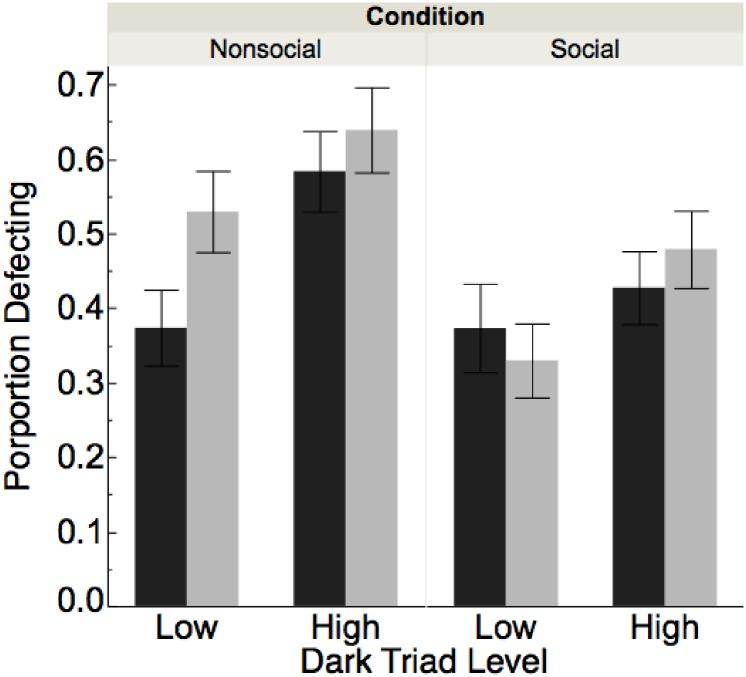
What causes us to display selfish behaviors? We explored the extent to which Dark Triad traits (sub-clinical psychopathy, narcissism, and Machiavellianism) support a selfish behavioral strategy. We related performance on a hypothetical Prisoner's Dilemma (an economic game that simulates a two-person social dilemma) to participants' (N = 1400) Dark Triad scores. Because contextual factors also impact selfish behaviors, we tested how framing (gain vs. loss; and social vs. nonsocial) shaped performance in the Prisoner's Dilemma. Participants with high Dark Triad scores were more likely to behave selfishly in the Prisoner's Dilemma. Participants were also most likely to betray their partner in loss-framed and non-socially framed contexts. These effects did not interact with Dark Triad scores. Our data are consistent with the view that seemingly negative personality traits (like those associated with the Dark Triad traits) that persist in the population may serve as evolutionarily adaptive behavioral strategies.
是什么导致我们表现出自私行为?我们探讨了黑暗人格特质(亚临床心理变态、自恋和马基雅维利主义)在多大程度上支持自私的行为策略。我们将参与者(N=1400)的黑暗人格特质得分与他们在囚徒困境(一种模拟两人社会困境的经济游戏)中的表现联系起来。因为背景因素也会影响自私行为,我们测试了框架(收益与损失;以及社会与非社会)如何影响囚徒困境中的表现。黑暗人格特质得分高的参与者在囚徒困境中更有可能表现出自私行为。参与者在损失框架和非社会框架中最有可能背叛他们的伙伴。这些影响与黑暗人格特质得分没有相互作用。我们的数据与这样一种观点一致,即在人群中持续存在的看似负面的人格特质(如与黑暗人格特质相关的特质)可能是进化上适应性的行为策略。

 Zotero 插件