Lores Luis, Monje Alfonso, Bergada Manel, Arellano Elisabeth, Rodríguez-Larrea Julian, Miravitlles Marc
Pneumology Department, Hospital General Parc Sanitari Sant Joan de Déu, Sant Boi de Llobregat, Barcelona, Spain.
Mental Health Services, Parc Sanitari Sant Joan de Déu, Sant Boi de Llobregat, Barcelona, Spain.
Int J Chron Obstruct Pulmon Dis. 2018 Sep 7;13:2797-2804. doi: 10.2147/COPD.S165880. eCollection 2018.
Psychiatric patients present an elevated rate of smoking, and the smoking habit is related to a high morbidity and mortality in this collective. The aim of this study was to determine the prevalence of smoking in patients admitted for psychiatric disorders and its relationship with respiratory disease, the prevalence of COPD, and alterations in the quality of life.
A cross-sectional, observational study was conducted and detailed information on smoking and respiratory symptomatology was obtained. The study participants underwent the following tests: spirometry with bronchodilator test, Fagerström test, determination of physical activity using the LCADL questionnaire, and evaluation of quality of life with the EuroQoL-5 Dimensions EQ-5D questionnaire.
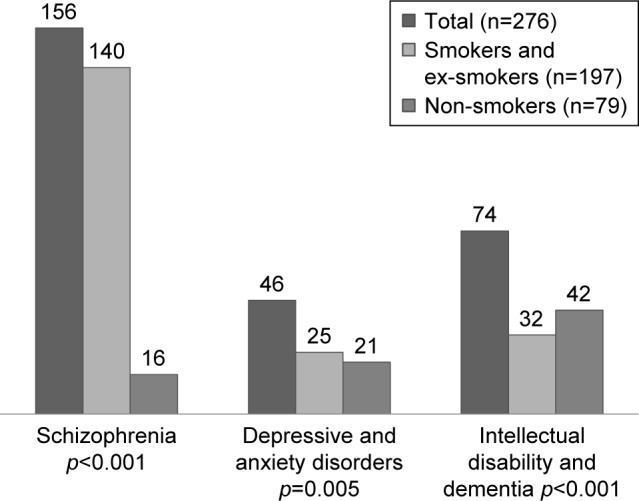
Two hundred seventy-six patients (mean age 56.8 years) were included: 155 with schizophrenia (87.7% smokers), 46 with depressive or anxiety disorders (54.3% smokers), and 49 and 25 with intellectual disability and dementia (43.2% smokers), respectively. The mean Fagerström test score was 5.75 points. Smokers presented with cough (47.6%), expectoration (41.4%), and chronic bronchitis (36.6%). The prevalence of COPD in the total population was 28.9%. The EQ-5D and LCADL scores were better in smokers because of their younger age and lesser psychiatric involvement. A high prevalence of smoking was observed in the psychiatric population studied, and 28.9% were diagnosed with COPD.
Smokers presented many more respiratory symptoms and chronic bronchitis but did not present a worse quality of life or physical activity due to their younger age and milder psychiatric involvement.
精神病患者的吸烟率较高,且这种吸烟习惯与该群体的高发病率和高死亡率相关。本研究的目的是确定因精神疾病入院患者的吸烟率及其与呼吸系统疾病、慢性阻塞性肺疾病(COPD)患病率以及生活质量改变之间的关系。
进行了一项横断面观察性研究,并获取了有关吸烟和呼吸道症状的详细信息。研究参与者接受了以下测试:支气管扩张试验后的肺功能测定、法格斯特罗姆测试、使用LCADL问卷确定身体活动情况以及使用欧洲五维健康量表(EuroQoL-5 Dimensions,EQ-5D)问卷评估生活质量。
纳入了276名患者(平均年龄56.8岁):155名精神分裂症患者(吸烟者占87.7%),46名抑郁或焦虑症患者(吸烟者占54.3%),以及分别有49名和25名智力残疾和痴呆患者(吸烟者占43.2%)。法格斯特罗姆测试的平均得分为5.75分。吸烟者出现咳嗽(47.6%)、咳痰(41.4%)和慢性支气管炎(36.6%)。总体人群中COPD的患病率为28.9%。由于吸烟者年龄较小且精神疾病程度较轻,其EQ-5D和LCADL评分较好。在所研究的精神病人群中观察到吸烟率较高,且28.9%的人被诊断患有COPD。
吸烟者出现更多的呼吸道症状和慢性支气管炎,但由于其年龄较小且精神疾病较轻,并未表现出更差的生活质量或身体活动水平。