Noh Yoojin, Lee Sukhyang, Shin Sooyoung
Department of Clinical Pharmacy, College of Pharmacy, Ajou University, Yeongtong-gu, Suwon, Republic of Korea,
Research Institute of Pharmaceutical Science and Technology (RIPST), Ajou University, Yeongtong-gu, Suwon, Republic of Korea,
Ther Clin Risk Manag. 2018 Sep 3;14:1563-1571. doi: 10.2147/TCRM.S169964. eCollection 2018.
As newly available antidiabetic drugs (ADs) are used more commonly as initial hypoglycemic choice for early stage diabetes patients, there is an urgent need to investigate how these agents may differ in treatment durability relative to metformin. This study aimed to investigate the incidence and risk of treatment adjustment among newly treated type 2 diabetes mellitus (T2DM) patients receiving an oral AD as initial monotherapy.
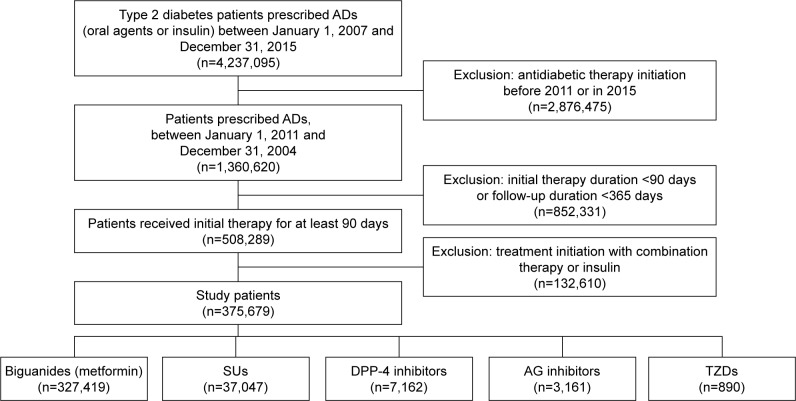
T2DM patients registered in the National Health Insurance Program who were newly prescribed an oral AD were identified. Time to treatment addition or switch to alternative antidiabetic therapy was determined using the Kaplan-Meier survival analysis. Cox proportional hazards regression was performed to estimate the hazard ratio (HR) after adjusting for potential confounding factors.
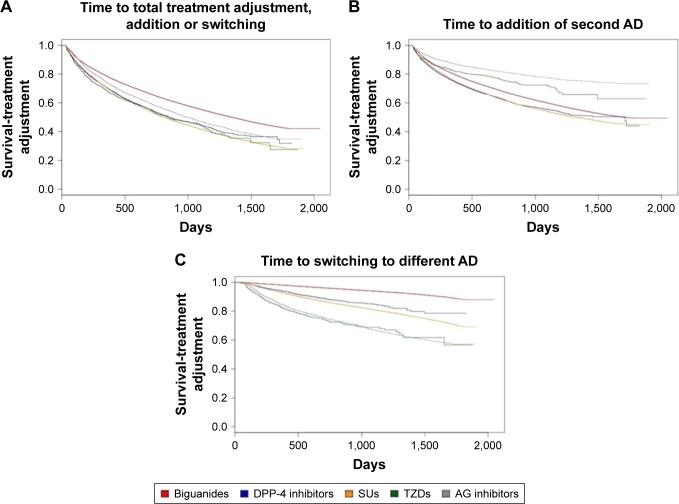
The median time to treatment adjustment was shorter for sulfonylureas (SUs), dipeptidyl peptidase-4 (DPP-4) inhibitors, alphaglucosidase (AG) inhibitors, and thiazolidinediones (TZDs) compared to that for metformin. Initiation of therapy with SUs or DPP-4 inhibitors was associated with a significantly higher risk of both treatment addition and switching than with metformin (HR 1.49 versus 1.47 for overall treatment adjustment, respectively). In contrast, among incident users of AG inhibitors or TZDs, only the hazard of switch was substantially increased compared to metformin starters (6.19, 95% confidence interval [CI] 5.77-6.64 and 7.31, 95% CI 6.35-8.42, respectively). When addition and switch events were collectively assessed, the risk of treatment adjustment was significantly elevated in all non-metformin cohorts.
Our results demonstrated that the durability of metformin as an initial monotherapy was superior to that of other ADs, including newer classes of antidiabetics, and appeared to be more effective in delaying treatment adjustment in real-world clinical practice.
随着新型抗糖尿病药物(ADs)越来越普遍地被用作早期糖尿病患者的初始降糖选择,迫切需要研究这些药物相对于二甲双胍在治疗持久性方面可能存在的差异。本研究旨在调查接受口服AD作为初始单药治疗的新诊断2型糖尿病(T2DM)患者中治疗调整的发生率和风险。
确定在国家健康保险计划中注册且新开具口服AD的T2DM患者。使用Kaplan-Meier生存分析确定添加治疗或换用其他抗糖尿病治疗的时间。进行Cox比例风险回归以估计在调整潜在混杂因素后的风险比(HR)。
与二甲双胍相比,磺脲类药物(SUs)、二肽基肽酶-4(DPP-4)抑制剂、α-葡萄糖苷酶(AG)抑制剂和噻唑烷二酮类药物(TZDs)的治疗调整中位时间更短。与二甲双胍相比,起始使用SUs或DPP-4抑制剂时添加治疗和换药的风险均显著更高(总体治疗调整的HR分别为1.49和1.47)。相比之下,在AG抑制剂或TZDs的新使用者中,与起始使用二甲双胍的患者相比,仅换药风险显著增加(分别为6.19,95%置信区间[CI]5.77 - 6.64和7.31,95%CI 6.35 - 8.42)。当综合评估添加治疗和换药事件时,所有非二甲双胍治疗组的治疗调整风险均显著升高。
我们的结果表明,二甲双胍作为初始单药治疗的持久性优于其他ADs,包括新型抗糖尿病药物,并且在实际临床实践中似乎在延迟治疗调整方面更有效。