Dornellas Ana P S, Boldarine Valter T, Pedroso Amanda P, Carvalho Lorenza O T, de Andrade Iracema S, Vulcani-Freitas Tânia M, Dos Santos Carla C C, do Nascimento Cláudia M da Penha Oller, Oyama Lila M, Ribeiro Eliane B
Physiology Department, Escola Paulista de Medicina, Universidade Federal de São Paulo, São Paulo, Brazil.
Front Neurosci. 2018 Sep 3;12:557. doi: 10.3389/fnins.2018.00557. eCollection 2018.
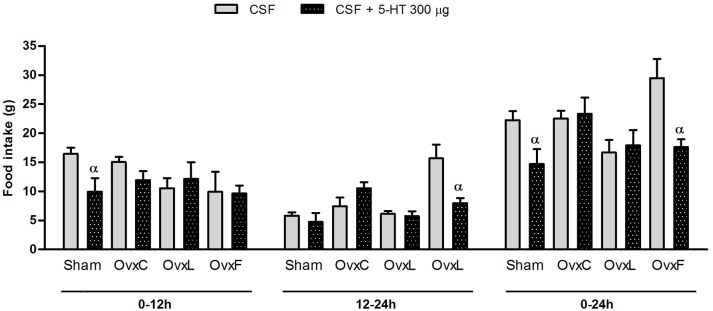
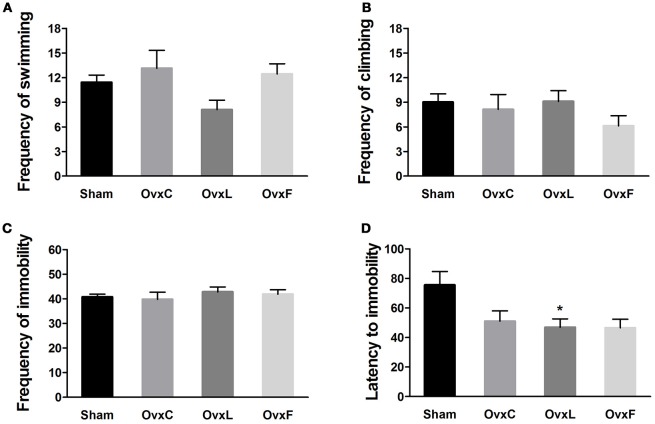
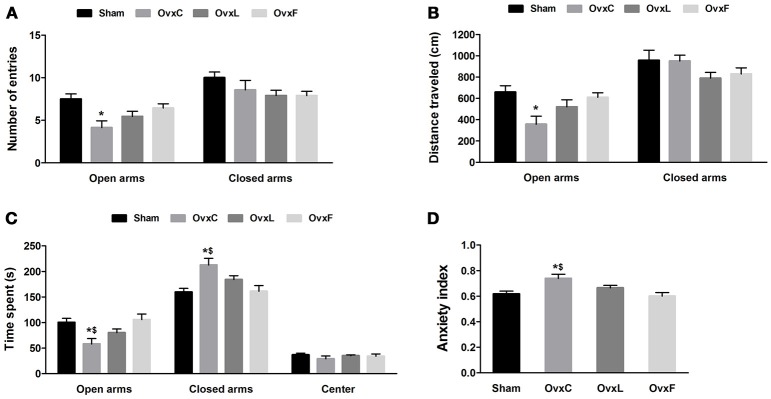
Menopause-induced changes may include increased incidence of both depression/anxiety and obesity. We hypothesized that behavioral changes that may develop after ovarian failure could be related to neurochemical and metabolic aspects affected by this condition and that high-fat intake may influence these associations. The present study investigated in rats the effects of ovariectomy, either alone or combined with high-fat diets enriched with either lard or fish-oil, on metabolic, behavioral and monoaminergic statuses, and on gene expression of neuropeptides and receptors involved in energy balance and mood regulation. Female rats had their ovaries removed and received either standard chow (OvxC) or high-fat diets enriched with either lard (OvxL) or fish-oil (OvxF) for 8 weeks. The Sham group received only chow diet. Ovariectomy increased feed efficiency and body weight gain and impaired glucose homeostasis and serotonin-induced hypophagia, effects either maintained or even accentuated by the lard diet but counteracted by the fish diet. The OvxL group developed obesity and hyperleptinemia. Regarding components of hypothalamic serotonergic system, both ovariectomy alone or combined with the fish diet increased 5-HT expression while the lard diet reduced 5-HT mRNA. Ovariectomy increased the anxiety index, as derived from the elevated plus maze test, while both high-fat groups showed normalization of this index. In the forced swimming test, ovariectomy allied to high-lard diet, but not to fish-oil diet, reduced the latency to immobility, indicating vulnerability to a depressive-like state. Linear regression analysis showed hippocampal AgRP to be negatively associated with the anxiety index and hypothalamic AgRP to be positively associated with the latency to immobility. These AgRp gene expression associations are indicative of a beneficial involvement of this neuropeptide on both depression and anxiety measures. The present findings demonstrate metabolic, neurochemical and behavioral alterations after ovaries removal and highlight a positive effect of high-fat feeding on the anxiety-like behavior shown by ovariectomized animals. Since the polyunsaturated ômega-3 intake (fish diet), unlike the saturated fat intake (lard diet), failed to induce deleterious metabolic or neurochemical consequences, further studies are needed focusing on the potential of this dietary component as an adjuvant anxiolytic agent after menopause.
绝经引起的变化可能包括抑郁/焦虑和肥胖的发生率增加。我们假设卵巢功能衰竭后可能出现的行为变化可能与受该病症影响的神经化学和代谢方面有关,并且高脂肪摄入可能会影响这些关联。本研究在大鼠中调查了卵巢切除术单独或与富含猪油或鱼油的高脂肪饮食联合使用对代谢、行为和单胺能状态,以及对参与能量平衡和情绪调节的神经肽和受体基因表达的影响。雌性大鼠被切除卵巢,并接受标准饲料(OvxC)或富含猪油(OvxL)或鱼油(OvxF)的高脂肪饮食8周。假手术组仅接受饲料饮食。卵巢切除术提高了饲料效率和体重增加,并损害了葡萄糖稳态和血清素诱导的食欲减退,猪油饮食维持甚至加剧了这些影响,但鱼类饮食抵消了这些影响。OvxL组出现肥胖和高瘦素血症。关于下丘脑血清素能系统的组成部分,单独的卵巢切除术或与鱼类饮食联合使用都会增加5-HT表达,而猪油饮食会降低5-HT mRNA。卵巢切除术增加了高架十字迷宫试验得出的焦虑指数,而两个高脂肪组的该指数均恢复正常。在强迫游泳试验中,与高脂肪猪油饮食联合的卵巢切除术而非鱼油饮食减少了不动的潜伏期,表明易患类似抑郁的状态。线性回归分析表明,海马AgRP与焦虑指数呈负相关,下丘脑AgRP与不动潜伏期呈正相关。这些AgRp基因表达关联表明该神经肽对抑郁和焦虑测量均有有益作用。本研究结果表明卵巢切除术后存在代谢、神经化学和行为改变,并突出了高脂肪喂养对去卵巢动物表现出的焦虑样行为的积极影响。由于多不饱和ω-3摄入量(鱼类饮食)与饱和脂肪摄入量(猪油饮食)不同,未引起有害的代谢或神经化学后果,因此需要进一步研究关注这种饮食成分作为绝经后辅助抗焦虑药物的潜力。