Tse Gary, Gong Mengqi, Meng Lei, Wong Cheuk W, Bazoukis George, Chan Matthew T V, Wong Martin C S, Letsas Konstantinos P, Baranchuk Adrian, Yan Gan-Xin, Liu Tong, Wu William K K
Department of Medicine and Therapeutics, Faculty of Medicine, Chinese University of Hong Kong, Hong Kong, Hong Kong.
Li Ka Shing Institute of Health Sciences, Faculty of Medicine, Chinese University of Hong Kong, Hong Kong, Hong Kong.
Front Physiol. 2018 Sep 3;9:1226. doi: 10.3389/fphys.2018.01226. eCollection 2018.
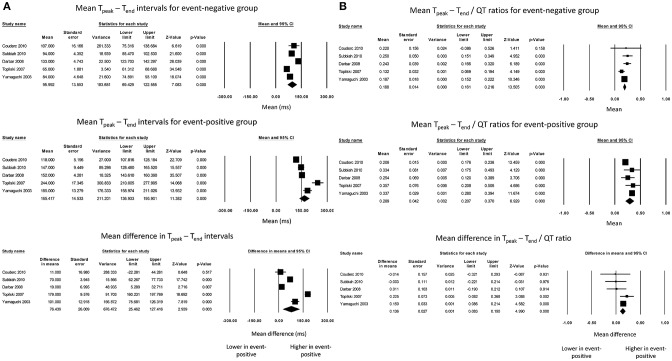
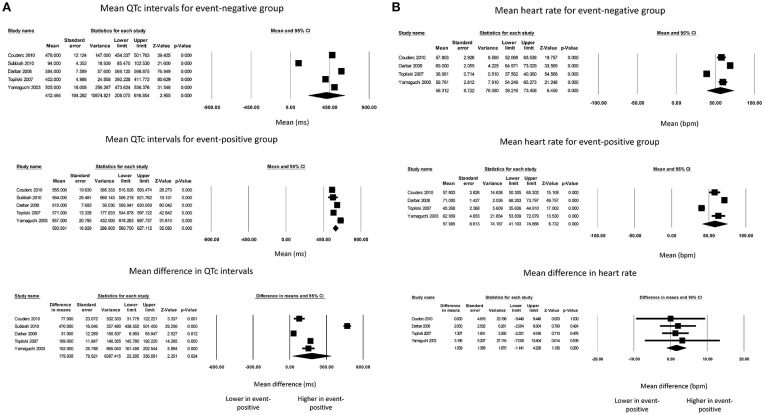
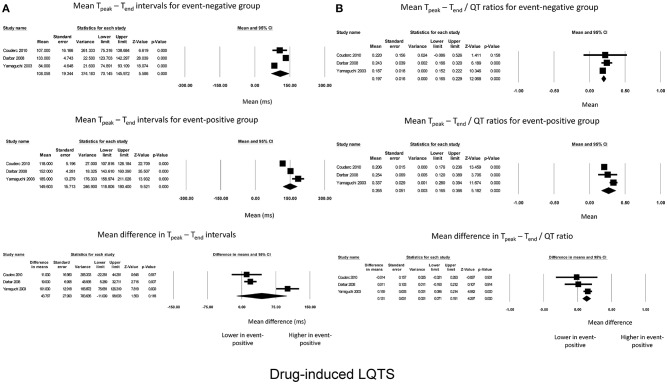
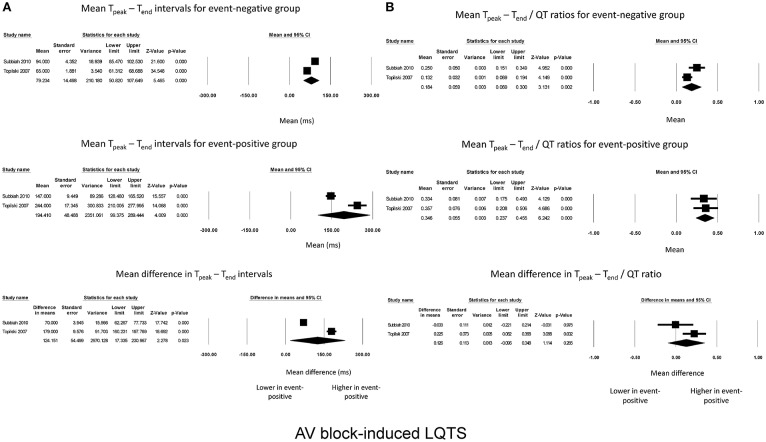
Acquired QT interval prolongation has been linked with malignant ventricular arrhythmias, such as , in turn predisposing to sudden cardiac death. Increased dispersion of repolarization has been identified as a pro-arrhythmic factor and can be observed as longer T - T interval and higher T - T/QT ratio on the electrocardiogram. However, the values of these repolarization indices for predicting adverse outcomes in this context have not been systematically evaluated. PubMed, Embase and Cochrane Library databases were searched until 14th February 2018, identifying 232 studies. Five studies on acquired QT prolongation met the inclusion criteria and 308 subjects with drug-induced LQTS patients (mean age: 66 ± 18 years old; 46% male) were included in this meta-analysis. T - T intervals were longer [mean difference [MD]: 76 ms, standard error [SE]: 26 ms, = 0.003; I = 98%] and T - T/QT ratios were higher (MD: 0.14, SE: 0.03, = 0.000; I = 29%) in patients with compared to those without these events. T - T interval and T - T/QT ratio were higher in patients with acquired QT prolongation suffering from compared to those who did not. These repolarization indices may provide additional predictive value for identifying high-risk individuals.
获得性QT间期延长与恶性室性心律失常有关,进而易导致心源性猝死。复极离散度增加已被确定为一种促心律失常因素,在心电图上可表现为T - T间期延长和T - T/QT比值升高。然而,在这种情况下,这些复极指标预测不良结局的价值尚未得到系统评估。检索了PubMed、Embase和Cochrane图书馆数据库直至2018年2月14日,共识别出232项研究。五项关于获得性QT延长的研究符合纳入标准,本荟萃分析纳入了308例药物性长QT综合征患者(平均年龄:66±18岁;46%为男性)。与未发生这些事件的患者相比,发生[具体事件未明确]的患者T - T间期更长[平均差值[MD]:76 ms,标准误[SE]:26 ms,P = 0.003;I² = 98%],T - T/QT比值更高(MD:0.14,SE:0.03,P = 0.000;I² = 29%)。与未发生[具体事件未明确]的获得性QT延长患者相比,发生该事件的患者T - T间期和T - T/QT比值更高。这些复极指标可能为识别高危个体提供额外的预测价值。