Woźniak Mateusz
Cognition and Philosophy Lab, Department of Philosophy, Monash University, Melbourne, VIC, Australia.
Front Psychol. 2018 Sep 4;9:1656. doi: 10.3389/fpsyg.2018.01656. eCollection 2018.
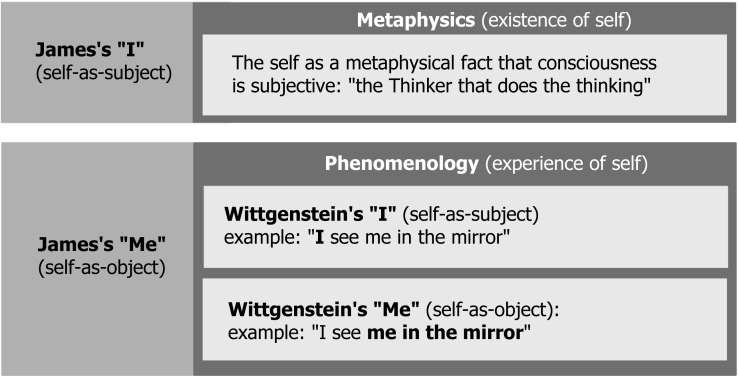
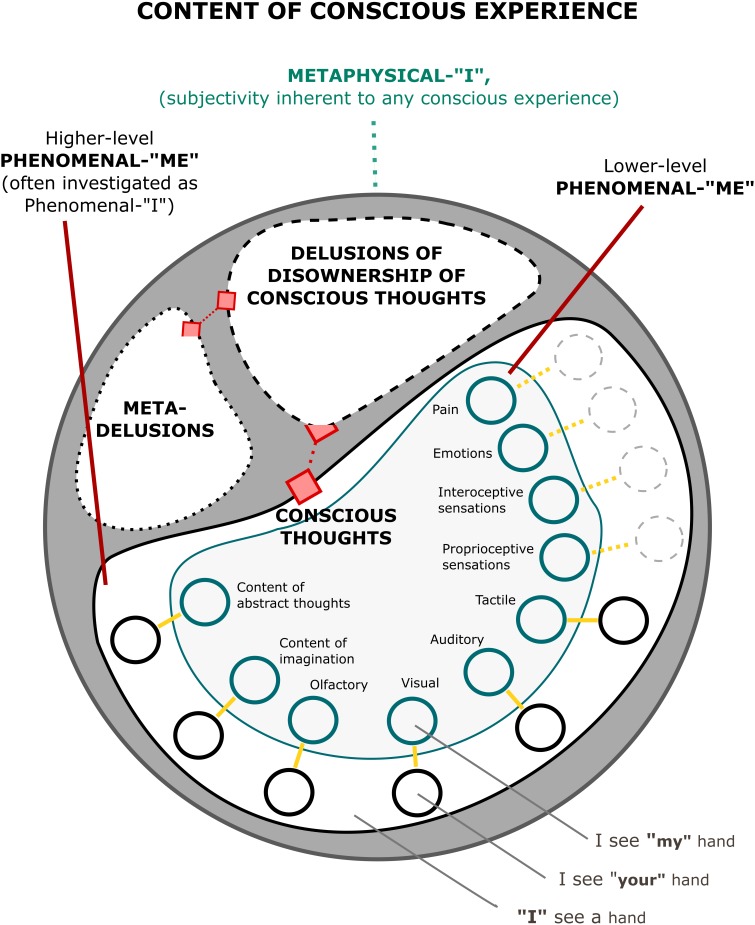
James (1890) distinguished two understandings of the self, the self as "Me" and the self as "I". This distinction has recently regained popularity in cognitive science, especially in the context of experimental studies on the underpinnings of the phenomenal self. The goal of this paper is to take a step back from cognitive science and attempt to precisely distinguish between "Me" and "I" in the context of consciousness. This distinction was originally based on the idea that the former ("Me") corresponds to the self as an object of experience (self as object), while the latter ("I") reflects the self as a subject of experience (self as subject). I will argue that in most of the cases (arguably all) this distinction maps onto the distinction between the phenomenal self (reflecting self-related content of consciousness) and the metaphysical self (representing the problem of subjectivity of all conscious experience), and as such these two issues should be investigated separately using fundamentally different methodologies. Moreover, by referring to Metzinger's (2018) theory of phenomenal self-models, I will argue that what is usually investigated as the phenomenal-"I" [following understanding of self-as-subject introduced by Wittgenstein (1958)] can be interpreted as object, rather than subject of experience, and as such can be understood as an element of the hierarchical structure of the phenomenal self-model. This understanding relates to recent predictive coding and free energy theories of the self and bodily self discussed in cognitive neuroscience and philosophy.
詹姆斯(1890)区分了对自我的两种理解,即作为“我”的自我和作为“我”的自我。这种区分最近在认知科学中再度流行起来,尤其是在关于现象自我基础的实验研究背景下。本文的目的是从认知科学中退一步,尝试在意识背景下精确区分“我”和“我”。这种区分最初基于这样一种观点,即前者(“我”)对应于作为经验对象的自我(自我即对象),而后者(“我”)反映的是作为经验主体的自我(自我即主体)。我将论证,在大多数情况下(可以说所有情况),这种区分对应于现象自我(反映意识中与自我相关的内容)和形而上学自我(代表所有意识体验的主体性问题)之间的区分,因此这两个问题应该使用根本不同的方法分别进行研究。此外,通过参考梅津格(2018)的现象自我模型理论,我将论证,通常作为现象学上的“我”来研究的内容[遵循维特根斯坦(1958)引入的自我即主体的理解]可以被解释为对象,而不是经验主体,因此可以被理解为现象自我模型层次结构的一个元素。这种理解与认知神经科学和哲学中讨论的关于自我和身体自我的近期预测编码和自由能理论相关。