Center for Infection Medicine, Institute of Immunology, Freie Universität Berlin, Berlin, Germany.
Vector Biology Unit, Max Planck Institute for Infection Biology, Berlin, Germany.
Front Cell Infect Microbiol. 2018 Sep 3;8:308. doi: 10.3389/fcimb.2018.00308. eCollection 2018.
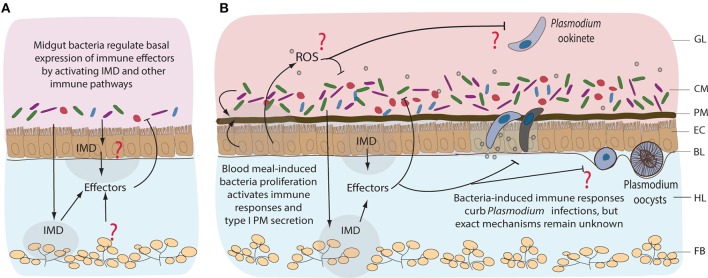
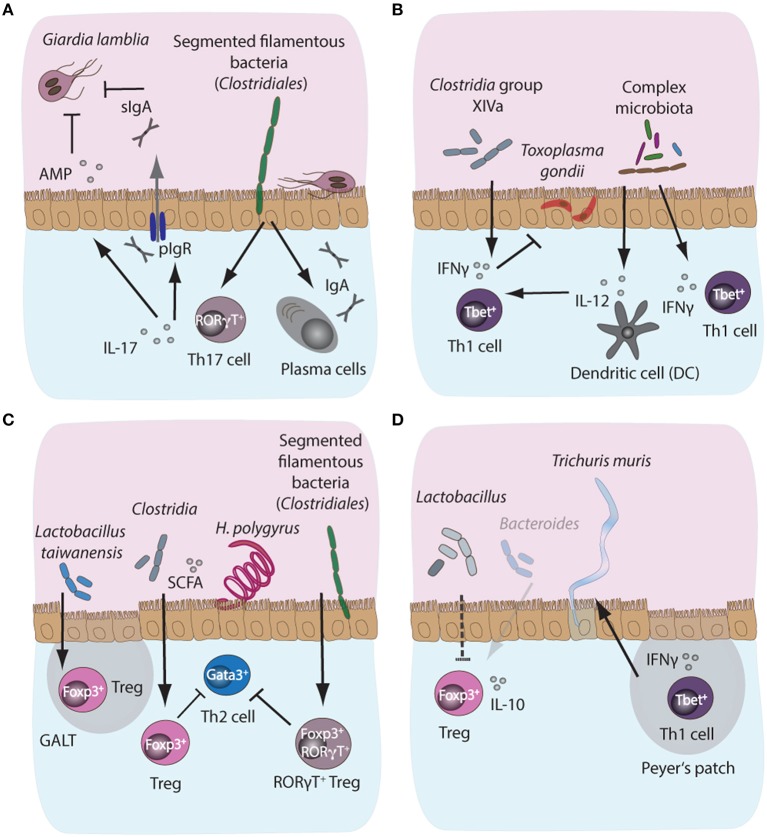
The digestive tract plays a central role in nutrient acquisition and harbors a vast and intricate community of bacteria, fungi, viruses and parasites, collectively known as the microbiota. In recent years, there has been increasing recognition of the complex and highly contextual involvement of this microbiota in the induction and education of host innate and adaptive immune responses under homeostasis, during infection and inflammation. The gut passage and colonization by unicellular and multicellular parasite species present an immense challenge to the host immune system and to the microbial communities that provide vital support for its proper functioning. In mammals, parasitic nematodes induce distinct shifts in the intestinal microbial composition. Vice versa, the commensal microbiota has been shown to serve as a molecular adjuvant and immunomodulator during intestinal parasite infections. Moreover, similar interactions occur within insect vectors of deadly human pathogens. The gut microbiota has emerged as a crucial factor affecting vector competence in mosquitoes, where it modulates outcomes of infections with malaria parasites. In this review, we discuss currently known involvements of the host microbiota in the instruction, support or suppression of host immune responses to gastrointestinal nematodes and protozoan parasites in mice, as well as in the malaria mosquito vector. A deeper understanding of the mechanisms underlying microbiota-dependent modulation of host and vector immunity against parasites in mammals and mosquitoes is key to a better understanding of the host-parasite relationships and the identification of more efficient approaches for intervention and treatment of parasite infections of both clinical and veterinary importance.
消化道在营养物质获取中起着核心作用,并且容纳了庞大而复杂的细菌、真菌、病毒和寄生虫群落,这些统称为微生物群落。近年来,人们越来越认识到这种微生物群落,在宿主固有和适应性免疫反应的诱导和教育中,具有复杂和高度背景的参与作用,无论是在稳态、感染和炎症期间。单细胞和多细胞寄生虫物种通过消化道的通行和定植,对宿主免疫系统和为其正常功能提供重要支持的微生物群落构成了巨大挑战。在哺乳动物中,寄生线虫会引起肠道微生物组成的明显变化。反之,共生微生物群落已被证明在肠道寄生虫感染期间可作为分子佐剂和免疫调节剂。此外,在致命人类病原体的昆虫媒介中也存在类似的相互作用。肠道微生物群已成为影响蚊子媒介能力的关键因素,它可调节疟原虫感染的结果。在这篇综述中,我们讨论了宿主微生物群在指导、支持或抑制宿主对胃肠道线虫和原生动物寄生虫的免疫反应方面的已知作用,包括在疟疾蚊子媒介中的作用。更深入地了解微生物依赖性调节宿主和媒介免疫力的机制,对于更好地理解宿主-寄生虫关系以及确定更有效的干预和治疗临床和兽医重要性寄生虫感染的方法至关重要。