1 California Institute of Technology , Pasadena, California.
2 NASA Jet Propulsion Laboratory, California Institute of Technology , Pasadena, California.
Astrobiology. 2018 Oct;18(10):1221-1242. doi: 10.1089/ast.2018.1917. Epub 2018 Sep 19.
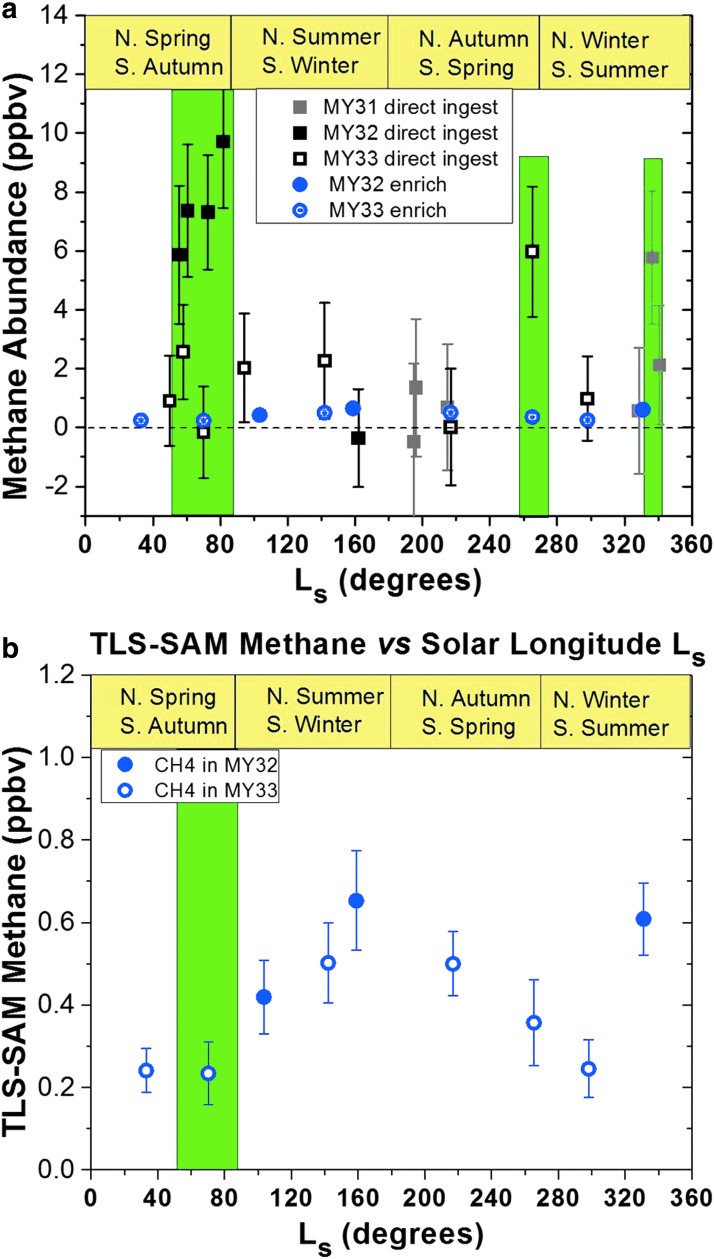
Recent measurements of methane (CH) by the Mars Science Laboratory (MSL) now confront us with robust data that demand interpretation. Thus far, the MSL data have revealed a baseline level of CH (∼0.4 parts per billion by volume [ppbv]), with seasonal variations, as well as greatly enhanced spikes of CH with peak abundances of ∼7 ppbv. What do these CH revelations with drastically different abundances and temporal signatures represent in terms of interior geochemical processes, or is martian CH a biosignature? Discerning how CH generation occurs on Mars may shed light on the potential habitability of Mars. There is no evidence of life on the surface of Mars today, but microbes might reside beneath the surface. In this case, the carbon flux represented by CH would serve as a link between a putative subterranean biosphere on Mars and what we can measure above the surface. Alternatively, CH records modern geochemical activity. Here we ask the fundamental question: how active is Mars, geochemically and/or biologically? In this article, we examine geological, geochemical, and biogeochemical processes related to our overarching question. The martian atmosphere and surface are an overwhelmingly oxidizing environment, and life requires pairing of electron donors and electron acceptors, that is, redox gradients, as an essential source of energy. Therefore, a fundamental and critical question regarding the possibility of life on Mars is, "Where can we find redox gradients as energy sources for life on Mars?" Hence, regardless of the pathway that generates CH on Mars, the presence of CH, a reduced species in an oxidant-rich environment, suggests the possibility of redox gradients supporting life and habitability on Mars. Recent missions such as ExoMars Trace Gas Orbiter may provide mapping of the global distribution of CH. To discriminate between abiotic and biotic sources of CH on Mars, future studies should use a series of diagnostic geochemical analyses, preferably performed below the ground or at the ground/atmosphere interface, including measurements of CH isotopes, methane/ethane ratios, H gas concentration, and species such as acetic acid. Advances in the fields of Mars exploration and instrumentation will be driven, augmented, and supported by an improved understanding of atmospheric chemistry and dynamics, deep subsurface biogeochemistry, astrobiology, planetary geology, and geophysics. Future Mars exploration programs will have to expand the integration of complementary areas of expertise to generate synergistic and innovative ideas to realize breakthroughs in advancing our understanding of the potential of life and habitable conditions having existed on Mars. In this spirit, we conducted a set of interdisciplinary workshops. From this series has emerged a vision of technological, theoretical, and methodological innovations to explore the martian subsurface and to enhance spatial tracking of key volatiles, such as CH.
最近,火星科学实验室(MSL)对甲烷(CH)的测量结果为我们提供了有力的数据,这些数据需要进行解释。到目前为止,MSL 数据显示 CH 的基线水平(体积比约为 0.4 部分/十亿[ppbv]),存在季节性变化,以及 CH 浓度大幅增加的峰值,最高可达约 7 ppbv。这些 CH 揭示了截然不同的丰度和时间特征,这在内部地球化学过程中代表什么,或者火星 CH 是生物特征吗?弄清楚 CH 是如何在火星上产生的,可能有助于我们了解火星的潜在可居住性。目前在火星表面没有生命的证据,但微生物可能存在于表面以下。在这种情况下,CH 所代表的碳通量将成为火星地下生物圈与我们在表面以上所能测量到的物质之间的联系。或者,CH 记录了现代地球化学活动。在这里,我们提出了一个基本问题:火星在地球化学和/或生物学方面有多活跃?在本文中,我们研究了与我们的主要问题相关的地质、地球化学和生物地球化学过程。火星的大气和表面是一个压倒性的氧化环境,生命需要将电子供体和电子受体配对,即氧化还原梯度,作为能量的基本来源。因此,关于火星上生命存在的可能性的一个基本和关键问题是,“我们在哪里可以找到氧化还原梯度作为火星生命的能量来源?”因此,无论 CH 在火星上的生成途径如何,CH 的存在——一种在富含氧化剂的环境中还原的物质——表明存在支持火星生命和可居住性的氧化还原梯度的可能性。最近的任务,如 ExoMars 痕量气体轨道飞行器,可能会提供 CH 全球分布的地图。为了在火星上区分 CH 的非生物和生物来源,未来的研究应该使用一系列诊断地球化学分析方法,最好在地下或地面/大气界面进行,包括测量 CH 同位素、甲烷/乙烷比、H 气体浓度以及乙酸等物质。火星探索和仪器领域的进展将通过对大气化学和动力学、深部地下生物地球化学、天体生物学、行星地质学和地球物理学的深入了解来推动、增强和支持。未来的火星探索计划将不得不扩大对互补专业领域的整合,以产生协同创新的想法,在推进我们对火星生命潜力和宜居条件的理解方面取得突破。本着这种精神,我们进行了一系列跨学科研讨会。从这一系列研讨会中,我们提出了一系列技术、理论和方法上的创新,以探索火星的地下环境,并增强对关键挥发物(如 CH)的空间跟踪。