Division of Nephrology and Hypertension, Department of Internal Medicine, Inha University College of Medicine, Incheon, Korea.
Department of Internal Medicine, College of Medicine, Severance Biomedical Science Institute, Brain Korea 21 PLUS, Institute of Kidney Disease Research, Yonsei University, Seoul, Korea.
Sci Rep. 2018 Sep 20;8(1):14123. doi: 10.1038/s41598-018-32281-w.
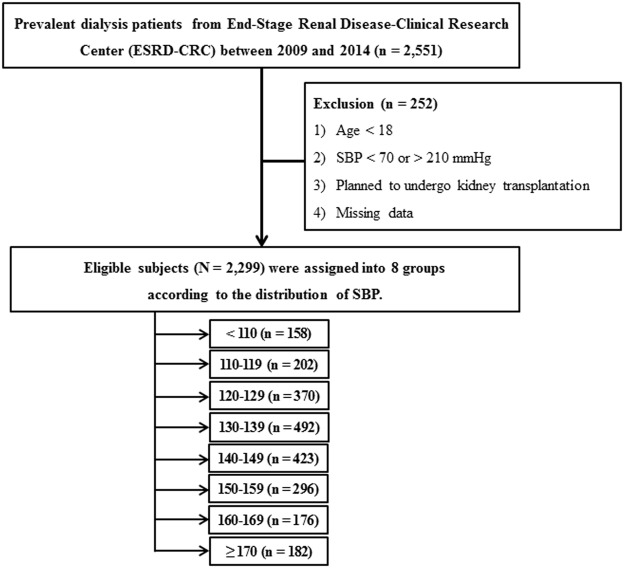
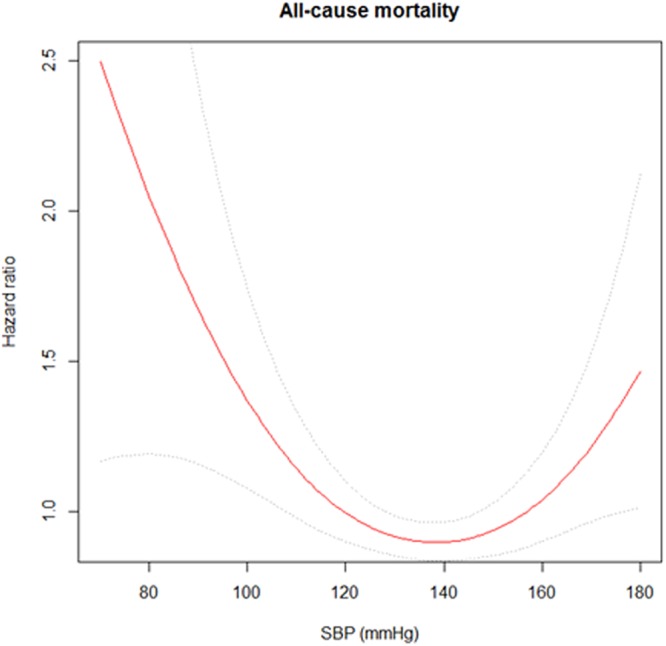
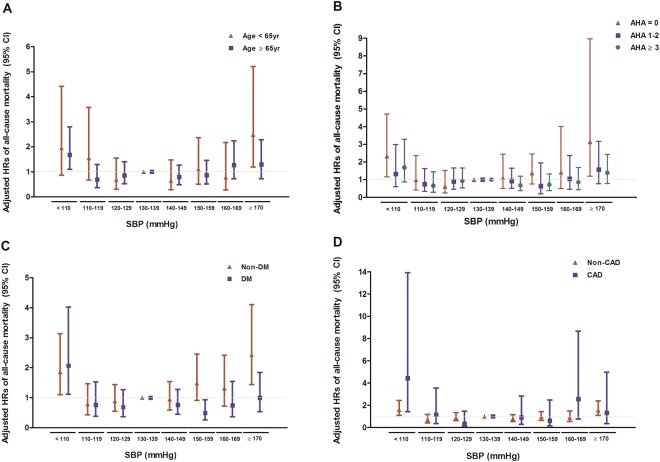
Hypertension is common and contributes to adverse outcomes in patients undergoing dialysis. However, the proper blood pressure (BP) target remains controversial and several factors make this difficult. This study aimed to investigate the adequate BP target in patients undergoing prevalent dialysis. Data were retrieved from the Clinical Research Center for End-Stage Renal Disease (2009-2014). 2,299 patients undergoing dialysis were evaluated. Patients were assigned into eight groups according to predialysis systolic blood pressure (SBP). The primary outcome was all-cause mortality. During the median follow-up of 4.5 years, a U-shape relation between SBP and mortality was found. The risk of mortality was increased in the SBP <110 and ≥170 mmHg groups. In subgroup analysis, the risk of mortality was similarly shown U-shape with SBP in subjects with no comorbidities, and no use of antihypertensive agents. However, only lowest SBP was a risk factor for mortality in patients with older, having diabetes or coronary artery disease, whereas highest SBP was an only risk factor in younger patients. In respect of dialysis characteristics, patients undergoing hemodialysis showed U-shape between SBP and mortality, while patients undergoing peritoneal dialysis did not. Among hemodialysis patients, patients with shorter dialysis vintage and less interdialytic weight gain showed U-shape association between SBP and mortality. This study showed that the lowest or highest SBP group had higher risk of mortality. Nevertheless, the optimal target BP should be applied according to individual condition of each patient.
高血压很常见,会导致透析患者的不良预后。然而,适当的血压(BP)目标仍然存在争议,有几个因素使其变得复杂。本研究旨在探讨正在进行的透析患者的适当 BP 目标。数据来自终末期肾脏疾病临床研究中心(2009-2014 年)。评估了 2299 名正在进行透析的患者。根据透析前收缩压(SBP),患者被分为 8 组。主要结局是全因死亡率。在中位数为 4.5 年的随访期间,SBP 与死亡率之间呈 U 形关系。SBP<110mmHg 和≥170mmHg 组的死亡率增加。在亚组分析中,在无合并症和未使用抗高血压药物的患者中,SBP 与死亡率也呈类似的 U 形关系。然而,只有最低 SBP 是无合并症、未使用抗高血压药物的老年患者死亡的危险因素,而最高 SBP 是年轻患者死亡的唯一危险因素。在透析特征方面,血液透析患者的 SBP 与死亡率之间呈 U 形关系,而腹膜透析患者则没有。在血液透析患者中,透析龄较短和透析间期体重增加较少的患者,SBP 与死亡率之间呈 U 形关联。本研究表明,最低或最高 SBP 组的死亡率较高。然而,应根据每个患者的个体情况应用最佳目标 BP。