Wei Yishul, Ramautar Jennifer R, Colombo Michele A, Te Lindert Bart H W, Van Someren Eus J W
Department of Sleep and Cognition, Netherlands Institute for Neuroscience (NIN), An Institute of the Royal Netherlands Academy of Arts and Sciences, Amsterdam, Netherlands.
Bernstein Center Freiburg and Faculty of Biology, University of Freiburg, Freiburg, Germany.
Front Psychiatry. 2018 Sep 6;9:395. doi: 10.3389/fpsyt.2018.00395. eCollection 2018.
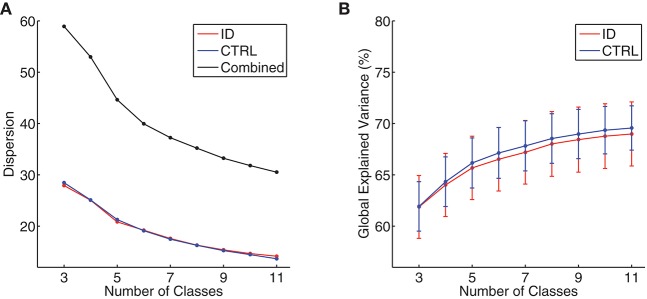
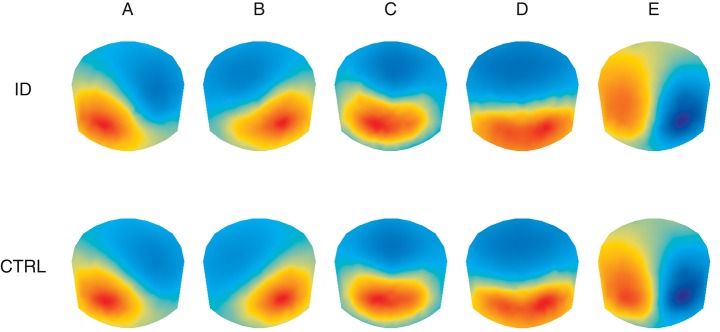
People with Insomnia Disorder (ID) not only experience abundant nocturnal mentation, but also report altered spontaneous mental content during daytime wakefulness, such as an increase in bodily experiences (heightened somatic awareness). Previous studies have shown that resting-state EEG can be temporally partitioned into quasi-stable microstates, and that these microstates form a small number of canonical classes that are consistent across people. Furthermore, the microstate classes have been associated with individual differences in resting mental content including somatic awareness. To address the hypothesis that altered resting mental content in ID would be reflected in an altered representation of the corresponding EEG microstates, we analyzed resting-state high-density EEG of 32 people with ID and 32 age- and sex-matched controls assessed during 5-min eyes-closed wakefulness. Using data-driven topographical k-means clustering, we found that 5 microstate classes optimally explained the EEG scalp voltage map sequences across participants. For each microstate class, 3 dynamic features were obtained: mean duration, frequency of occurrence, and proportional coverage time. People with ID had a shorter mean duration of class C microstates, and more frequent occurrence of class D microstates. The finding is consistent with previously established associations of these microstate properties with somatic awareness, and increased somatic awareness in ID. EEG microstate assessment could provide objective markers of subjective experience dimensions in studies on consciousness during the transition between wake and sleep, when self-report is not possible because it would interfere with the very process under study. Addressing somatic awareness may benefit psychotherapeutic treatment of insomnia.
失眠症(ID)患者不仅夜间思绪丰富,而且还报告称白天清醒时自发心理内容发生了变化,比如身体体验增加(躯体意识增强)。先前的研究表明,静息态脑电图(EEG)在时间上可划分为准稳定的微状态,且这些微状态形成了少量在个体间一致的典型类别。此外,微状态类别与包括躯体意识在内的静息心理内容的个体差异有关。为了验证ID患者静息心理内容的改变会反映在相应EEG微状态的改变这一假设,我们分析了32名ID患者以及32名年龄和性别匹配的对照者在闭眼清醒5分钟期间的静息态高密度EEG。使用数据驱动的地形k均值聚类法,我们发现5个微状态类别能最佳地解释所有参与者的EEG头皮电压图序列。对于每个微状态类别,获取了3个动态特征:平均持续时间、出现频率和比例覆盖时间。ID患者的C类微状态平均持续时间较短,D类微状态出现频率更高。这一发现与先前确立的这些微状态属性与躯体意识的关联以及ID患者躯体意识增强相一致。在清醒与睡眠转换期间的意识研究中,当自我报告因会干扰正在研究的过程而无法进行时,EEG微状态评估可为主观体验维度提供客观指标。关注躯体意识可能有益于失眠症的心理治疗。