Sadat-Ali Mir, Al-Anii Fawaz M, Al-Turki Haifa A, AlBadran Adeebah Abdulaziz, AlShammari Sa'ad Mohammed
Department of Orthopaedic Surgery, King Fahd Hospital of the University, Imam AbdulRahman Bin Faisal University, Al-Khobar, Saudi Arabia.
Department of Obstetrics and Gynecology, King Fahd Hospital of the University, Imam AbdulRahman Bin Faisal University, Al-Khobar, Saudi Arabia.
J Bone Metab. 2018 Aug;25(3):161-164. doi: 10.11005/jbm.2018.25.3.161. Epub 2018 Aug 31.
It is still unclear the ideal vitamin D dosage once the deficiency and insufficiency is treated. Once deficiency was corrected we prospectively treated patients with 2,000 IU of vitamin D3 to check whether this dosage is enough to keep them above the 30 ng/mL of 25-hydroxy-vitamin D (25[OH]D).
One hundred and thirty-five Saudi Arabian men and women treatment naïve for the vitamin D deficiency and insufficiency were part of this study. History and clinical examination were done to rule out any metabolic bone disease. Weight and height was taken to calculate the body mass index (BMI). Patients who were vitamin D deficient (≥30 ng/mL), a standard treatment of 50,000 IU of vitamin D3 weekly for 3 months, a blood test for the vitamin D levels at the end of 3 months, maintenance dose of 2,000 IU of vitamin D3 for 3 months and a third blood sample after 3 months.
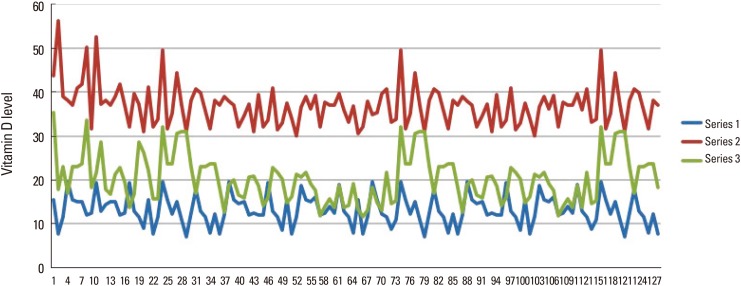
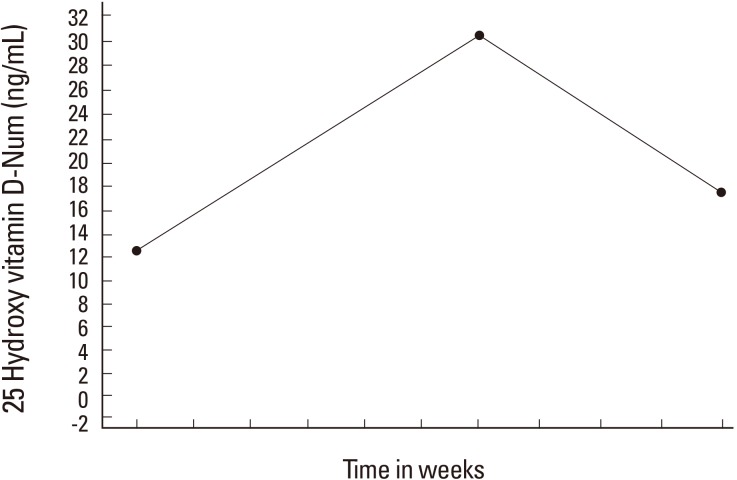
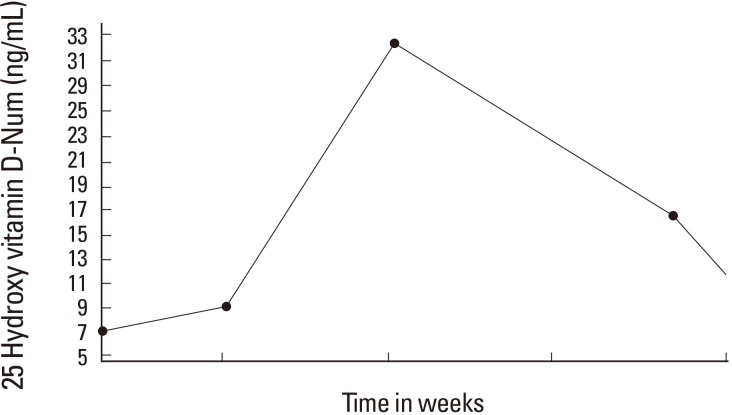
The data for 128 patients was available for analysis. The average age was 44.95±12.97 years with the mean BMI of 29.60±2.59 kg/m. The baseline 25(OH)D level was 13.16±3.30 ng/mL. The increase in the level of 25(OH)D on 50,000 IU weekly was significant from 13.16±3.3 ng/mL to 36.97±4.67 ng/mL (<0.001) and then 2,000 IU daily for next 3 months, the level of 25(OH)D dropped top 20.38±5.42 ng/mL (<0.001).
Our study indicates that the maintenance dose of 2,000 IU of vitamin D is not enough for patients to keep the 25(OH)D levels above 30 ng/mL.
维生素D缺乏和不足得到治疗后,理想的维生素D剂量仍不明确。一旦纠正了缺乏状态,我们对患者进行前瞻性治疗,给予2000国际单位的维生素D3,以检查该剂量是否足以使他们的25-羟维生素D(25[OH]D)水平保持在30纳克/毫升以上。
135名未接受过维生素D缺乏和不足治疗的沙特阿拉伯男性和女性参与了本研究。进行病史和临床检查以排除任何代谢性骨病。测量体重和身高以计算体重指数(BMI)。维生素D缺乏(≥30纳克/毫升)的患者,接受标准治疗,每周服用50000国际单位的维生素D3,持续3个月,在3个月末进行维生素D水平的血液检测,之后给予2000国际单位的维生素D3维持剂量,持续3个月,并在3个月后采集第三份血样。
128名患者的数据可供分析。平均年龄为44.95±12.97岁,平均BMI为29.60±2.59千克/平方米。基线25(OH)D水平为13.16±3.30纳克/毫升。每周服用50000国际单位时,25(OH)D水平从13.16±3.3纳克/毫升显著升高至36.97±4.67纳克/毫升(<0.001),随后在接下来的3个月每天服用2000国际单位,25(OH)D水平降至20.38±5.42纳克/毫升(<0.001)。
我们的研究表明,2000国际单位的维生素D维持剂量不足以使患者的25(OH)D水平保持在30纳克/毫升以上。