Alam Muhammad S
Laboratory of Immune Cell Biology, National Cancer Institute, National Institutes of Health, Bethesda, Maryland.
Curr Protoc Immunol. 2018 Nov;123(1):e58. doi: 10.1002/cpim.58. Epub 2018 Sep 20.
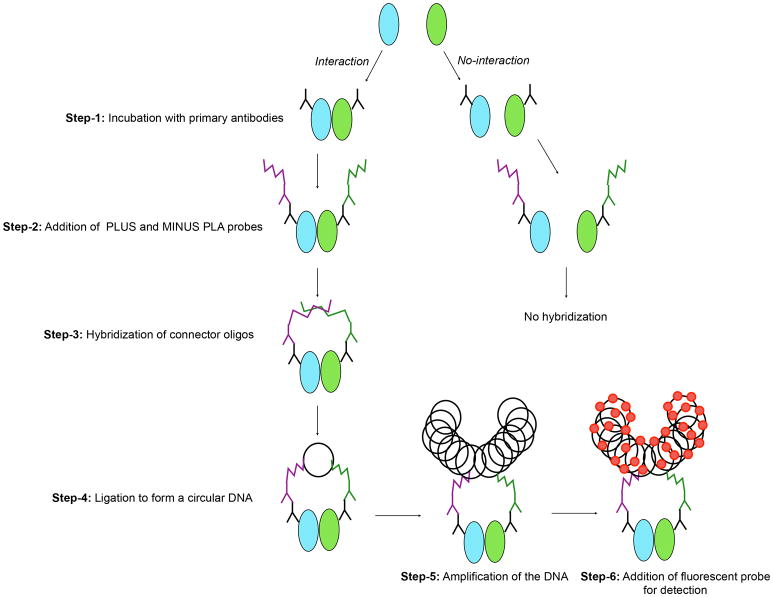
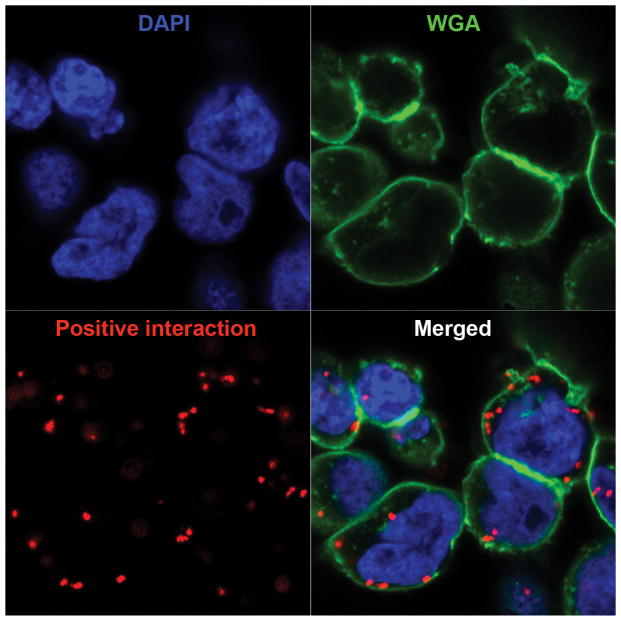
Proximity ligation assay (PLA), also referred to as Duolink® PLA technology, permits detection of protein-protein interactions in situ (at distances <40 nm) at endogenous protein levels. It exploits specific antibodies identifying (either directly or indirectly) the two proteins of interest and utilizes specific DNA primers covalently linked to the antibodies. A hybridization step followed by DNA amplification with fluorescent probes permit visualization of spots of proximity by fluorescence microscopy. Since the development of PLA in 2002, it has been increasingly used to detect the interaction between two proteins with high sensitivity and specificity. It is a simple and sensitive technique to study protein-protein interaction in cells. © 2018 by John Wiley & Sons, Inc.
邻近连接分析(PLA),也被称为Duolink® PLA技术,能够在内源蛋白水平原位检测(距离<40nm)蛋白质-蛋白质相互作用。它利用特异性抗体(直接或间接)识别两种目标蛋白,并使用与抗体共价连接的特异性DNA引物。随后进行杂交步骤,并用荧光探针进行DNA扩增,通过荧光显微镜观察邻近位点的斑点。自2002年PLA技术问世以来,它越来越多地被用于高灵敏度和特异性地检测两种蛋白质之间的相互作用。它是一种用于研究细胞中蛋白质-蛋白质相互作用的简单且灵敏的技术。© 2018约翰威立父子出版公司。