Okar Sefa, Kaypakli Onur, Şahin Durmuş Yıldıray, Koç Mevlüt
Department of Cardiology, University of Health Sciences, Adana Health Practices and Research Center, Adana, Turkey.
Department of Cardiology, Mustafa Kemal University, Faculty of Medicine, Hatay, Turkey.
Korean Circ J. 2018 Oct;48(10):920-929. doi: 10.4070/kcj.2018.0047.
We aimed to investigate the relationship between the recurrence of atrial fibrillation (AF) and fibrosis marker soluble ST2 (sST2) in patients with nonvalvular paroxysmal AF (PAF).
We prospectively included 100 consecutive patients with PAF diagnosis and scheduled for cryoballoon catheter ablation for AF (47 males, 53 females; mean age 55.1±10.8 years). sST2 plasma levels were determined using the ASPECT-PLUS assay on ASPECT Reader device (Critical Diagnostics). The measurement range of these measurements was 12.5-250 ng/mL. Patients had regular follow-up visits with 12-lead electrocardiogram (ECG), medical history, and clinical evaluation. Twenty-four hours Holter ECG monitoring had been recorded 12 months after ablation.
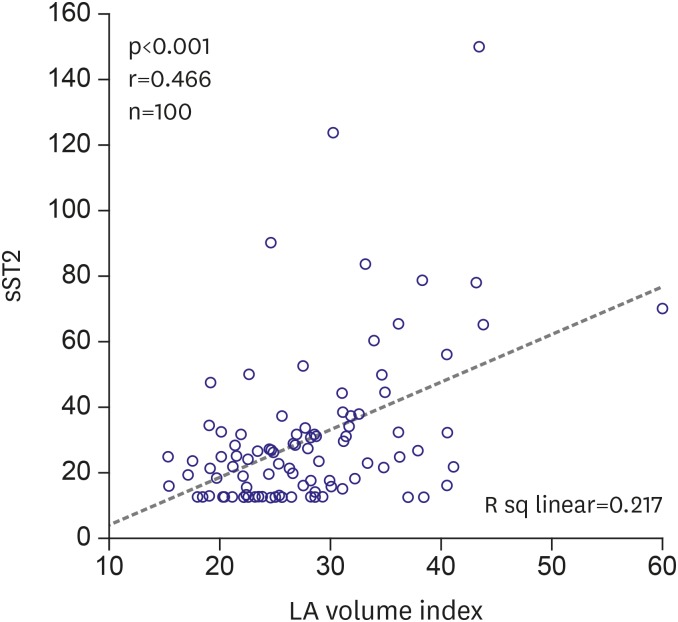
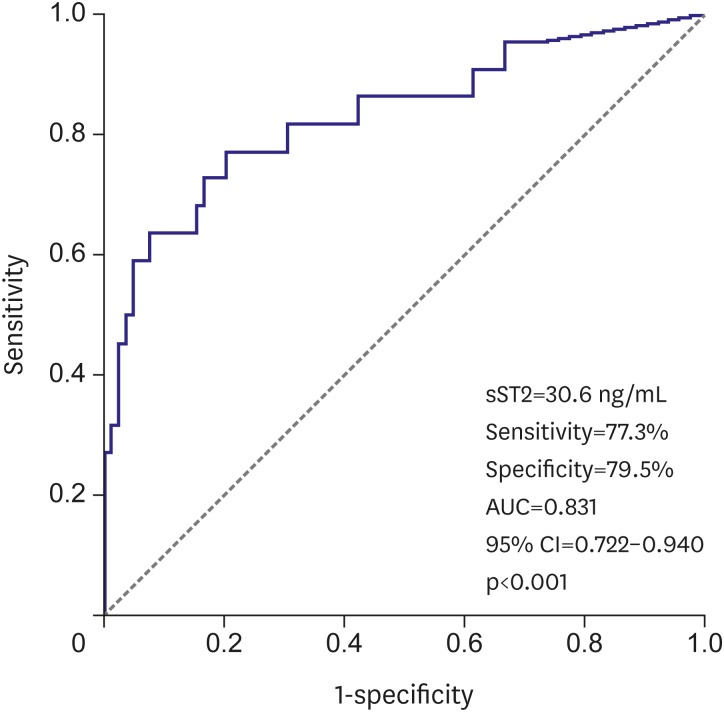
AF recurrence was detected in 22 patients after 1 year. Age, smoking history, diabetes mellitus,hypertension frequency, angiotensin converting enzyme inhibitor-angiotensin receptor blocker use, CHA₂DS₂VASc and HAS-BLED scores, serum sST2 level, left atrium (LA) end-diastolic diameter, LA volume and LA volume index were related to AF recurrence. In multivariable logistic regression analysis, sST2 was found to be only independent parameter for predicting AF recurrence (odds ratio, 1.085; p=0.001). Every 10-unit increase in sST2 was found to be associated with 2.103-fold increase in the risk of AF recurrence. The cut-off value of sST2 obtained by receiver operating characteristic curve analysis was 30.6 ng/mL for prediction of AF recurrence (sensitivity: 77.3%, specificity: 79.5%). The area under the curve was 0.831 (p<0.001).
sST2, which is associated with atrial fibrosis, can be thought to be a useful marker for detection of patients with high-grade fibrosis who will get less benefit from cryoablation.
我们旨在研究非瓣膜性阵发性心房颤动(PAF)患者心房颤动(AF)复发与纤维化标志物可溶性ST2(sST2)之间的关系。
我们前瞻性纳入了100例连续诊断为PAF且计划接受AF冷冻球囊导管消融术的患者(47例男性,53例女性;平均年龄55.1±10.8岁)。使用ASPECT Reader设备(Critical Diagnostics)上的ASPECT-PLUS检测法测定sST2血浆水平。这些测量的范围是12.5 - 250 ng/mL。患者进行定期随访,包括12导联心电图(ECG)、病史和临床评估。消融术后12个月记录24小时动态心电图监测。
1年后在22例患者中检测到AF复发。年龄、吸烟史、糖尿病、高血压发生率、血管紧张素转换酶抑制剂 - 血管紧张素受体阻滞剂使用情况、CHA₂DS₂VASc和HAS - BLED评分、血清sST2水平、左心房(LA)舒张末期直径、LA容积和LA容积指数与AF复发有关。在多变量逻辑回归分析中,发现sST2是预测AF复发的唯一独立参数(比值比,1.085;p = 0.001)。发现sST2每增加10个单位与AF复发风险增加2.103倍相关。通过受试者工作特征曲线分析获得的sST2预测AF复发的临界值为30.6 ng/mL(敏感性:77.3%,特异性:79.5%)。曲线下面积为0.831(p < 0.001)。
与心房纤维化相关的sST2可被认为是一种有用的标志物,用于检测从冷冻消融中获益较少的高级别纤维化患者。