Waterborne Disease Prevention Branch, Division of Foodborne, Waterborne, and Environmental Diseases, National Center for Emerging and Zoonotic Infectious Diseases, Centers for Disease Control and Prevention, Atlanta, Georgia.
James A. Ferguson Emerging Infectious Diseases Fellowship Program, Baltimore, Maryland.
Clin Infect Dis. 2019 May 17;68(11):1815-1822. doi: 10.1093/cid/ciy813.
Balamuthia mandrillaris is a free-living ameba that causes rare, nearly always fatal disease in humans and animals worldwide. B. mandrillaris has been isolated from soil, dust, and water. Initial entry of Balamuthia into the body is likely via the skin or lungs. To date, only individual case reports and small case series have been published.
The Centers for Disease Control and Prevention (CDC) maintains a free-living ameba (FLA) registry and laboratory. To be entered into the registry, a Balamuthia case must be laboratory-confirmed. Several sources were used to complete entries in the registry, including case report forms, CDC laboratory results, published case reports, and media information. SAS© version 9.3 software was used to calculate descriptive statistics and frequencies.
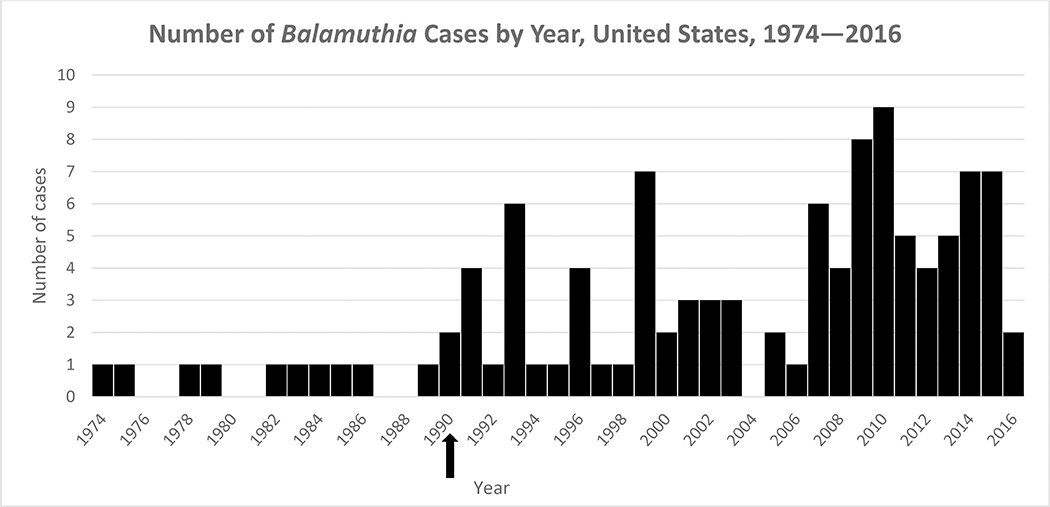
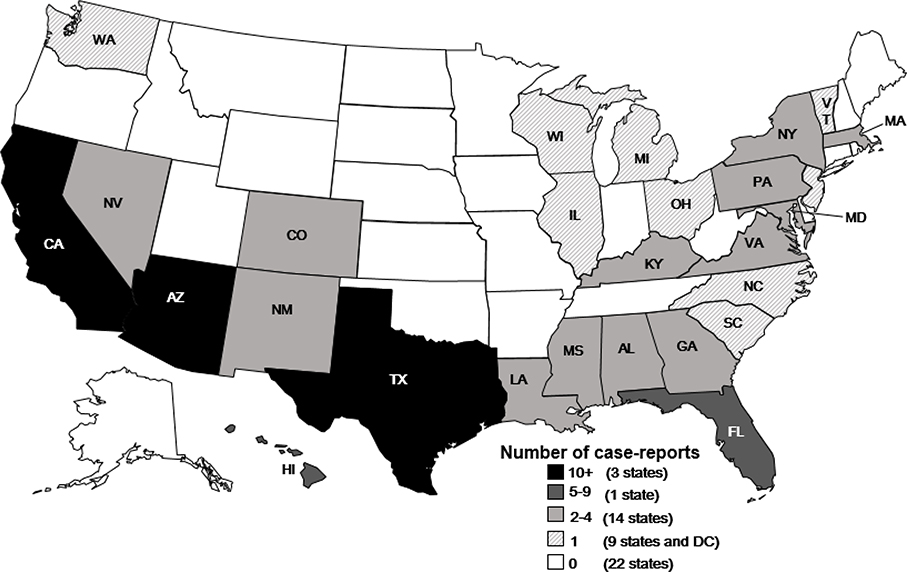
We identified 109 case reports of Balamuthia disease between 1974 and 2016. Most (99%) had encephalitis. The median age was 36 years (range 4 months to 91 years). Males accounted for 68% of the case patients. California had the highest number of case reports, followed by Texas and Arizona. Hispanics constituted 55% for those with documented ethnicity. Exposure to soil was commonly reported. Among those with a known outcome, 90% of patients died.
Balamuthia disease in the United States is characterized by a highly fatal encephalitis that affects patients of all ages. Hispanics were disproportionately affected. The southwest region of the United States reported the most cases. Clinician awareness of Balamuthia as a cause of encephalitis might lead to earlier diagnosis and initiation of treatment, resulting in better outcomes.
棘阿米巴是一种自由生活的变形虫,可在全球范围内导致人类和动物罕见且几乎总是致命的疾病。棘阿米巴已从土壤、灰尘和水中分离出来。Balamuthia 最初进入人体的途径可能是皮肤或肺部。迄今为止,仅发表了个别病例报告和小病例系列。
疾病控制与预防中心(CDC)维护着自由生活阿米巴(FLA)登记处和实验室。要进入登记处,Balamuthia 病例必须经过实验室确认。注册表中的条目是通过多种来源完成的,包括病例报告表、CDC 实验室结果、已发表的病例报告和媒体信息。SAS©版本 9.3 软件用于计算描述性统计数据和频率。
我们确定了 1974 年至 2016 年间 109 例棘阿米巴病病例报告。大多数(99%)患有脑炎。中位年龄为 36 岁(范围为 4 个月至 91 岁)。男性占病例患者的 68%。加利福尼亚州报告的病例报告最多,其次是德克萨斯州和亚利桑那州。有记录种族的患者中,西班牙裔占 55%。普遍报告了接触土壤的情况。在已知结局的患者中,90%的患者死亡。
美国的棘阿米巴病以影响所有年龄段患者的高度致命性脑炎为特征。西班牙裔受到不成比例的影响。美国西南部报告的病例最多。临床医生意识到棘阿米巴是脑炎的一个原因,可能会导致更早的诊断和治疗开始,从而获得更好的结果。