Physics of Synthetic Biological Systems-E14, Physics-Department and ZNN, Technische Universität München, 85748, Garching, Germany.
Department of Chemistry, Center for Integrated Protein Science Munich (CIPSM), Technische Universität München, Lichtenbergstraße 4, 85748, Garching, Germany.
Nat Commun. 2018 Sep 21;9(1):3862. doi: 10.1038/s41467-018-06379-8.
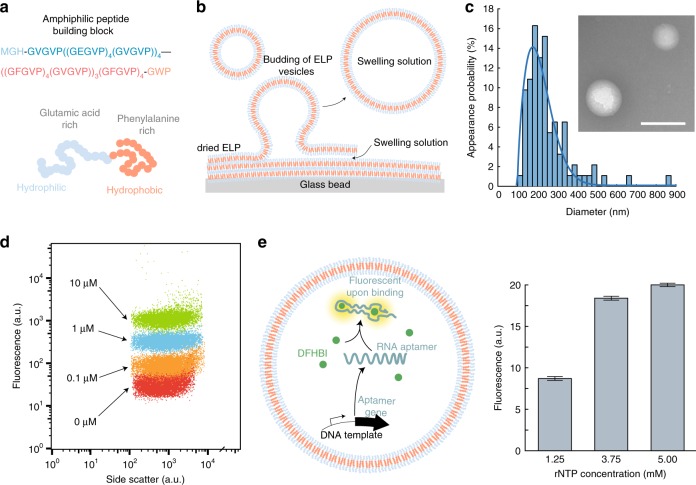
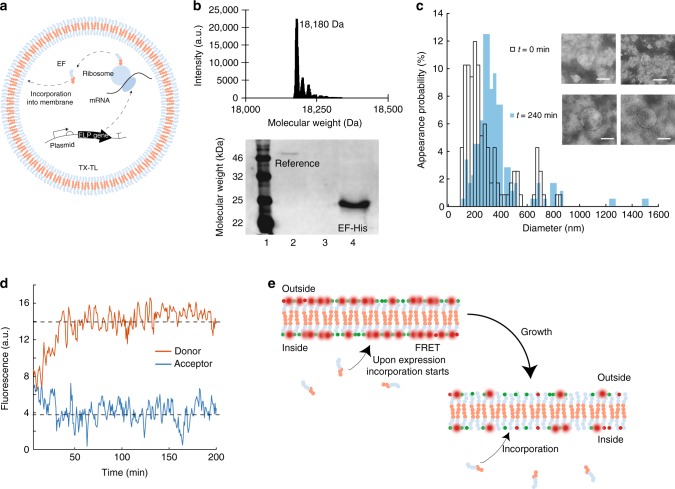
Membrane compartmentalization and growth are central aspects of living cells, and are thus encoded in every cell's genome. For the creation of artificial cellular systems, genetic information and production of membrane building blocks will need to be coupled in a similar manner. However, natural biochemical reaction networks and membrane building blocks are notoriously difficult to implement in vitro. Here, we utilized amphiphilic elastin-like peptides (ELP) to create self-assembled vesicular structures of about 200 nm diameter. In order to genetically encode the growth of these vesicles, we encapsulate a cell-free transcription-translation system together with the DNA template inside the peptide vesicles. We show in vesiculo production of a functioning fluorescent RNA aptamer and a fluorescent protein. Furthermore, we implement in situ expression of the membrane peptide itself and finally demonstrate autonomous vesicle growth due to the incorporation of this ELP into the membrane.
膜区室化和生长是活细胞的核心方面,因此被编码在每个细胞的基因组中。为了创建人工细胞系统,需要以类似的方式将遗传信息和膜构建块的生产耦合在一起。然而,天然生化反应网络和膜构建块在体外实施非常困难。在这里,我们利用两亲弹性蛋白样肽(ELP)来创建直径约 200nm 的自组装囊泡结构。为了对这些囊泡的生长进行基因编码,我们将无细胞转录-翻译系统与 DNA 模板一起封装在肽囊泡内。我们展示了在囊泡生产中具有功能的荧光 RNA 适体和荧光蛋白。此外,我们还实现了膜肽本身的原位表达,最后由于将这种 ELP 掺入到膜中,证明了囊泡的自主生长。