• 文献检索
  • 文档翻译
  • 深度研究
  • 学术资讯
  • Suppr Zotero 插件Zotero 插件
  • 邀请有礼
  • 套餐&价格
  • 历史记录
应用&插件
Suppr Zotero 插件Zotero 插件浏览器插件Mac 客户端Windows 客户端微信小程序
定价
高级版会员购买积分包购买API积分包
服务
文献检索文档翻译深度研究API 文档MCP 服务
关于我们
关于 Suppr公司介绍联系我们用户协议隐私条款
关注我们

Suppr 超能文献

核心技术专利:CN118964589B侵权必究
粤ICP备2023148730 号-1Suppr @ 2026

文献检索

告别复杂PubMed语法,用中文像聊天一样搜索,搜遍4000万医学文献。AI智能推荐,让科研检索更轻松。

立即免费搜索

文件翻译

保留排版,准确专业,支持PDF/Word/PPT等文件格式,支持 12+语言互译。

免费翻译文档

深度研究

AI帮你快速写综述,25分钟生成高质量综述,智能提取关键信息,辅助科研写作。

立即免费体验

社会化、合法化和向中低收入国家转让生物医学知识:以印度急诊医学为例。

Socialization, legitimation and the transfer of biomedical knowledge to low- and middle-income countries: analyzing the case of emergency medicine in India.

机构信息

Center for Health and the Social Sciences, University of Chicago, 5841 S. Maryland Avenue, MC 1005, Suite M200, Chicago, IL, USA.

School of Public Health, University of the Western Cape, Robert Sobukwe Road, Bellville, 7535, Republic of South Africa.

出版信息

Int J Equity Health. 2018 Sep 24;17(1):142. doi: 10.1186/s12939-018-0824-y.

DOI:10.1186/s12939-018-0824-y
PMID:30244680
原文链接:https://pmc.ncbi.nlm.nih.gov/articles/PMC6151935/
Abstract

BACKGROUND

Medical specialization is a key feature of biomedicine, and is a growing, but weakly understood aspect of health systems in many low- and middle-income countries (LMICs), including India. Emergency medicine is an example of a medical specialty that has been promoted in India by several high-income country stakeholders, including the Indian diaspora, through transnational and institutional partnerships. Despite the rapid evolution of emergency medicine in comparison to other specialties, this specialty has seen fragmentation in the stakeholder network and divergent training and policy objectives. Few empirical studies have examined the influence of stakeholders from high-income countries broadly, or of diasporas specifically, in transferring knowledge of medical specialization to LMICs. Using the concepts of socialization and legitimation, our goal is to examine the transfer of medical knowledge from high-income countries to LMICs through domestic, diasporic and foreign stakeholders, and the perceived impact of this knowledge on shaping health priorities in India.

METHODS

This analysis was conducted as part of a broader study on the development of emergency medicine in India. We designed a qualitative case study focused on the early 1990s until 2015, analyzing data from in-depth interviewing (n = 87), document review (n = 248), and non-participant observation of conferences and meetings (n = 6).

RESULTS

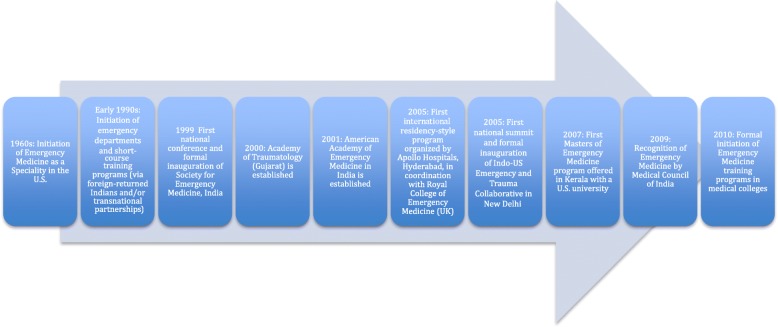
From the early 1990s, domestic stakeholders with exposure to emergency medicine in high-income countries began to establish Emergency Departments and initiate specialist training in the field. Their efforts were amplified by the active legitimation of emergency medicine by diasporic and foreign stakeholders, who formed transnational partnerships with domestic stakeholders and organized conferences, training programs and other activities to promote the field in India. However, despite a broad commitment to expanding specialist training, the network of domestic, diasporic and foreign stakeholders was highly fragmented, resulting in myriad unstandardized postgraduate training programs and duplicative policy agendas. Further, the focus in this time period was largely on training specialists, resulting in more emphasis on a medicalized, tertiary-level form of care.

CONCLUSIONS

This analysis reveals the complexities of the roles and dynamics of domestic, diasporic and foreign stakeholders in the evolution of emergency medicine in India. More research and critical analyses are required to explore the transfer of medical knowledge, such as other medical specialties, models of clinical care, and medical technologies, from high-income countries to India.

摘要

背景

医学专业化是生物医学的一个重要特征,也是许多低收入和中等收入国家(LMICs),包括印度,卫生系统日益发展但理解薄弱的一个方面。急诊医学就是一个通过跨国和机构伙伴关系,由包括印度侨民在内的几个高收入国家利益攸关方在印度推广的医学专业范例。尽管与其他专业相比,急诊医学的发展迅速,但该专业的利益攸关者网络已经出现分裂,培训和政策目标也出现分歧。很少有实证研究从广义上考察高收入国家的利益攸关者,或专门考察侨民,考察他们将医学专业化知识转移到 LMICs 的情况。利用社会化和合法化的概念,我们的目标是研究通过国内、侨民和外国利益攸关者从高收入国家向 LMICs 转移医学知识,以及这种知识对塑造印度卫生重点的感知影响。

方法

本分析是印度急诊医学发展的更广泛研究的一部分。我们设计了一项定性案例研究,重点关注 20 世纪 90 年代初至 2015 年,对深入访谈(n=87)、文件审查(n=248)和非参与式会议和会议观察(n=6)进行分析。

结果

从 20 世纪 90 年代初开始,接触过高收入国家急诊医学的国内利益攸关方开始建立急诊部并开始在该领域进行专业培训。侨民和外国利益攸关方积极使急诊医学合法化,他们与国内利益攸关方建立跨国伙伴关系,并组织会议、培训计划和其他活动,以促进印度的这一领域,这扩大了他们的努力。然而,尽管有广泛的扩大专科培训的承诺,但国内、侨民和外国利益攸关者的网络高度分散,导致无数非标准化的研究生培训计划和重复的政策议程。此外,在这一时期,重点主要是培训专家,因此更注重一种医疗化的、三级护理形式的护理。

结论

本分析揭示了国内、侨民和外国利益攸关方在印度急诊医学发展中的角色和动态的复杂性。需要进行更多的研究和批判性分析,以探讨从高收入国家向印度转移医学知识,如其他医学专业、临床护理模式和医疗技术。
https://cdn.ncbi.nlm.nih.gov/pmc/blobs/e2e2/6151935/754e26520e84/12939_2018_824_Fig1_HTML.jpg

相似文献

1
Socialization, legitimation and the transfer of biomedical knowledge to low- and middle-income countries: analyzing the case of emergency medicine in India.社会化、合法化和向中低收入国家转让生物医学知识:以印度急诊医学为例。
Int J Equity Health. 2018 Sep 24;17(1):142. doi: 10.1186/s12939-018-0824-y.
2
The Making of a New Medical Specialty: A Policy Analysis of the Development of Emergency Medicine in India.新医学专科的形成:印度急诊医学发展的政策分析。
Int J Health Policy Manag. 2018 Nov 1;7(11):993-1006. doi: 10.15171/ijhpm.2018.55.
3
Regulating recognition and training for new medical specialties in India: the case of emergency medicine.规范印度新医学专业的认可和培训:以急诊医学为例。
Health Policy Plan. 2018 Sep 1;33(7):840-852. doi: 10.1093/heapol/czy055.
4
Bureaucracies and power: Examining the Medical Council of India and the development of emergency medicine in India.官僚主义与权力:审视印度医学理事会与印度急诊医学的发展
Soc Sci Med. 2020 Jul;256:113038. doi: 10.1016/j.socscimed.2020.113038. Epub 2020 May 14.
5
Emergency Medicine Training Programs in Low- and Middle-Income Countries: A Systematic Review.中低收入国家的急诊医学培训项目:系统评价。
Ann Glob Health. 2020 Jun 16;86(1):60. doi: 10.5334/aogh.2681.
6
Academic emergency medicine in India.印度的急诊医学。
Emerg Med Australas. 2013 Aug;25(4):359-64. doi: 10.1111/1742-6723.12095. Epub 2013 Jul 21.
7
Developing the National Knowledge Platform in India: a policy and institutional analysis.发展印度国家知识平台:政策与制度分析。
Health Res Policy Syst. 2018 Feb 20;16(1):13. doi: 10.1186/s12961-018-0283-3.
8
Postgraduate Diploma in Emergency Medicine in India.印度急诊医学研究生文凭。
Clin Teach. 2020 Oct;17(5):515-520. doi: 10.1111/tct.13128. Epub 2020 Jan 22.
9
Teaching critical care in Europe: analysis of a survey.欧洲重症监护教学:一项调查分析
Crit Care Med. 1996 Apr;24(4):696-704. doi: 10.1097/00003246-199604000-00024.
10
A framework for medical power in two case studies of health policymaking in India and Niger.在印度和尼日尔的两项卫生决策制定案例研究中构建医疗权力框架。
Glob Public Health. 2019 Apr;14(4):542-554. doi: 10.1080/17441692.2018.1457705. Epub 2018 Apr 4.

引用本文的文献

1
Associations, unions and everything in between: contextualising the role of representative health worker organisations in policy.协会、工会及其他组织:从背景角度看卫生工作者代表组织在政策中的作用。
BMJ Glob Health. 2023 Sep;8(9). doi: 10.1136/bmjgh-2023-012661.
2
Contribution of 15 Years (2007-2022) of Indo-US Training Partnerships to the Emergency Physician Workforce Capacity in India.15 年(2007-2022 年)印美培训伙伴关系对印度急诊医师队伍能力的贡献。
West J Emerg Med. 2023 Jul 17;24(4):814-822. doi: 10.5811/westjem.59912.
3
Transnational social networks, health, and care: a systematic narrative literature review.

本文引用的文献

1
The Making of a New Medical Specialty: A Policy Analysis of the Development of Emergency Medicine in India.新医学专科的形成:印度急诊医学发展的政策分析。
Int J Health Policy Manag. 2018 Nov 1;7(11):993-1006. doi: 10.15171/ijhpm.2018.55.
2
Regulating recognition and training for new medical specialties in India: the case of emergency medicine.规范印度新医学专业的认可和培训:以急诊医学为例。
Health Policy Plan. 2018 Sep 1;33(7):840-852. doi: 10.1093/heapol/czy055.
3
Health Care Reforms in India.印度的医疗保健改革
跨国社会网络、健康与护理:系统叙述性文献综述。
Int J Equity Health. 2021 Jun 12;20(1):138. doi: 10.1186/s12939-021-01467-6.
4
Mentorship and how to conduct research: A research primer for low- and middle-income countries.指导与如何开展研究:中低收入国家研究入门指南
Afr J Emerg Med. 2020;10(Suppl 2):S150-S153. doi: 10.1016/j.afjem.2020.09.005. Epub 2020 Oct 1.
5
Strengthening medical specialisation policy in low-income and middle-income countries.加强中低收入国家的医学专业化政策。
BMJ Glob Health. 2020 Feb 11;5(2):e002053. doi: 10.1136/bmjgh-2019-002053. eCollection 2020.
6
Showcasing the contribution of social sciences to health policy and systems research.展示社会科学对卫生政策和体系研究的贡献。
Int J Equity Health. 2018 Sep 24;17(1):145. doi: 10.1186/s12939-018-0862-5.
JAMA. 2018 Jun 26;319(24):2477-2478. doi: 10.1001/jama.2018.5284.
4
Newborn healthcare in urban India.印度城市的新生儿医疗保健
J Perinatol. 2016 Dec;36(s3):S24-S31. doi: 10.1038/jp.2016.187.
5
The Role of Academic Institutions in Global Health: Building Partnerships With Low- and Middle-Income Countries.学术机构在全球健康中的作用:与低收入和中等收入国家建立伙伴关系。
JAMA Surg. 2017 Feb 1;152(2):123-124. doi: 10.1001/jamasurg.2016.3107.
6
Contribution of Sudanese medical diaspora to the healthcare delivery system in Sudan: exploring options and barriers.苏丹海外医学人才对苏丹医疗服务体系的贡献:探索机遇与障碍
Hum Resour Health. 2016 Jun 30;14(Suppl 1):28. doi: 10.1186/s12960-016-0123-x.
7
Giving Back: A mixed methods study of the contributions of US-Based Nigerian physicians to home country health systems.回馈:一项关于美国尼日利亚医生对祖国卫生系统贡献的混合方法研究。
Global Health. 2016 Jun 14;12(1):33. doi: 10.1186/s12992-016-0165-9.
8
Power and pro-poor policies: the case of iCCM in Niger.权力与扶贫政策:以尼日尔的综合社区病例管理为例
Health Policy Plan. 2015 Dec;30 Suppl 2:ii84-ii94. doi: 10.1093/heapol/czv064.
9
Altogether now... understanding the role of international organizations in iCCM policy transfer.现在一起来……了解国际组织在综合社区病例管理政策转移中的作用。
Health Policy Plan. 2015 Dec;30 Suppl 2:ii26-ii35. doi: 10.1093/heapol/czv071.
10
Epistemic communities in global health and the development of child survival policy: a case study of iCCM.全球卫生领域的认知共同体与儿童生存政策的发展:以综合社区病例管理为例
Health Policy Plan. 2015 Dec;30 Suppl 2:ii12-ii25. doi: 10.1093/heapol/czv043.