Lung Biology Laboratory, Department of Pathobiological Sciences, School of Veterinary Medicine, Louisiana State University (LSU), Baton Rouge, LA, United States of America.
Section of Pulmonary and Critical Care, Department of Medicine, LSU Health Science Center, New Orleans, LA, United States of America.
PLoS Pathog. 2018 Sep 24;14(9):e1007308. doi: 10.1371/journal.ppat.1007308. eCollection 2018 Sep.
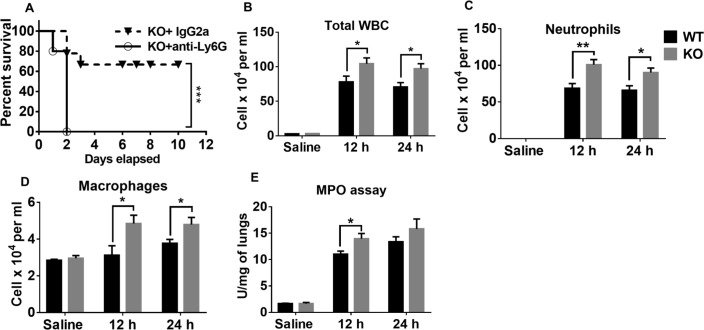
Gram-positive bacteria, including Staphylococcus aureus are endemic in the U.S., which cause life-threatening necrotizing pneumonia. Neutrophils are known to be critical for clearance of S. aureus infection from the lungs and extrapulmonary organs. Therefore, we investigated whether the NLRP6 inflammasome regulates neutrophil-dependent host immunity during pulmonary S. aureus infection. Unlike their wild-type (WT) counterparts, NLRP6 knockout (KO) mice were protected against pulmonary S. aureus infection as evidenced by their higher survival rate and lower bacterial burden in the lungs and extrapulmonary organs. In addition, NLRP6 KO mice displayed increased neutrophil recruitment following infection, and when neutrophils were depleted the protective effect was lost. Furthermore, neutrophils from the KO mice demonstrated enhanced intracellular bacterial killing and increased NADPH oxidase-dependent ROS production. Intriguingly, we found higher NK cell-mediated IFN-γ production in KO mouse lungs, and treatment with IFN-γ was found to enhance the bactericidal ability of WT and KO neutrophils. The NLRP6 KO mice also displayed decreased pyroptosis and necroptosis in the lungs following infection. Blocking of pyroptosis and necroptosis in WT mice resulted in increased survival, reduced bacterial burden in the lungs, and attenuated cytokine production. Taken together, these novel findings show that NLRP6 serves as a negative regulator of neutrophil-mediated host defense during Gram-positive bacterial infection in the lungs through regulating both neutrophil influx and function. These results also suggest that blocking NLRP6 to augment neutrophil-associated bacterial clearance should be considered as a potential therapeutic intervention strategy for treatment of S. aureus pneumonia.
革兰氏阳性菌,包括金黄色葡萄球菌,在美国普遍存在,可导致危及生命的坏死性肺炎。众所周知,中性粒细胞对于清除肺部和肺外器官的金黄色葡萄球菌感染至关重要。因此,我们研究了 NLRP6 炎性小体是否调节肺部金黄色葡萄球菌感染期间中性粒细胞依赖性宿主免疫。与野生型(WT)相比,NLRP6 敲除(KO)小鼠对肺部金黄色葡萄球菌感染具有保护作用,这表现在它们的存活率更高,肺部和肺外器官中的细菌负荷更低。此外,NLRP6 KO 小鼠在感染后表现出中性粒细胞募集增加,而当耗尽中性粒细胞时,保护作用消失。此外,来自 KO 小鼠的中性粒细胞显示出增强的细胞内细菌杀伤作用和增加的 NADPH 氧化酶依赖性 ROS 产生。有趣的是,我们发现 KO 小鼠肺部的 NK 细胞介导的 IFN-γ 产生增加,并且 IFN-γ 的治疗被发现增强了 WT 和 KO 中性粒细胞的杀菌能力。NLRP6 KO 小鼠在感染后肺部的细胞焦亡和坏死性凋亡也减少。在 WT 小鼠中阻断细胞焦亡和坏死性凋亡导致存活率增加,肺部细菌负荷减少,细胞因子产生减少。总之,这些新发现表明,NLRP6 通过调节中性粒细胞的流入和功能,作为肺部革兰氏阳性菌感染期间中性粒细胞介导的宿主防御的负调节剂。这些结果还表明,阻断 NLRP6 以增强与中性粒细胞相关的细菌清除应被视为治疗金黄色葡萄球菌肺炎的潜在治疗干预策略。