Ibáñez María Dolores, Blázquez María Amparo
Departament de Farmacologia, Facultat de Farmàcia, Universitat de València, Avd. Vicent Andrés Estellés s/n, 46100 Burjassot, Valencia, Spain.
Plants (Basel). 2018 Sep 22;7(4):79. doi: 10.3390/plants7040079.
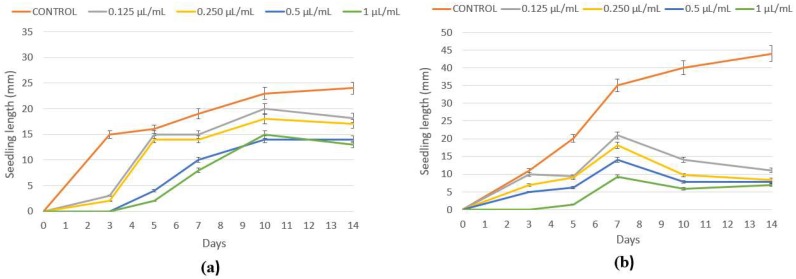
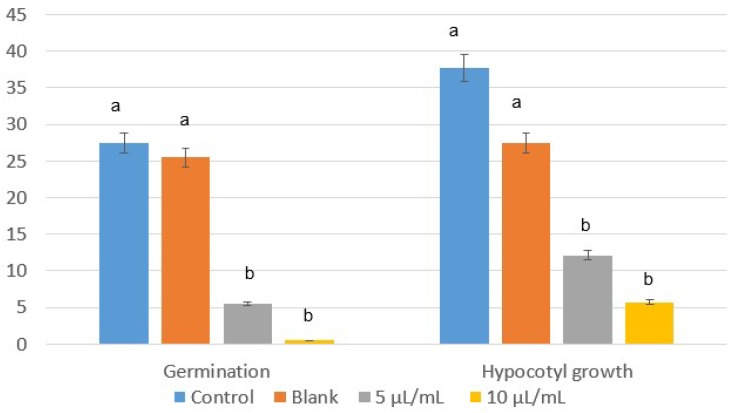
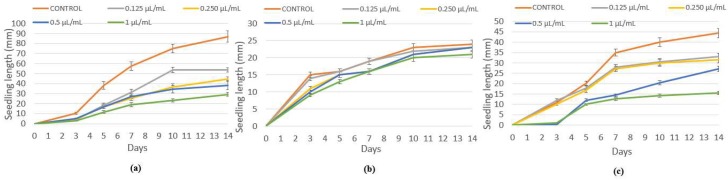
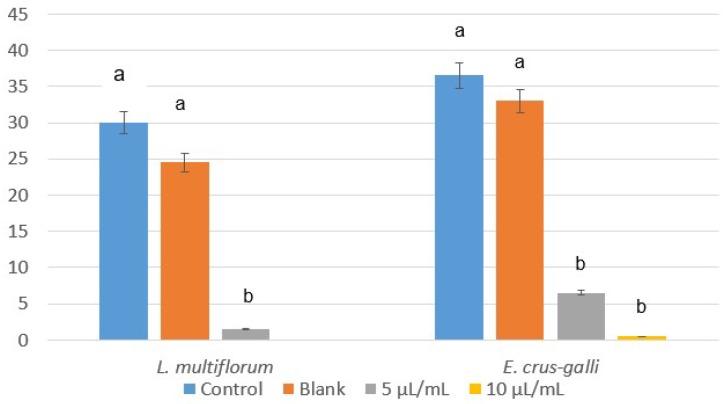
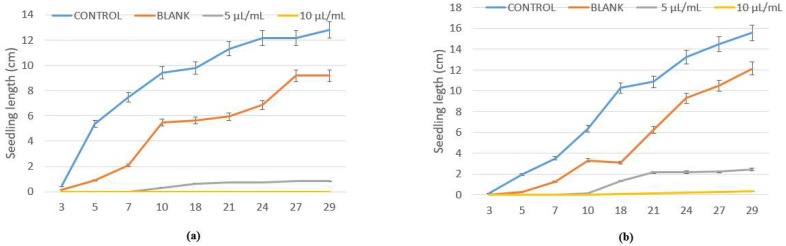
The chemical composition of winter savory, peppermint, and anise essential oils, and in vitro and in vivo phytotoxic activity against weeds (, , and ) and food crops (maize, rice, and tomato), have been studied. Sixty-four compounds accounting for between 97.67⁻99.66% of the total essential oils were identified by Gas Chromatography-Mass Spectrometry analysis. Winter savory with carvacrol (43.34%) and thymol (23.20%) as the main compounds produced a total inhibitory effect against the seed germination of tested weed. Menthol (48.23%), menthone (23.33%), and -menthone (16.33%) from peppermint only showed total seed germination inhibition on , whereas no significant effects were observed with -anethole (99.46%) from anise at all concentrations (0.125⁻1 µL/mL). Low doses of peppermint essential oil could be used as a sustainable alternative to synthetic agrochemicals to control The results corroborate that in vivo assays with a commercial emulsifiable concentrate need higher doses of the essential oils to reproduce previous in vitro trials. The higher in vivo phytotoxicity of winter savory essential oil constitutes an eco-friendly and less pernicious alternative to weed control. It is possible to achieve a greater in vivo phytotoxicity if less active essential oil like peppermint is included with other active excipients.
已对冬香薄荷、薄荷和茴芹精油的化学成分及其对杂草(、、)和粮食作物(玉米、水稻和番茄)的体外和体内植物毒性活性进行了研究。通过气相色谱-质谱分析鉴定出64种化合物,占精油总量的97.67⁻99.66%。以香芹酚(43.34%)和百里香酚(23.20%)为主要成分的冬香薄荷对受试杂草种子萌发产生了完全抑制作用。薄荷中的薄荷醇(48.23%)、薄荷酮(23.33%)和异薄荷酮(16.33%)仅对的种子萌发表现出完全抑制作用,而茴芹中的茴香脑(99.46%)在所有浓度(0.125⁻1微升/毫升)下均未观察到显著影响。低剂量的薄荷精油可作为合成农用化学品的可持续替代品用于防治 结果证实,使用商业乳油进行体内试验需要更高剂量的精油才能重现之前的体外试验结果。冬香薄荷精油较高的体内植物毒性构成了一种环保且危害较小的杂草防治替代品。如果将活性较低的精油如薄荷与其他活性辅料混合使用,有可能实现更高的体内植物毒性。