Department of Dermatology, University of Pennsylvania, Pennsylvania, Philadelphia, United States of America.
Department of Dermatology, Duke University Medical Center, Durham, North Carolina, United States of America.
PLoS One. 2018 Sep 25;13(9):e0198074. doi: 10.1371/journal.pone.0198074. eCollection 2018.
Rituximab is a promising steroid sparing agent used in the treatment of moderate to severe pemphigus vulgaris. Its exact place in the algorithm of pemphigus treatment, vis-à-vis other, conventional adjuvant therapy (CAT) is not known.
To describe and compare disease course outcomes and morbidity among patients with moderate to severe pemphigus who received rituximab therapy (RT) in addition to prednisone and CAT, versus those who were treated with prednisone and CAT alone.
A 16-year retrospective case control study was designed with adult patients who were seen at the Duke University Dermatology Immunodermatology clinic from 1999-2015, who had a diagnosis of pemphigus vulgaris, and required prednisone and at least 1 systemic CAT. All patients had at least 6 months follow up from the initial visit. Interventions included RT, systemic CAT, and prednisone. The main outcome measured was prednisone intake. Secondary outcomes were complete remission (CR) and partial remission (PR).
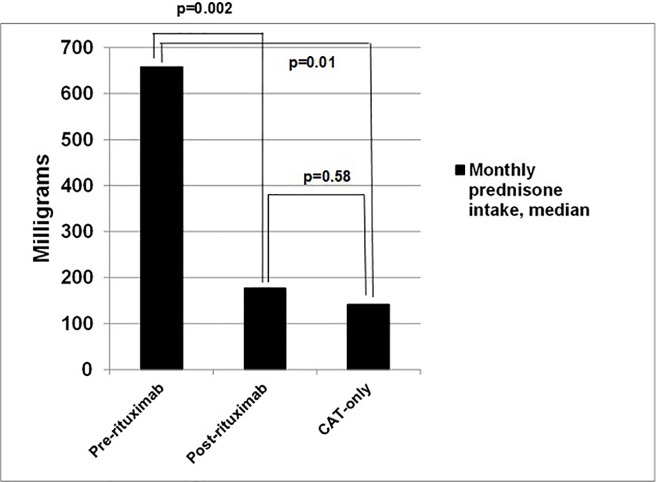
40 patients were included in the study. All initially received prednisone and at least 1 systemic CAT. 13/40 eventually went on to receive RT, while 27/40 remained on CAT (CAT-only). Patients in the RT group, pre-RT, had a median prednisone intake of 658.57 mg/month. Rituximab treatment significantly reduced this to 177.22 mg/month (p = 0.002). Median prednisone intake of the CAT-only group was 141.33 mg/month. This was significantly less than Pre-RT (p = 0.01) and on par with Post-RT intake (p = 0.58). 54% of patients in the RT group and 64% of those in the CAT-only group achieved CR. All patients in the RT group and 96% of those in the CAT-only group achieved at least PR.
32.5% of our patients with moderate to severe pemphigus vulgaris failed prednisone and traditional CAT treatment and required rituximab therapy. Rituximab reduced the monthly prednisone intake in these patients by 73%. This suggests that a subset of patients with moderate to severe pemphigus may benefit from early institution of rituximab therapy. Rituximab significantly reduces the monthly prednisone requirement among CAT-resistant pemphigus vulgaris patients to levels on par with CAT-responsive patients.
利妥昔单抗是一种有前途的类固醇节约剂,用于治疗中重度寻常型天疱疮。它在天疱疮治疗方案中的具体位置,相对于其他常规辅助治疗(CAT)尚不清楚。
描述并比较接受利妥昔单抗治疗(RT)联合泼尼松和 CAT 治疗的中重度寻常型天疱疮患者与仅接受泼尼松和 CAT 治疗的患者的疾病过程结局和发病率。
设计了一项 16 年回顾性病例对照研究,纳入 1999 年至 2015 年在杜克大学皮肤病学免疫皮肤科诊所就诊的成年患者,诊断为寻常型天疱疮,需要泼尼松和至少 1 种系统性 CAT。所有患者在初次就诊后至少有 6 个月的随访。干预措施包括 RT、系统性 CAT 和泼尼松。主要结局测量指标是泼尼松的摄入量。次要结局包括完全缓解(CR)和部分缓解(PR)。
共纳入 40 例患者。所有患者最初均接受泼尼松和至少 1 种系统性 CAT。40 例患者中有 13 例最终接受 RT,27 例仅接受 CAT(CAT 组)。在 RT 组,在 RT 前,中位泼尼松摄入量为 658.57mg/月。利妥昔单抗治疗后显著减少至 177.22mg/月(p=0.002)。CAT 组的中位泼尼松摄入量为 141.33mg/月。这明显低于 RT 前(p=0.01),与 RT 后摄入量相当(p=0.58)。RT 组 54%的患者和 CAT 组 64%的患者达到 CR。RT 组的所有患者和 CAT 组的 96%的患者均达到至少 PR。
我们有 32.5%的中重度寻常型天疱疮患者对泼尼松和传统 CAT 治疗无效,需要利妥昔单抗治疗。利妥昔单抗可使这些患者的每月泼尼松摄入量减少 73%。这表明,一部分中重度寻常型天疱疮患者可能受益于早期使用利妥昔单抗治疗。利妥昔单抗可显著降低 CAT 抵抗性寻常型天疱疮患者的每月泼尼松需求,使其达到与 CAT 反应性患者相当的水平。