
巴拉圭冬青通过嘌呤能系统 (ADOR-1) 和核激素受体 (NHR-49) 途径调节秀丽隐杆线虫的脂肪代谢。
Ilex paraguariensis modulates fat metabolism in Caenorhabditis elegans through purinergic system (ADOR-1) and nuclear hormone receptor (NHR-49) pathways.
机构信息
Departamento de Bioquímica e Biologia Molecular, Programa de Pós-graduação em Ciências Biológicas: Bioquímica Toxicológica, Universidade Federal de Santa Maria, Santa Maria, Rio Grande do Sul, Brazil.
Centro de Ciências Biológicas e da Saúde, Campus Reitor Edgard Santos, Universidade Federal do Oeste da Bahia, Barreiras, Bahia, Brazil.
出版信息
PLoS One. 2018 Sep 25;13(9):e0204023. doi: 10.1371/journal.pone.0204023. eCollection 2018.
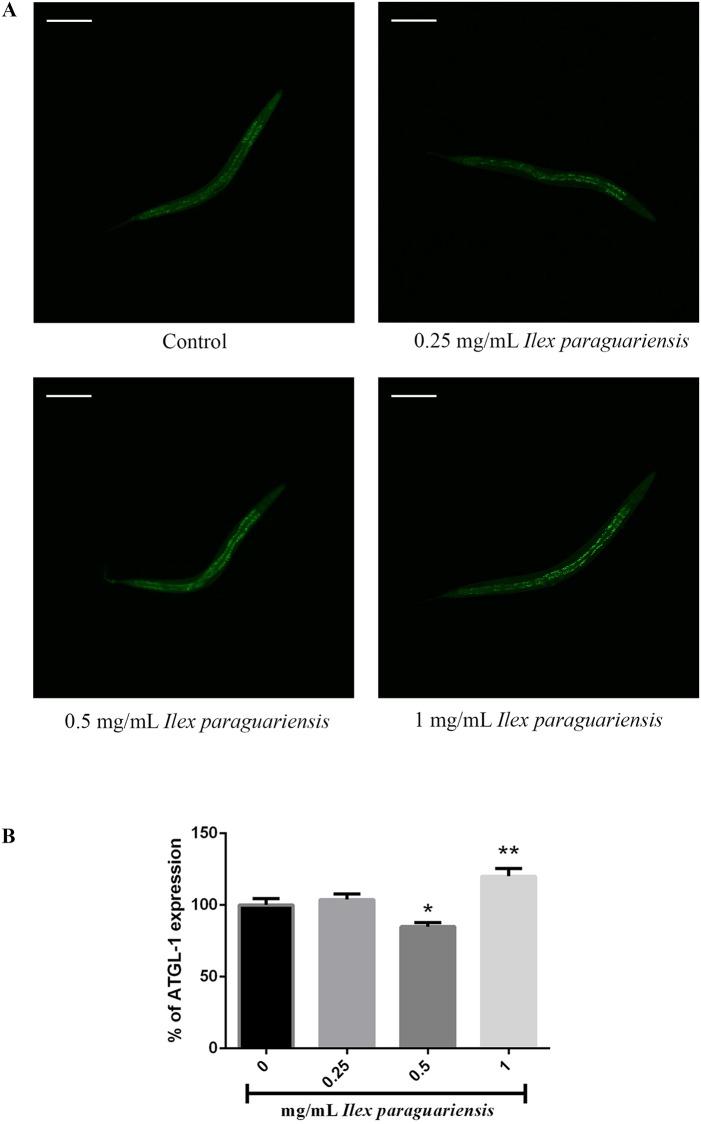
Ilex paraguariensis is a well-known plant that is widely consumed in South America, primarily as a drink called mate. Mate is described to have stimulant and medicinal properties. Considering the potential anti-lipid effects of I. paraguariensis infusion, we used an extract of this plant as a possible modulator of fat storage to control lipid metabolism in worms. Herein, the I. paraguariensis-dependent modulation of fat metabolism in Caenorhabditis elegans was investigated. C. elegans were treated with I. paraguariensis aqueous extract (1 mg/ml) from L1 larvae stage until adulthood, to simulate the primary form of consumption. Expression of adipocyte triglyceride lipase 1 (ATGL-1) and heat shock protein 16.2, lipid accumulation through C1-BODIPY-C12 (BODIPY) lipid staining, behavioral parameters, body length, total body energy expenditure and overall survival were analyzed. Total body energy expenditure was determined by the oxygen consumption rate in N2, nuclear hormone receptor knockout, nhr-49(nr2041), and adenosine receptor knockout, ador-1(ox489) strains. Ilex paraguariensis extract increased ATGL-1 expression 20.06% and decreased intestinal BODIPY fat staining 63.36%, compared with the respective control group, without affecting bacterial growth and energetic balance, while nhr-49(nr2041) and ador-1(ox489) strains blocked the worm fat loss. In addition, I. paraguariensis increased the oxygen consumption in N2 worms, but not in mutant strains, increased N2 worm survival following juglone exposure, and did not alter hsp-16.2 expression. We demonstrate for the first time that I. paraguariensis can decrease fat storage and increase body energy expenditure in worms. These effects depend on the purinergic system (ADOR-1) and NHR-49 pathways. Ilex paraguariensis upregulated the expression of ATGL-1 to modulate fat metabolism. Furthermore, our data corroborates with other studies that demonstrate that C. elegans is a useful tool for studies of fat metabolism and energy consumption.
巴拉圭冬青是一种广为人知的植物,主要在南美洲被用作饮料,称为马黛茶。马黛茶被描述为具有兴奋剂和药用特性。考虑到冬青提取物的潜在抗脂质作用,我们使用这种植物的提取物作为脂肪储存的可能调节剂,以控制蠕虫中的脂质代谢。在此,研究了冬青对秀丽隐杆线虫脂肪代谢的依赖性调节。从 L1 幼虫阶段开始,用冬青水提物(1mg/ml)处理秀丽隐杆线虫,直至成虫期,以模拟主要的消费形式。分析了脂肪甘油三酯脂肪酶 1 (ATGL-1) 和热休克蛋白 16.2 的表达、通过 C1-BODIPY-C12(BODIPY)脂质染色的脂肪积累、行为参数、体长、总身体能量消耗和整体存活率。通过 N2、核激素受体敲除、nhr-49(nr2041) 和腺苷受体敲除、ador-1(ox489) 菌株的耗氧量来确定总身体能量消耗。与相应的对照组相比,冬青提取物使 ATGL-1 的表达增加了 20.06%,使肠道 BODIPY 脂肪染色减少了 63.36%,而不影响细菌生长和能量平衡,而 nhr-49(nr2041) 和 ador-1(ox489) 菌株阻断了蠕虫的脂肪损失。此外,冬青提取物增加了 N2 蠕虫的耗氧量,但在突变株中没有增加,增加了 N2 蠕虫在 Juglone 暴露后的存活率,并且没有改变 hsp-16.2 的表达。我们首次证明,冬青可以减少蠕虫体内的脂肪储存并增加身体能量消耗。这些作用依赖于嘌呤能系统(ADOR-1)和 NHR-49 途径。冬青上调 ATGL-1 的表达以调节脂肪代谢。此外,我们的数据与其他研究结果一致,表明秀丽隐杆线虫是研究脂肪代谢和能量消耗的有用工具。



 Zotero 插件